For industrial buyers, product managers, and engineering teams, selecting the right manufacturing process is the difference between a seamless production run and a costly bottleneck. When it comes to processing non-ferrous metals, cnc machining aluminum و cnc router aluminum are two of the most widely utilized methods. However, misallocating a project to the wrong machinery can result in compromised tolerances, wasted material, or inflated per-part costs.
This comprehensive guide breaks down the technical nuances, material behaviors, and structural differences between standard CNC milling centers and CNC routers for aluminum fabrication, helping you optimize your supply chain and procurement strategy.
Understanding the Core Mechanisms
Before outsourcing your next production batch, it is essential to understand how these two machining environments handle aluminum alloys like 6061-T6, 5052, or 7075.
CNC Machining Aluminum: High Rigidity and Heavy Duty
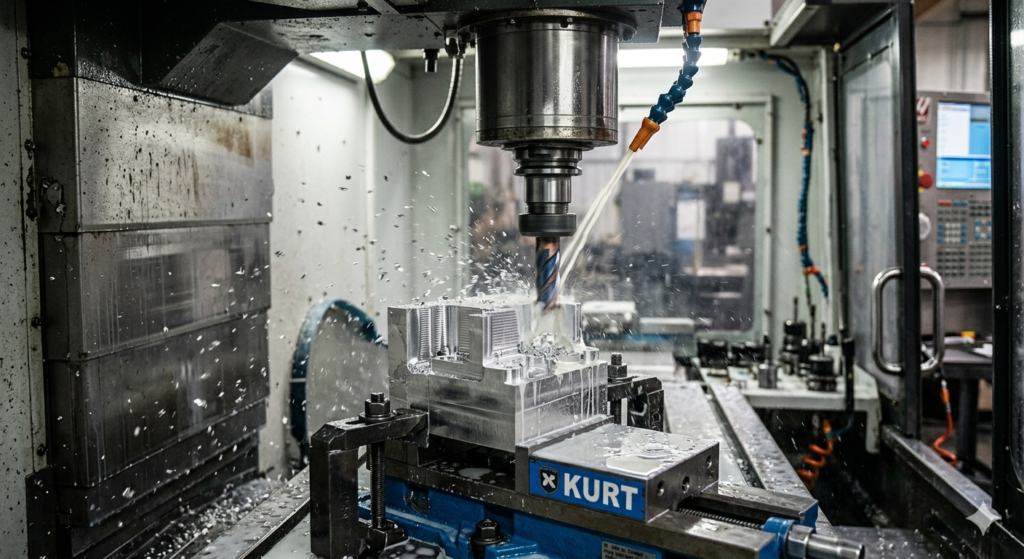
When we talk about traditional cnc machining aluminum, we are typically referring to Vertical Machining Centers (VMCs) or Horizontal Machining Centers (HMCs). These machines are engineered for extreme rigidity, heavy-duty cutting forces, and multi-axis complexity (3-محور, 4-محور, and 5-axis).
- Spindle Dynamics: Lower RPM (typically 6,000 ل 15,000 RPM) but exceptionally high torque.
- Material Removal: Designed for deep axial cuts and heavy chip loads.
- Workholding: Parts are secured via heavy vises, fixtures, or vacuum chucks onto a rigid, enclosed worktable.
CNC Router Aluminum: High Speed for Large Form Factors
Conversely, a cnc router aluminum setup utilizes a gantry-style system moving over a large, often open bed. While historically reserved for woodworking or plastics, modern industrial CNC routers are heavily optimized with mist coolants and rigid frames specifically for light metal fabrication.
- Spindle Dynamics: High RPM (ranging from 18,000 ل 24,000+ RPM) with lower torque.
- Material Removal: Relies on high-speed machining (HSM) pathways—shallow depths of cut (DOC) paired with incredibly fast feed rates.
- Workholding: Predominantly utilizes high-power vacuum tables to secure large, flat sheet stock.
Key Differences for B2B Procurement and Engineering
To maximize ROI, procurement teams must evaluate parts based on three core metrics: part geometry, tolerance requirements, and volume scaling.
| Feature / Metric | CNC Machining Aluminum (VMC/HMC) | CNC Router Aluminum |
| Primary Part Geometry | Complex 3D shapes, thick blocks, deep cavities | Large, flat sheets, enclosures, panels, plates |
| Dimensional Tolerances | $\pm0.005 \text{ مم}$ to $\pm0.02 \text{ مم}$ (Ultra-precise) | $\pm0.1 \text{ مم}$ to $\pm0.2 \text{ مم}$ (Standard precision) |
| Material Thickness | Unlimited (determined by machine travel) | Typically thin sheets ($1 \text{ مم}$ ل $20 \text{ مم}$) |
| Production Speed | Slower per-part cycle for large surface areas | Exceptionally fast nesting and cutting for flat parts |
When to Choose CNC Machining for Aluminum
Traditional CNC mills excel when structural integrity and dimensional precision cannot be compromised. If your project involves complex aerospace components, automotive engine parts, or custom medical devices, CNC milling is the mandatory choice.
1. Tight Geometric Tolerances
Aluminum deforms under high heat and improper tool pressure. High-rigidity CNC mills eliminate tool deflection, allowing machinists to hit tight tolerances repeatedly across thousands of units. If your drawings specify press-fit bearings, threaded holes, or critical mating surfaces, a standard CNC mill is required.
2. Multi-Axis Complexity
If your aluminum component requires machining on multiple sides (such as complex manifolds or brackets), 4-axis or 5-axis CNC machining centers can complete the part in fewer setups. This drastically reduces labor costs and eliminates human error during part flipping.
When to Choose a CNC Router for Aluminum
A CNC router is not a “lesser” machine; rather, it is a highly specialized tool optimized for scale, surface area, and speed. For industries like architectural cladding, signage, marine panels, or electronic enclosures, routers offer unmatched efficiency.
1. Large Surface Area and Sheet Nesting
Standard VMCs are limited by their enclosed workspace. If you need to cut a $2000 \times 3000 \text{ مم}$ aluminum sheet into dozens of smaller components, a CNC router handles this seamlessly. Advanced nesting software optimizes the layout on the sheet, drastically reducing raw material waste.
2. Cost-Effective High-Speed Cutting
Because routers operate at incredibly high feed rates, they can clear thin-gauge aluminum paneling faster than a traditional mill. This high-throughput capability translates to lower machine-hour rates, giving B2B buyers a significantly lower Cost Per Part (CPP) for sheet metal profiles.
Overcoming Technical Challenges in Aluminum Fabrication
Regardless of the machine type used, aluminum presents unique material challenges that an experienced manufacturing partner must mitigate:
- Galling and Built-Up Edge (BUE): Aluminum is gummy and tends to fuse to the cutting edges of tools under heat. Professional shops use specialized single-flute or three-flute carbide endmills with polished flutes (often coated with ZrN) to ensure smooth chip evacuation.
- Coolant and Lubrication: Dry machining aluminum is a recipe for broken tools. CNC routers use micro-drop MQL (Minimum Quantity Lubrication) mist systems, while CNC machining centers use flood coolant to wash away chips and keep temperatures stable.
Summary: Optimizing Your Manufacturing Strategy
Choosing between cnc machining aluminum و cnc router aluminum comes down to matching your design blueprint to the right mechanical strengths.
- Choose CNC Machining if your aluminum parts are thick, highly intricate, require tight tolerances, or need complex 3D contours.
- Choose a CNC Router if you are processing large-format aluminum sheets, thin-walled panels, enclosures, or require rapid, cost-effective profiling.
Partnering with a turnkey manufacturer that houses both capabilities ensures your production runs are always routed to the most cost-efficient and technically viable machinery, protecting both your margins and your product quality.
Contact Our Engineering Team Today
Looking for reliable B2B aluminum fabrication? Contact us today to upload your STP/DXF files for a detailed DFM (Design for Manufacturability) analysis and a competitive wholesale quote.