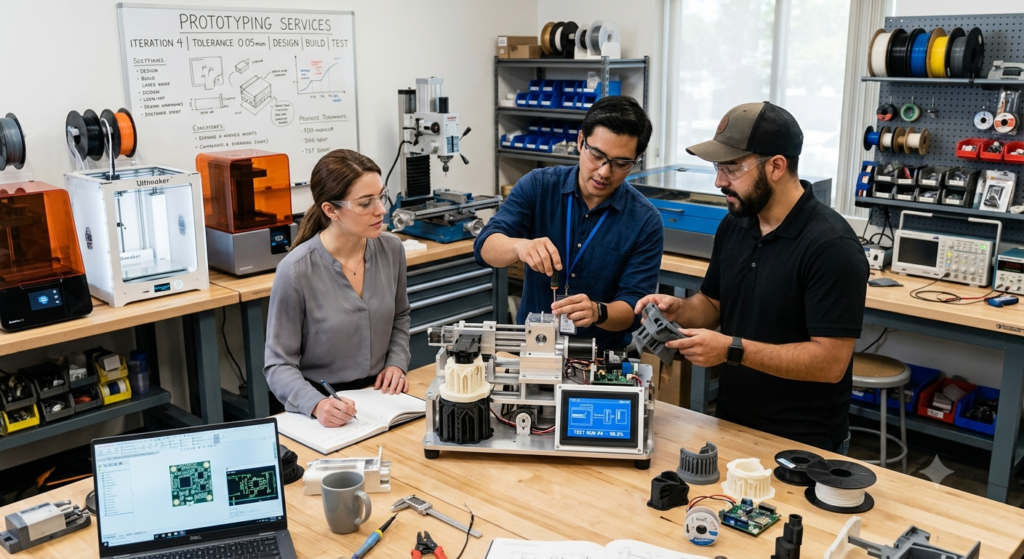
Prototyping services driven by Swiss machining offer engineers and product developers an immediate edge when off-the-shelf rapid prototyping tools simply fall short. While standard 3D printing or basic 3-axis milling work fine for early visual concept models, they often choke when tasked with creating tiny, ultra-precise, long-and-thin metallic parts.
If your design involves micro-tolerances within $\pm0.0001$ inches (roughly 2.5 microns), complex geometries, or tricky biocompatible metals like Titanium Grade 5, you need rapid, scalable prototype creation that matches your final production specs from day one.
Here is how modern CNC Swiss turning technology elevates prototype development, speeds up design iterations, and prevents costly engineering redesigns before you transition into full-scale manufacturing.
What Makes Swiss Machining Different for Early-Stage Prototypes?
To understand why product teams opt for Swiss turning center setups early in the R&D cycle, you have to look at the mechanical principles behind the cut.
In a conventional CNC lathe, the workpiece is clamped at the chuck and rotated while a cutting tool moves against it. If you try to turn a long, slender rod—say, a 0.5 mm diameter pin that is 30 mm long—the force of the cutting tool causes the stock to bend or flex. Machinists call this deflection. Deflection ruins tight tolerances, creates chatter marks on the metal surface, and often breaks the tool outright.
Swiss machines tackle this issue head-on with a clever mechanism:
- The Sliding Headstock & Guide Bushing: The raw bar stock passes through a hardened guide bushing. The cutting tool operates just millimeters away from where the bar exits this support zone.
- Zero Deflection: Because the material receives constant radial support at the exact point of cut, material flex becomes virtually zero.
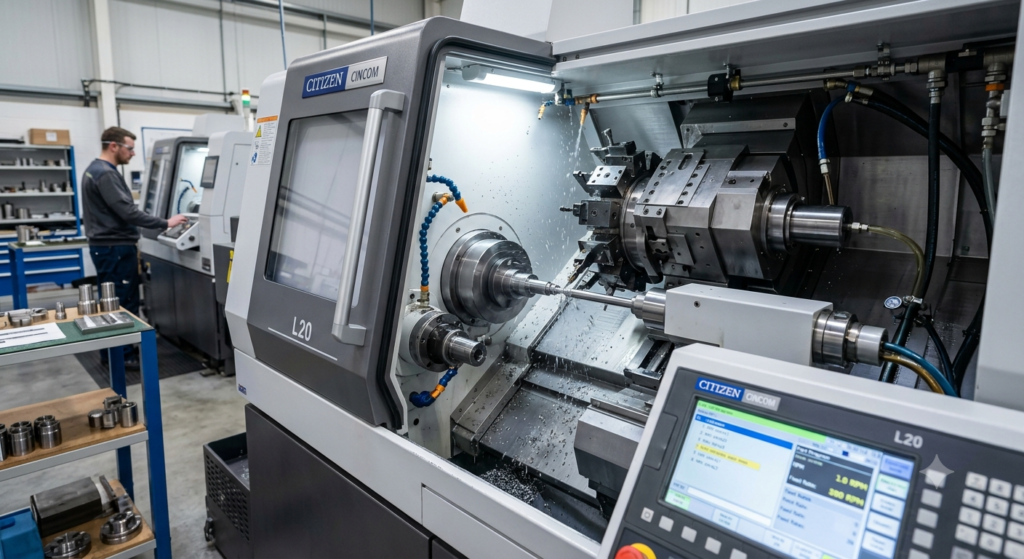
- Simultaneous Operations: Modern 7- to 13-axis Swiss lathes perform turning, cross-drilling, back-end tapping, and side-milling in a single unified setup.
Instead of waiting weeks to route a prototype through three different machine shops—one for turning, one for milling slots, and another for micro-drilling—a single Swiss turning unit can spit out a completely finished, deburred part in minutes.
الفوائد الرئيسية: Why Use Swiss Machining in Prototyping Services?
Engineering teams often hesitate to use Swiss CNC setups for small prototype runs because set-up times historically favored mass production. لكن, high-speed CAD/CAM integrations and quick-change tooling fixtures have changed the game completely.
Here is why engineering leads lean on Swiss prototyping options today:
1. “تصميم لقابلية التصنيع” (سوق دبي المالي) Validation
When you prototype on a basic 3D printer or standard toolroom lathe, you might validate the shape, but you fail to validate the process. If your production plan relies on Swiss machines later down the line, prototyping on the same machinery guarantees that tool clearances, spindle speeds, surface finishes, and feed forces are tested early. You discover machining bottlenecks early—not during a 100,000-unit run.
2. Elimination of Secondary Operations
In prototyping, time-to-market is everything. Conventional prototype turning often requires manual repositioning, secondary milling on a separate bench, or manual deburring. Swiss lathes utilize dual-spindle setups (main spindle and sub-spindle) to perform backside operations concurrently. Your prototype comes off the machine drop-complete.
3. Surface Finish Excellence Right Out of the Machine
Due to rigid workpiece clamping and high-pressure oil coolant systems, Swiss machines frequently deliver surface finishes as smooth as Ra 0.4 µm (16 micro-inches) or better. For medical components or fluidic valves, this reduces or eliminates the need for manual polishing or secondary grinding operations.
4. Extreme Material Versatility
Whether you are machining free-machining brass, tough 17-4 PH stainless steel, Nitinol, or high-performance polymers like PEEK, Swiss prototyping setups handle them effortlessly without heat distortion.
Real-World Applications Across Precision-Critical Industries
Where do you actually see Swiss-turned prototypes making a difference? Mainly in high-stakes fields where component failure is simply not an option.
الأجهزة الطبية & Surgical Instruments
Minimally invasive surgical tools, catheter tips, and dental implants require micro-features on long, flexible rods. Swiss prototyping allows biomechanical engineers to quickly test tactile feedback, thread engagements, and fluid-flow dynamics in real surgical alloys like Titanium Grade 5.
الفضاء الجوي & Defense Sensors
Weight-saving requirements push aerospace engineers to design small, hollowed-out connectors and sensor bodies with complex wall thicknesses. Prototyping these components via Swiss turning ensures that wall consistency and concentricity remain stable under extreme pressure changes.
Overcoming Common Misconceptions About Swiss Prototyping
“Isn’t Swiss machining too expensive for just 5 or 10 prototype parts?”
This used to be true back when Swiss lathes were set up using manual cams and mechanical stops. Setting up a machine took a full day.
اليوم, modern digital offline CAM simulation software allows programmers to verify tool paths virtually. Setup times have plummeted from hours to under 40 minutes. When you factor in the money saved by avoiding scrapped parts, manual secondary steps, and re-machining errors, Swiss turning often turns out to be cheaper for complex miniature prototypes than conventional multi-step machining.
What to Keep in Mind When Ordering Your Prototypes
To get the fastest turnaround times from your manufacturing partner, keep these quick guidelines in mind during your design phase:
- Specify Stock Diameters Wisely: Try to design your max outer diameter (OD) around standard ground bar sizes (على سبيل المثال, 3 مم, 6 مم, 12 مم, 20 مم). This saves your vendor from having to pre-turn custom raw stock.
- Watch Your Aspect Ratios: If your length-to-diameter ratio exceeds 3:1, explicitly request a Swiss-type process. Standard lathes struggle past 3:1 without tailstocks, whereas Swiss machines can easily handle ratios past 20:1.
- Keep Corner Radii in Mind: Allow for standard micro-end mill radii on internal slots or keyways so your vendor doesn’t have to source custom-ground carbide tools for a quick prototype run.
The Verdict
When speed, dimensional accuracy, and real-world material integrity matter, combining professional prototyping services with Swiss machining capabilities offers the shortest path from a digital CAD file to a fully functional, high-precision part. By getting your parts right during the prototype stage, you set up a smooth, predictable path toward mass production without surprise costs down the road.