 Ugrás a tartalomhoz
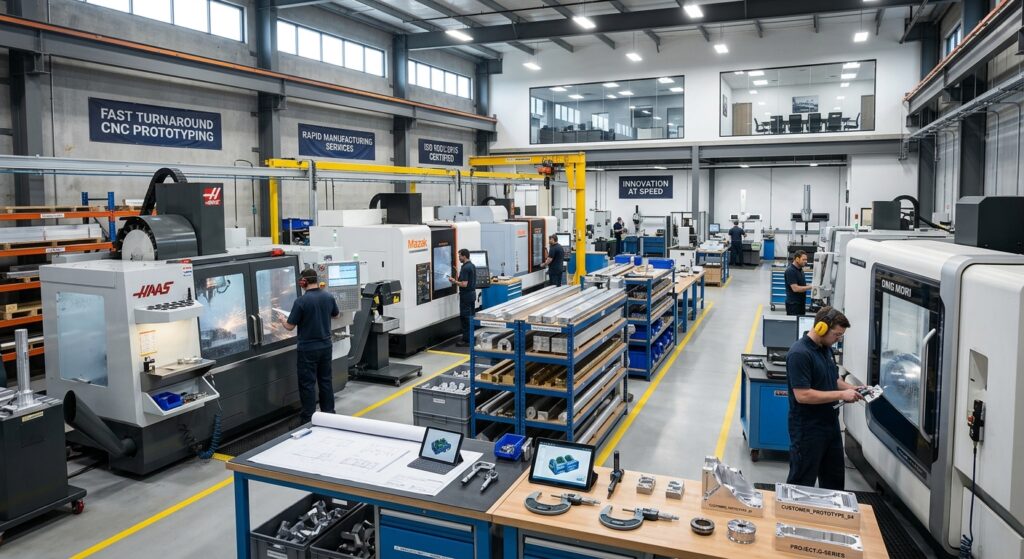
 In modern manufacturing, speed and accuracy are no longer a tradeoff—they are a absolute baseline. Whether you are scaling an industrial assembly line, developing custom robotic end-effectors, or iterating on next-generation pneumatic actuators, getting your designs off the CAD screen and onto the factory floor rapidly is critical. Working directly with a specialized Rapid CNC Prototyping Factory to produce Machined Automation Parts has become the primary competitive edge for hardware engineers, system integrators, and OEM equipment manufacturers worldwide.
Understanding how rapid manufacturing bridges the gap between early-stage prototype development and high-volume automation production allows engineering teams to minimize downtime, reduce development costs, and capture market share faster.
Why Custom Machined Automation Parts Demand Rapid CNC Prototyping
Automation machinery demands structural integrity, tight tolerances, and predictable performance. Unlike standard off-the-shelf components, custom automated systems often feature complex geometric contours, precise mounting patterns, and exact material specifications designed for high-cycle environments.
- Sub-Millimeter Tolerances: High-speed automation units rely on precise positioning. Off-by-a-hair alignment on a sensor bracket or linear guide mount can cause cumulative backlash, premature wear, or system failure.
- Anyag sokoldalúsága: Automated components encounter structural stress, thermal expansion, and aggressive wear. Rapid CNC machining handles everything from aerospace-grade aluminum (6061-T6, 7075) to high-wear plastics (Delrin/POM, PEEK) and structural steels (304, 316 Stainless).
- Zero-Tooling Latency: Unlike injection molding or casting, CNC machining reads digital CAD models directly. This means high-precision prototypes can be cut within hours of design finalization, completely skipping long tooling lead times.
Critical Machined Automation Components in Production Today(Rapid CNC Prototyping Factory)
Custom robotic and automated production lines rely on dozens of unique machined elements working in unison. A specialized rapid prototype facility provides quick-turn capabilities across the full spectrum:
| Component Category | Typical Materials | Key Function in Automation |
| End-Effectors & Gripper Arms | Aluminum 6061-T6, Carbon Fiber Composites | Minimizes arm payload mass while preserving structural rigidity during high-acceleration pick-and-place routines. |
| Linear Motion Brackets & Mounts | Stainless Steel 304, Anodized Aluminum | Secures gantry axes, ball screws, and servo motors to prevent structural deflection during operation. |
| Custom Sensor Enclosures | Delrin (POM), Polycarbonate, Anodized Aluminum | Protects optical, inductive, and laser sensors against workshop debris, coolant splash, and thermal drift. |
| Precision Fixtures & Jigging | Tool Steel (A2, D2), Hardened Stainless | Holds workpieces accurately during automated assembly, inspection, or secondary processing steps. |
Key Technical Advantages of Partnering with a Specialized Rapid CNC Prototyping Factory
Selecting the right manufacturing partner goes beyond basic 3-axis milling. To successfully execute complex automation components on tight timelines, advanced manufacturing capabilities are non-negotiable.
Multi-Axis Machining (4-Tengely & 5-Tengely) Complex automation parts often feature undercut channels, angled mounting faces, or multi-sided mounting patterns. Utilizing 5-axis CNC machines reduces setup changes from four or five down to a single “one-and-done” fixture setup. This eliminates cumulative positioning errors and ensures pinpoint positional accuracy across complex geometric features.
Surface Finishing Tailored for Automation A machined part is rarely complete right off the cutting table. Custom functional finishes ensure longevity in harsh industrial environments:
- Type II & Type III Anodizing: Provides corrosion resistance and electrical insulation while adding a hardened outer shell to aluminum parts.
- Electroless Nickel Plating: Offers uniform thickness on steel components, protecting intricate internal threads and sliding surfaces from corrosion.
- Passivation: Cleans stainless steel automation components for cleanroom or pharmaceutical packaging machinery environments.

How to Optimize Your CAD Designs for Rapid CNC Machining (DFM Tips)
To get the fastest turnaround times and lowest costs from a prototyping factory, optimizing your designs for manufacturability (DFM) is paramount:
- Standardize Internal Radii: Avoid sharp 90-degree internal vertical corners, as CNC milling bits are round. Incorporate internal radii equal to or slightly larger than standard end mill dimensions (például, a 3.175mm radius for a 1/4-inch cutter).
- Kerülje el a Deep-et, Keskeny zsebek: Deep pockets require long-reach cutting tools, which suffer from tool chatter and deflection. Keep pocket depths under four times the tool diameter whenever possible.
- Limit Tight Tolerances to Critical Mating Surfaces: Applying tight tolerances (például, ±0.01mm) across an entire part bloats production costs and cycle times. Limit ultra-tight tolerances strictly to bearing seats, dowel pin locates, and critical slide interfaces.
Streamlining the Shift from Prototyping to Full-Scale Production(Machined Automation Parts)
The true power of rapid CNC prototyping lies in its scalability. Because prototypes are manufactured using production-grade machinery and real engineering materials, testing data gathered during validation directly translates to full production runs.
By catching interference issues, structural flex, or assembly friction early during the rapid prototyping phase, engineering teams avoid catastrophic redesigns when scaling up to hundreds or thousands of units.
Working hand-in-hand with an agile, technology-driven machining partner ensures your automated machinery designs transition smoothly from initial CAD concept to physical deployment—faster, cheaper, and with uncompromising precision.