In the modern industrial ecosystem, the line between “supplier” e “engineer” has blurred. For businesses requiring high-level components, the search for precision metal fabricators is no longer just about finding someone with a laser cutter and a press brake. It is about finding a strategic partner capable of translating complex digital designs into physical reality with zero margin for error.
As global supply chains become more fragmented and specialized, the role of precision sheet metal has evolved. It is the silent architecture behind our most critical technologies—from the chassis of an electric vehicle to the internal housing of a high-speed server. This article explores the nuanced shifts in the industry and how the right fabrication partner can fundamentally optimize your product’s speed-to-market.
O “Precisão” Threshold: Where General Fabrication Fails
Many procurement officers make the mistake of treating metalwork as a commodity. However, there is a vast technical chasm between general “job shops” and true precision metal fabricators. A standard shop might handle structural steel for construction where a variance of an eighth of an inch is acceptable. In contrast, precision fabrication lives in the world of decimals.
When your project involves precision sheet metal, you are often dealing with:
- Interlocking Geometries: Parts that must fit perfectly into a larger assembly without the need for manual filing or adjustment.
- Thermal Management: Components designed with intricate venting patterns that must remain structurally sound even after thousands of laser-cut perforations.
- Aesthetic Integrity: High-end consumer electronics or medical interfaces where “witness marks” or heat discoloration are unacceptable.
Achieving this requires more than just machines; it requires a controlled environment and a culture of obsessive measurement.
Engineering for Efficiency: The DFM Advantage
The most valuable contribution a precision sheet metal expert makes happens before a single spark flies. Design for Manufacturing (DFM) is the process of reviewing a part’s design to ensure it can be produced efficiently, consistently, and affordably.
Elite precision metal fabricators analyze your CAD files to identify potential “cost drivers.” For example:
- Can two parts be combined into one? Reducing the part count simplifies the supply chain and lowers assembly labor.
- Is the bend radius realistic for the material thickness? Improper bend specs lead to “orange peeling” or cracking in the metal.
- Are the tolerances necessary? Sometimes, a designer will specify a tight tolerance on a non-critical dimension, unnecessarily driving up the price. A good partner will point this out.
By optimizing the design early, you don’t just save money on the raw material; you reduce the failure rate of the finished product.
Technological Synergy: The Modern Shop Floor
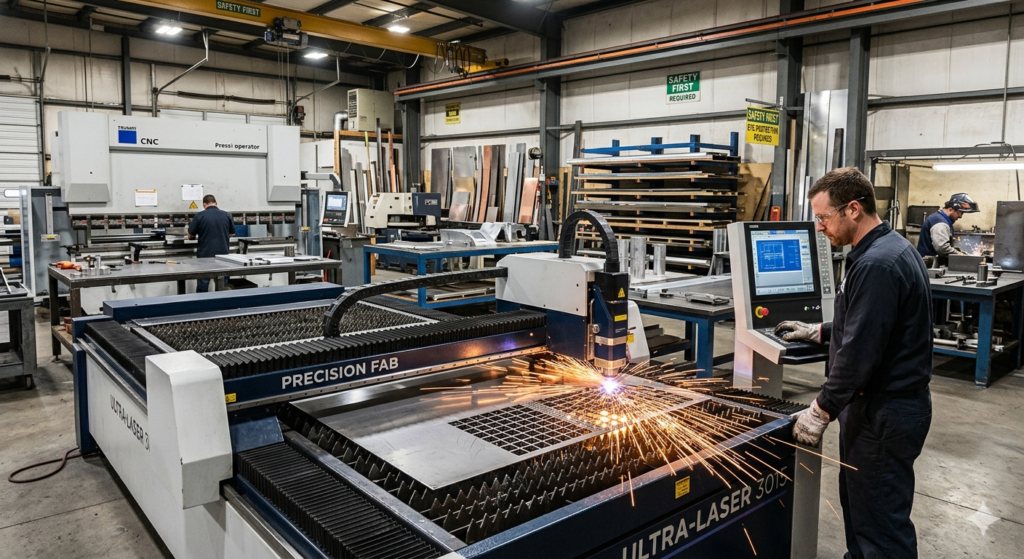
The equipment used by precision metal fabricators today is closer to robotics than traditional blacksmithing. To stay competitive, a facility must invest in a “closed-loop” manufacturing system.
- Fiber Laser Mastery: Modern fiber lasers can cut through thin-gauge copper and brass—materials that were once “forbidden” for traditional CO2 lasers due to their reflective properties.
- Automated Tool Changers: On a CNC press brake, manual tool changes can take 15 para 20 minutes. Automated systems do it in 60 seconds, allowing for “micro-batches” and rapid prototyping that doesn’t break the bank.
- Hardware Insertion Consistency: For many B2B clients, the metal is just a carrier for hardware like threaded studs or standoffs. Using automated insertion machines with force-monitoring ensures that every piece of hardware is seated perfectly, preventing “spin-outs” during your final assembly.
Material Science: The Backbone of Precision
The versatility of precision sheet metal is rooted in its material diversity. A fabrication partner must be a master of metallurgy, understanding how different alloys behave under stress and heat.
- Stainless Steel (300 e 400 series): Requires specialized non-marring tooling to ensure the surface finish remains pristine for food or medical use.
- High-Strength Aluminum: Used heavily in aerospace, these alloys require precise “over-bending” calculations to account for significant spring-back.
- Pre-Plated Metals: Cutting and forming materials like galvannealed steel requires a deep understanding of how the coating will react at the cut edge to prevent future corrosion.
The Human Element in an Automated World
Despite the rise of AI and automation, o “eye” of a master fabricator remains irreplaceable. While a machine can cut a perfect circle, it takes a human to understand the “feel” of a specific batch of cold-rolled steel.
The best precision metal fabricators invest heavily in their workforce. Certified welders, experienced estimators, and QA inspectors who understand the intent of a part are what separate a successful project from a scrap heap. When you vet a partner, ask about their staff’s longevity and their internal training programs. A shop with low turnover is a shop that retains the “tribal knowledge” necessary for complex problem-solving.
Conclusão: Scaling for the Future
Whether you are a startup building a prototype or a global OEM looking for high-volume production, your choice of a precision sheet metal partner will define your product’s quality.
In a world where “good enough” is being replaced by “perfect and fast,” precision metal fabricators act as the bridge between a visionary design and a functional reality. Look for a partner who offers transparency, technical depth, and a commitment to the microscopic details. Because in the world of precision manufacturing, the smallest detail is often the most important one.