Finding a parceiro confiável de usinagem CNC China relies on moving past generic online directories and identifying a facility that treats your 2D blueprints and 3D CAD files with exact, repeatable precision. In today’s fast-moving industrial landscape, the procurement of high-tier OEM CNC machining components demands more than automated cutting tools. It requires a manufacturing extension of your own engineering team—one capable of handling everything from initial rapid prototyping down to complex multi-axis mass production runs without breaking your tolerance parameters or lead time schedules.
For procurement officers and supply chain directors across North America and Europe, the hurdles of offshore production aren’t related to raw capacity. The challenges lie in engineering communication alignment, raw material verification, and rigorous quality assurance. Let’s pull back the curtain on what separates a premium custom shop from a standard broker, and explore how you can secure a manufacturing relationship that protects your operational bottom line.
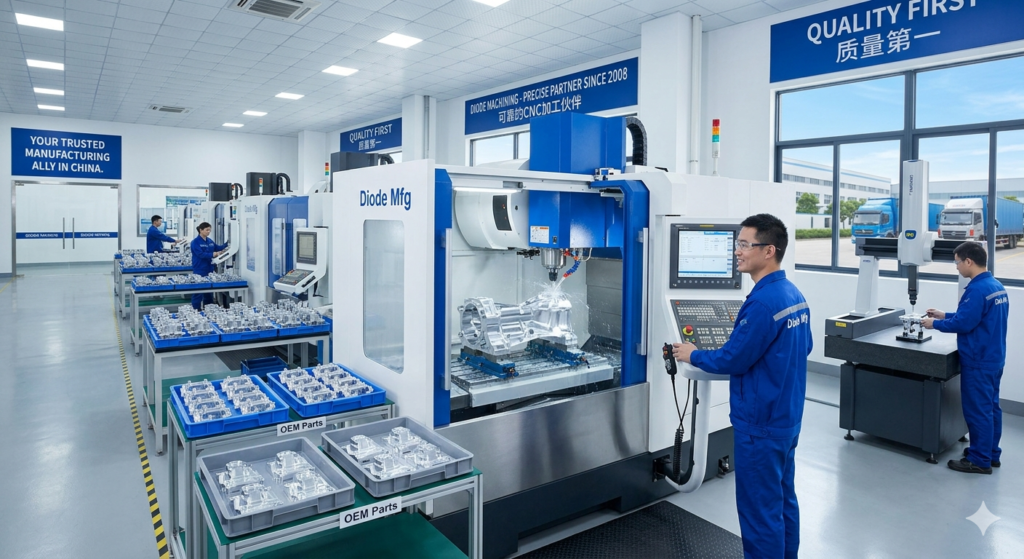
The Structural Footprint of a Truly Reliable CNC Machining Partner in China
When you start evaluating potential manufacturing plants overseas, superficial website pictures tell very little of the real story. UM parceiro confiável de usinagem CNC China distinguishes itself through its operational infrastructure, processing capabilities, and transparent communication style. You aren’t just buying machine time; you are investing in a cross-border workflow system.
First, look closely at their technical adaptability. A manufacturing facility focused on premium production will house advanced, multi-axis machining centers (including 3-axis, 4-axis, and high-precision 5-axis setups) alongside dedicated CNC turning lathes, milling machines, and precision tapping lines. This dynamic array allows them to tackle intricate geometries without requiring multiple subcontractors. When a single factory manages your component’s path from a raw billet of aluminum, stainless steel, or brass down to the final anodized surface treatment, you eliminate the risks of multi-vendor finger-pointing if a dimension falls out of spec.
Second, top-tier partners thrive on flexibility. The classic industrial dilemma involves finding a vendor that doesn’t penalize you for small batches but still possesses the machine depth to scale up as demand spikes. Look for facilities that actively support low-volume production runs (even starting from a single prototype piece) and offer straightforward paths to scale up to high-volume manufacturing. This balance ensures your product development cycles remain nimble and cost-effective from day one.
Engineering Specifications for OEM CNC Machining Components
The phrase OEM CNC machining components encompasses a massive spectrum of hardware, ranging from robust structural blocks for heavy machinery to highly intricate, thin-walled enclosures for medical electronics or automotive sensors. Successfully sourcing these parts requires a deep alignment between your original engineering drawings and the factory’s internal tooling setup.
A capable factory must seamlessly process a wide range of industrial raw materials. Whether your bill of materials (BOM) specifies lightweight 6061-T6 aluminum, hard-wearing 316 stainless steel, marine-grade brass, structural carbon steel, or high-performance engineering plastics like POM and PEEK, the machinist’s toolpaths and feed rates must be carefully optimized. A true OEM specialist understands how different metals behave under high-stress cutting conditions, managing heat dissipation effectively to prevent internal material warping.
Furthermore, look for a partner whose engineering office speaks your language—technically speaking. They should effortlessly interpret complex file formats including AutoCAD (DWG/DXF), Pro/ENGINEER, SolidWorks, and universal STEP/IGES files. The initial stages of a project should always involve a comprehensive Design for Manufacturing (DFM) review. If an overseas engineering team reviews your drawings and suggests subtle modifications to a tight internal radius or a deep tapped thread to reduce machining time and lower your unit costs, you know you have found a partner, not just a service provider.
The Non-Negotiable Core: Two-Tier Quality Control Workflows
How does a foreign buyer maintain complete trust when their factory is thousands of miles away? The absolute answer is a documented, transparent quality control (QC) infrastructure. Premium Chinese manufacturers do not rely on a single, hasty visual check before packing boxes. Em vez de, they enforce a rigorous, multi-tiered inspection protocol.
A dependable operation splits its quality management into two distinct layers:
- In-House Quality Control: This begins right at the machine tool. First-article inspections ensure the setup is flawless before the run proceeds. Operators perform regular in-process dimensional audits using calibrated micrometers, thread gauges, and automated Coordinate Measuring Machines (CMM). If a tool begins to wear down, the deviation is caught and corrected before a single out-of-tolerance part is completed.
- Out-House/Independent Quality Auditing: Before any batch moves to international shipping, a separate, independent internal audit or secondary specialized lab inspection checks the final products against the master blueprint. This phase evaluates surface roughness (Ra), coating thickness, material hardness, and dimensional accuracy, delivering a complete, traceable inspection report alongside your shipment.
By enforcing this dual-gate approach, factories ensure that the free initial sample you approved matches the quality of the 5,000th production unit delivered to your assembly floor.
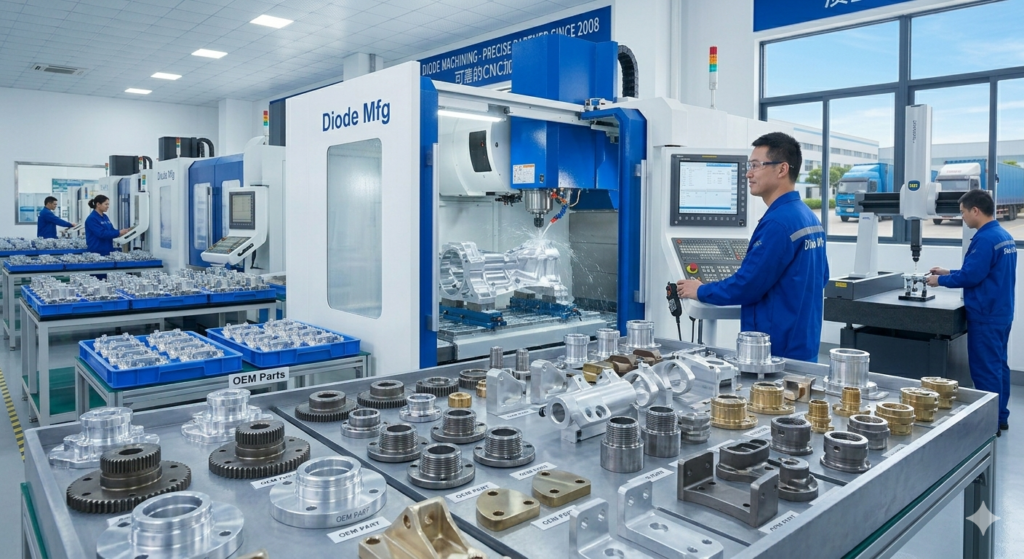
Maximizing Value: Beyond the Basic CNC Cutting Cycle
A comprehensive parceiro confiável de usinagem CNC China adds immense value by offering a complete, one-stop solution. Sourcing custom parts often involves secondary processes like sheet metal fabrication, precision stamping, custom metal tubing, or advanced welding. When you partner with an enterprise that integrates these distinct fabrication methods with precise CNC machining, you unlock the ability to source complex mechanical assemblies effortlessly.
Imagine a project requiring a bent, stamped sheet metal bracket perfectly mated to a multi-axis CNC-milled aluminum block, held together with welded structural tubing. Managing three separate vendors for this single assembly is an operational nightmare. A unified partner handles the entire manufacturing matrix, executing the stamping, milling, conjunto, and final surface treatment under a single purchase order. This streamlined workflow dramatically reduces shipping costs, shortens lead times, and ensures perfect structural fitment when the finished assembly arrives at your loading dock.
Strategic Sourcing Actions for Global Procurement Managers
If you are looking to optimize your supplier network this quarter, use this simple checklist when contacting new candidates:
- Request a Sample and a DFM Report Simultaneously: Evaluate not just how accurately they cut the metal, but how deeply they analyzed your technical drawings before starting the spindle.
- Audit the Traceability: Ask for example material test certificates (MTC) and sample CMM inspection reports from previous production lots to confirm their data integrity.
- Clarify the Secondary Processes: Ensure they have verified in-house or closely audited local lines for specialized anodizing, powder coating, or heat treatment to keep your workflow simple and centralized.
By anchoring your global sourcing strategy around technical transparency and strict, multi-tiered quality guardrails, you convert standard supply chains into long-term competitive advantages. Your ideal manufacturing partner shouldn’t just meet your expectations—they should provide the predictable stability your business needs to grow.