In today’s fast-paced manufacturing landscape, the race to bring a product from concept to market is fiercer than ever. Engineers, product designers, and innovators face a constant challenge: how do you validate a design quickly without sacrificing quality? The answer lies in sheet metal rapid prototyping for high precision components.
By leveraging advanced fabrication techniques early in the development cycle, industries ranging from aerospace to medical devices can drastically cut lead times while ensuring their tightest tolerances are met. Let’s dive deep into how this process works, why precision matters, and how you can optimize your designs for the best results.
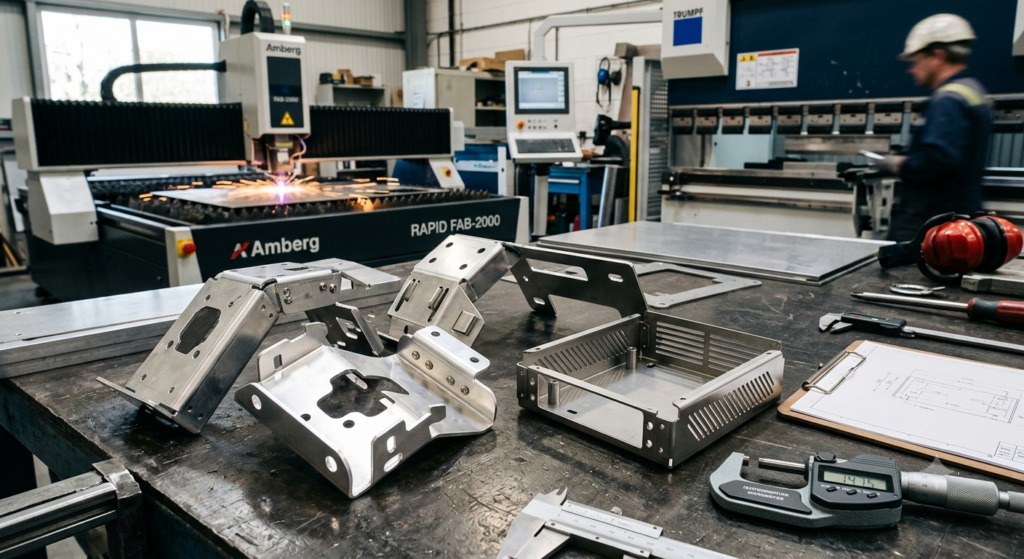
Why Speed and Precision Must Coexist
Historically, prototyping was a bottleneck. Traditional manufacturing required expensive, hard tooling and weeks of setup time just to produce a single test part. If a design flaw was discovered, the entire process had to start over, draining budgets and delaying product launches.
Sheet metal rapid prototyping changes the game. By utilizing flexible, software-driven machinery like CNC laser cutters, press brakes, and punching machines, manufacturers can turn 3D CAD models into physical parts in a matter of days—sometimes even hours.
However, speed means nothing if the parts don’t fit. For sectors like electronics, automotive, and defense, high precision components are non-negotiable. A variance of even a fraction of a millimeter can cause mechanical failure, electromagnetic interference (EMI) leaks, or assembly misalignment. Rapid prototyping bridges this gap, allowing you to test functional, end-use-quality metal parts under real-world conditions before committing to mass production.
Key Technologies Behind High-Precision Sheet Metal Prototypes
To achieve both rapid turnaround and extreme accuracy, modern fabrication shops rely on a suite of cutting-edge technologies:
1. Precision Laser Cutting
Instead of relying on physical dies, fiber lasers cut through sheet metal with incredible speed and a tiny heat-affected zone (HAZ). This ensures clean edges, intricate geometries, and tolerances as tight as $\pm 0.1\text{ mm}$.
2. CNC Bending and Forming
Modern press brakes are equipped with automated backgauges and angle-tracking systems. This allows fabricators to execute complex, multi-angle bends on a single component with absolute repeatability.
3. Rapid Tooling for Deep Drawing and Stamping
When a prototype requires complex, three-dimensional forming that simple bending can’t achieve, shops use “soft tooling” or modular insert dies. This mimics the final production process without the exorbitant costs of permanent steel molds.
Material Selection: Balancing Function and Form
Choosing the right material is critical when developing high precision components. The alloy you choose dictates not only the part’s performance but also how easily it can be prototyped.
| Material | Key Benefits | Common Applications |
| Alumínio (6061 / 5052) | Lightweight, excellent strength-to-weight ratio, highly corrosion-resistant. | Aerospace enclosures, automotive brackets, consumer electronics. |
| Aço inoxidável (304 / 316) | High tensile strength, extreme durability, heat and corrosion resistance. | Medical devices, marine hardware, chemical processing components. |
| Cobre & Latão | Superior electrical and thermal conductivity, naturally antimicrobial. | Busbars, shielding cans, heat exchangers, electronic contacts. |
| CR Steel (Cold Rolled) | Cost-effective, excellent surface finish, highly malleable. | Internal structural parts, brackets, appliances. |
Design for Manufacturability (DFM) Tips for Precision Parts
Even the most advanced prototyping shop will struggle if a design violates the basic laws of sheet metal physics. To keep your project on schedule and within budget, keep these DFM principles in mind:
- Maintain Uniform Wall Thickness: Sheet metal parts are made from a single sheet of uniform gauge. Avoid designing parts with varying thicknesses in a single body.
- Mind the Bend Radii: As a rule of thumb, the internal bend radius should at least equal the material thickness ($R \ge T$). Bends that are too sharp can cause the metal to crack or deform unpredictably.
- Keep Holes Away from Bends: Placing holes or slots too close to a bend line will cause them to distort during the forming process. Keep holes at a distance of at least $2 \times \text{material thickness}$ away from the bend.
- Account for Material Springback: Different metals “spring back” slightly after being bent. High-precision shops use advanced software to calculate this ahead of time, but it’s always wise to discuss critical dimensions with your fabricator.
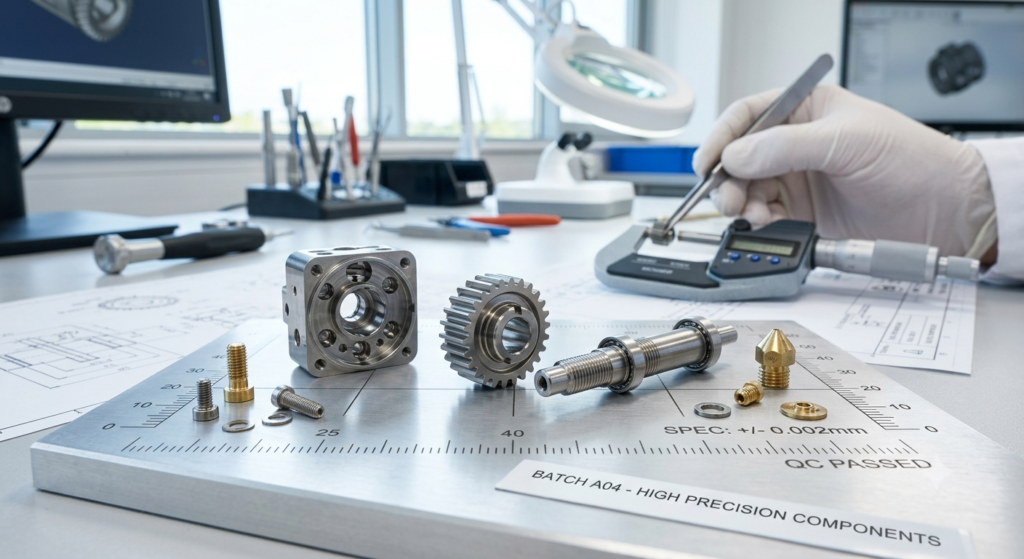
The Strategic Value: Moving Beyond the Prototype
The ultimate goal of sheet metal rapid prototyping isn’t just to make one good part; it’s to clear the runway for seamless mass production.
Pro Tip: Treat your prototyping phase as a dress rehearsal. The insights gained during the creation of your high precision components—such as identifying material stresses or assembly bottlenecks—will save thousands of dollars when you scale up to hard tooling and high-volume manufacturing.
By partnering with a manufacturer that specializes in both rapid prototyping and low-to-high volume production, you ensure that the design DNA remains intact from day one to the final product rollout.
Ready to Elevate Your Product Development?
In a market where being first matters just as much as being the best, you cannot afford to compromise on your manufacturing partner. Specialized sheet metal prototyping eliminates the guesswork, allowing you to iterate freely, test rigorously, and launch confidently.
Whether you need a single complex enclosure or a short run of intricate brackets, focusing on precision from the very first cut is the smartest investment your engineering team can make.