Choosing the right sheet metal stamping services can completely transform your production timeline, slash your per-part costs, and ensure your components meet exact tolerances every single time. Let’s dive into how this powerful manufacturing process works, why precision matters, and how to choose the right partner for your next project.
In the world of modern manufacturing, efficiency and accuracy aren’t just goals—they are survival traits. When you need thousands or millions of identical, complex metal parts, standard fabrication methods like laser cutting or manual bending quickly become too slow and expensive. That is where precision sheet metal stamping steps in.
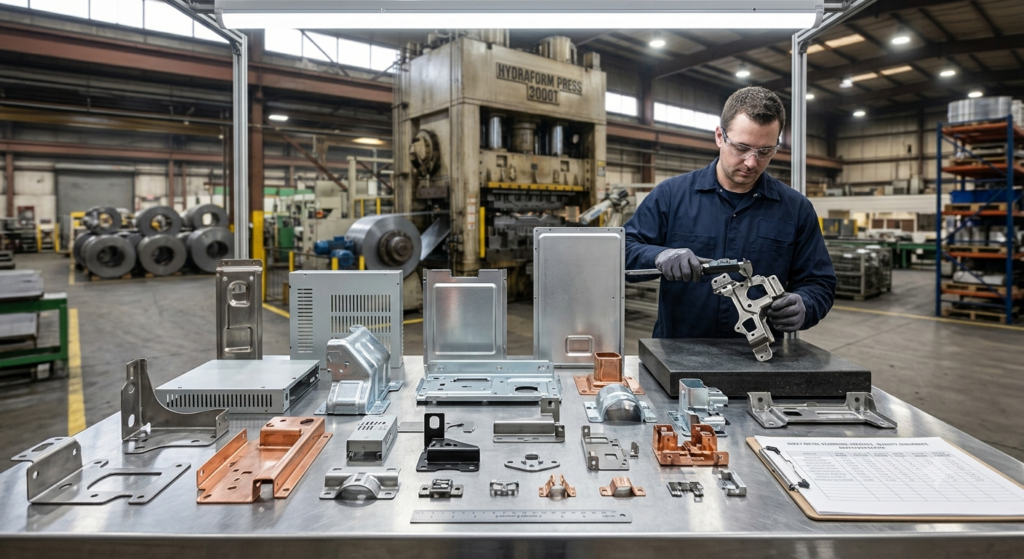
What is Precision Sheet Metal Stamping?
At its core, precision sheet metal stamping is a cold-forming manufacturing process that utilizes a press and a series of custom dies to transform flat sheets of metal into specific shapes. Unlike older, cruder stamping methods, precision stamping leverages advanced computer-aided design (CAD) and highly engineered tooling to achieve incredibly tight tolerances—often down to a fraction of a millimeter.
The process is incredibly versatile. Depending on your part design, a stamping press can perform multiple operations in a single stroke or across a progressive sequence:
- Punching and Blanking: Cutting shapes or holes out of the metal sheet.
- Bending: Shaping the metal along straight lines to create angles.
- Coining: Squeezing the metal to thin it out or stamp precise patterns into the surface.
- Embossing: Creating raised or sunken designs in the sheet.
By combining these actions, a single machine can turn raw coils of steel, aluminum, or copper into complex, three-dimensional components at blistering speeds.
The Core Benefits of High-Quality Sheet Metal Stamping Services
If you are evaluating manufacturing methods for a new component, you need to weigh the upfront investment against the long-term payoff. Sheet metal stamping services offer unique advantages that other fabrication methods simply cannot match, especially when scaling up production.
1. Unmatched Cost Efficiency at Scale
The biggest advantage of sheet metal stamping is its speed. Once a custom die is built and calibrated, the press can stamp out parts in seconds. While the initial cost to design and manufacture the tool (the die) can be significant, the cost per individual part drops drastically as production volume increases. For mid-to-high-volume runs, it is far more economical than CNC machining or laser cutting.
2. Exceptional Consistency and Repeatability
Human error and tool wear are the enemies of precision. Because the stamping process relies on a hard, custom-engineered die, the millionth part off the assembly line will look identical to the very first one. This level of repeatability is crucial for industries where even a tiny deviation can cause assembly line failures or product defects.
3. Material Efficiency and High Strength
Stamping is a highly efficient process that minimizes scrap material. Furthermore, because the metal is cold-worked (formed at room temperature), the mechanical properties of the material often improve. The bending and shaping process can actually introduce structural rigidity and strength to the finished component without adding weight.
Industries That Rely on Precision Stamping
You interact with stamped metal components every day without even realizing it. Because precision sheet metal stamping handles thin-gauge metals so incredibly well, it is the backbone of several major global industries:
- Automotive: From structural brackets and shield plates to intricate electrical connectors inside EV batteries, the automotive sector relies heavily on stamping to keep vehicles light, safe, and affordable.
- Electronics and Telecom: The tiny pins inside your USB-C cables, computer chassis, shielding enclosures, and circuit board brackets are almost exclusively created via precision stamping.
- Medical Devices: The medical sector requires extreme accuracy and biocompatible materials. Stamping services create surgical instruments, implant components, and equipment housings under strict regulatory standards.
- Aerospace: Lightweight materials like titanium and specialized aluminum alloys are stamped into aerospace brackets, clips, and interior components where weight reduction is vital.
Key Material Options for Stamping
A major factor in the success of your project is choosing the right material. Professional sheet metal stamping services regularly work with a vast spectrum of metals, each offering distinct mechanical advantages:
- Steel (Carbon and Stainless): Carbon steel offers incredible structural strength, while stainless steel adds excellent corrosion resistance, making it ideal for outdoor or medical applications.
- Aluminiu: Known for its fantastic strength-to-weight ratio, non-magnetic properties, and natural resistance to rust.
- Copper and Brass: Prized for their superior electrical and thermal conductivity, these metals are the go-to choices for electronic components and connectors.
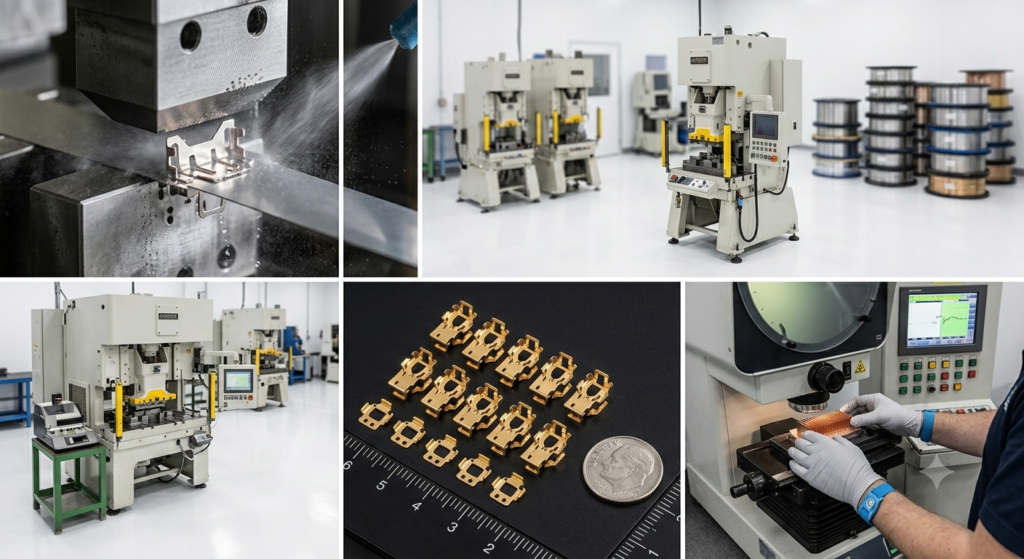
How to Choose the Right Stamping Partner
Successfully bringing a stamped part to life requires deep technical collaboration. When searching for a provider, look beyond the price tag and evaluate their technical capabilities.
First, ensure they offer Design for Manufacturing (DFM) support. A truly expert partner won’t just take your blueprint and run with it; they will analyze your design to see if minor tweaks can reduce material waste, simplify the tooling, and lower your overall costs.
Second, ask about their internal quality control systems. Do they hold ISO certifications? Do they use automated optical inspection systems on the line?
Finally, clarify their capacity. A shop that excels at low-volume prototyping might struggle to scale up if your product takes off in the market. Finding a partner that can support you from the initial prototype all the way through millions of units of production will save you massive headaches down the road.
Final Thoughts
Investing in precision sheet metal stamping is one of the smartest moves you can make when scaling a hardware product. By front-loading the effort into smart tool design and partnering with a reliable manufacturing team, you unlock a level of speed, accuracy, and cost efficiency that pushes your business ahead of the competition.