Brass CNC machining services are the backbone of high-precision component manufacturing, delivering the reliability that modern industrial applications demand. When you are sourcing custom hardware, the quality of your brass CNC machining parts directly dictates the performance of your entire assembly. For procurement managers, engineers, and B2B buyers, finding a manufacturing partner that balances tight tolerances with cost-efficiency is a common bottleneck. This guide breaks down exactly why brass remains a premier choice for precision engineering and how to optimize your custom parts for production.
Brass CNC Machining Services: Why This Material Dominates Precision Engineering
Selecting the right alloy is the first critical step in manufacturing. Brass—primarily an alloy of copper and zinc—is highly favored in CNC milling and turning centers because of its exceptional machinability, corrosion resistance, and thermal conductivity.
Compared to stainless steel or titanium, brass allows for significantly higher cutting speeds and lower tool wear. This translates to shorter cycle times in the workshop, which directly reduces your per-part cost. However, not all brass is created equal. Depending on your application, different grades offer distinct mechanical advantages:
- C36000 (Free-Cutting Brass): The gold standard for high-volume production. It contains a small percentage of lead, which acts as an internal lubricant, producing highly manageable chips and an incredibly smooth surface finish straight off the machine.
- C46400 (Naval Brass): Engineered for harsh environments. It features added tin to provide high resistance to zinc stripping (dezincification) in saltwater and marine applications.
- C26000 (Cartridge Brass): Best suited for components requiring severe cold working or deep drawing alongside machining operations.
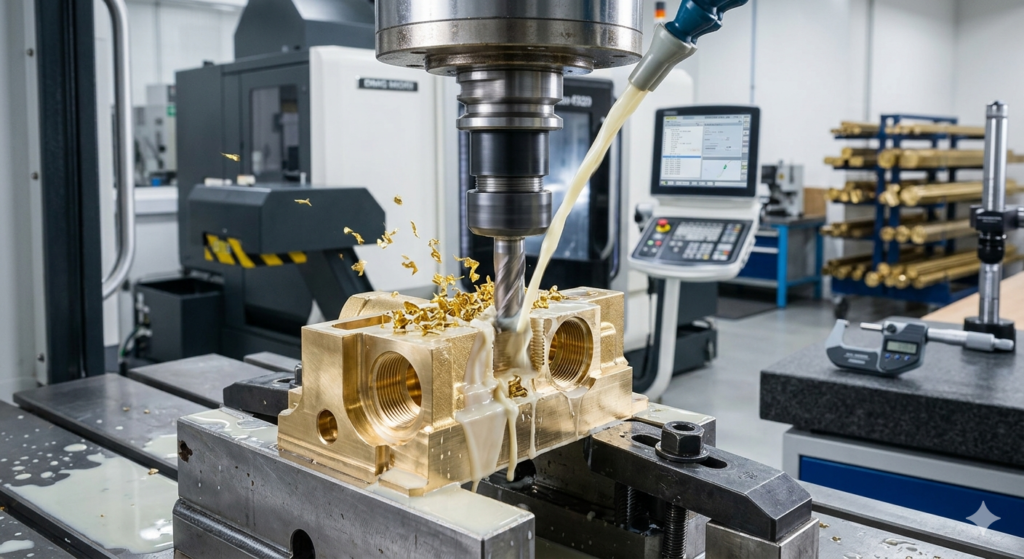
Brass CNC Machining Parts: Essential Design Considerations for Cost-Effective Sourcing
Optimizing your designs specifically for brass CNC machining parts ensures a seamless transition from CAD model to finished product, minimizing material waste and machine downtime. While brass is forgiving to cut, smart design adjustments can lower your manufacturing overhead significantly.
1. Wall Thickness Boundaries
While brass is robust, designing excessively thin walls can lead to part distortion or chattering during high-speed milling. Maintain a minimum wall thickness of 0.8 mm for structural integrity. For deep cavities, ensure the walls are slightly thicker to withstand the cutting forces.
2. Thread Optimization
Brass taps beautifully, making it ideal for threaded connectors, fluid power valves, and electrical terminals. However, deep blind-hole threads add unnecessary complexity. Limit thread depths to 2 ĐẾN 3 times the hole diameter. Anything deeper offers no structural advantage but risks tool breakage.
3. Internal Corner Radii
Sharp internal 90-degree corners are impossible to achieve with standard rotating milling cutters. Always design internal corners with a radius slightly larger than the radius of the milling tool you expect the workshop to use. A good rule of thumb is a minimum radius of 1.5 mm.
| Surface Finish | Primary Purpose | Best Application |
| As-Machined | Keeps costs low while retaining tight tolerances ($\pm 0.01\text{ mm}$). | Internal mechanical components, fluid fittings. |
| Electroless Nickel Plating | Provides superior wear resistance and barrier corrosion protection. | Marine hardware, aerospace fuel systems. |
| Passivation | Removes surface iron particles to boost natural corrosion resistance. | Medical devices, high-purity fluid control. |
| Chrome Plating | Offers a mirror-like finish with high surface hardness. | High-end architectural hardware, consumer goods. |
Partnering with the Right B2B Manufacturing Vendor
Sourcing custom components requires more than just submitting a blueprint; it demands a technical partnership. When evaluating manufacturing vendors for high-volume production runs, look beyond the unit price.
Ensure your supplier utilizes multi-axis CNC machines (4-axis or 5-axis) to handle complex geometries in a single setup, which dramatically reduces cumulative tolerances. Furthermore, robust quality control protocol—backed by Coordinate Measuring Machines (CMM) and optical comparators—is non-negotiable to ensure that every shipment matches your strict geometric dimensioning and tolerancing (GD&T) specifications.