In today’s hyper-competitive manufacturing landscape, speed isn’t just an advantage—it is survival. Whether you are an aerospace engineer rushing a critical component to a test flight or a medical device startup trying to beat competitors to market, production delays can cost millions. This is where rapid machining services step in, fundamentally changing how industries approach CNC metal machining.
But how exactly do rapid machining services compress production timelines from months to days without sacrificing the razor-thin tolerances required in modern engineering? Let’s dive deep into the mechanics of speed, precision, and material selection in modern rapid manufacturing.
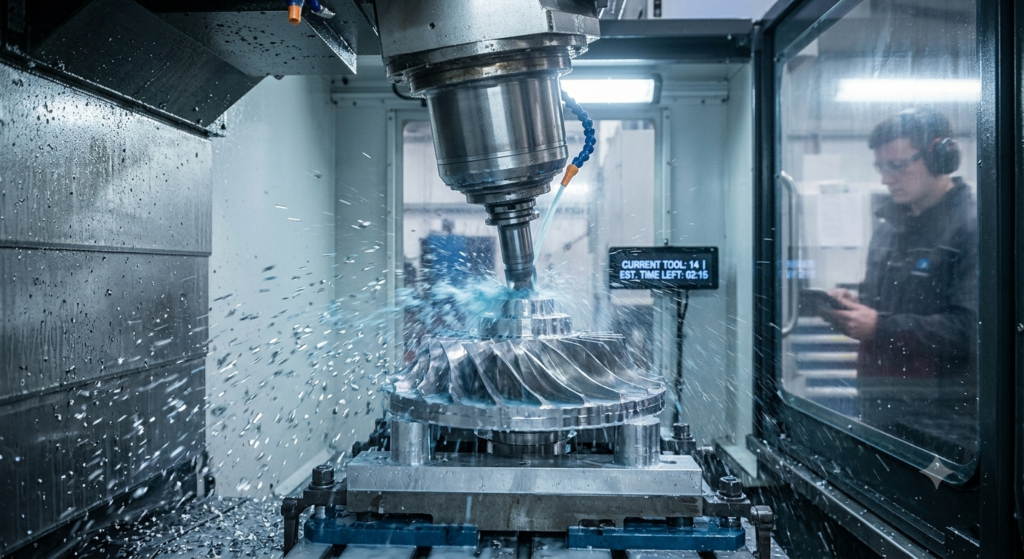
What are Rapid Machining Services in CNC Metal Machining?
At its core, CNC metal machining is a subtractive manufacturing process where pre-programmed computer software dictates the movement of factory tools and machinery. While traditional machining is often bogged down by long setup times, manual blueprint translations, and bureaucratic quoting pipelines, rapid machining services leverage advanced automation and digital workflows to eliminate these bottlenecks.
By combining high-speed CNC milling, quay, and multi-axis machining with instant digital quoting engines, manufacturers can now transition from a 3D CAD model to a physical metal part in as little as 24 giờ. This isn’t just about spinning the cutting tools faster; it is about optimizing the entire lifecycle of a manufacturing order.
The Core Benefits of Speed-Optimized CNC Metal Machining
When you utilize a specialized rapid manufacturing partner, you are investing in more than just quick turnaround times. You are unlocking a suite of operational benefits:
- Accelerated Time-to-Market: Successfully launch products ahead of schedule, capturing market share before competitors can react.
- Design Validation with Real Metals: Unlike 3D-printed plastic mockups, rapid CNC machining allows you to test functional prototypes using production-grade metals like titanium, aluminum, or stainless steel.
- Agile Iteration: Found a flaw in your stress test? Modify the CAD file and have a revised metal prototype back on your workbench by the end of the week.
- No Minimum Order Quantities (MOQs): Rapid services are tailored for low-volume production runs, meaning you don’t have to commit to thousands of units just to get a fair price.
High-Speed CNC Metal Machining: Material Selection Guide
Choosing the right metal is crucial because material machinability directly influences the speed of rapid machining services. Different metals react uniquely to high-speed cutting tools. Here is a breakdown of the most common metals used in rapid production:
| Metal Alloy | Machinability Rating | Common Applications | Why Choose It for Rapid Machining? |
| Aluminum 6061 | Excellent (Highest) | Aerospace, Automotive, Enclosures | Extremely fast to mill, highly cost-effective, and excellent strength-to-weight ratio. |
| Stainless Steel 304 | Moderate | Medical devices, Marine hardware | Offers superb corrosion resistance, though it requires slower cutting speeds than aluminum. |
| Titanium (Grade 5) | Challenging | Bio-medical implants, Aerospace components | Exceptional strength and lightweight, but requires advanced CNC cooling strategies. |
| Brass C360 | Excellent | Plumbing, Electrical components | Highly conductive and shears effortlessly, allowing for incredibly fast cycle times. |
How Digital Workflows Power Fast Turnarounds
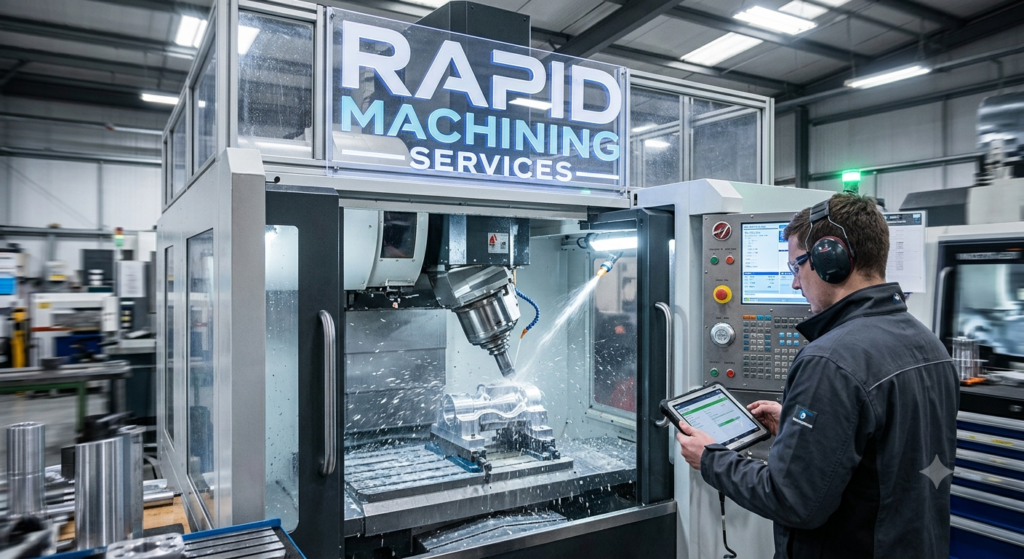
các “secret sauce” behind modern rapid machining services isn’t just the hardware on the shop floor; it is the software in the front office. Traditional machine shops can take days just to calculate a quote. Modern rapid manufacturers utilize automated Design for Manufacturability (DFM) software.
How DFM Analysis Works: When you upload your 3D CAD file to a rapid machining platform, algorithms instantly analyze the geometry. The software flags issues like impossibly deep pockets, overly thin walls, or sharp internal corners that a circular drill bit cannot replicate.
By catching these design flaws instantly, engineers can fix their models before production begins, eliminating the back-and-forth emails that traditionally stall manufacturing timelines. Once approved, the software automatically generates the CNC G-code, sending it directly to a scheduled, available machine on the floor.
Designing Parts for Rapid CNC Metal Machining: Best Practices
If you want your parts manufactured fast, you need to design them with the CNC process in mind. Complicated setups drastically slow down production. Follow these engineering tips to keep your turnaround times lightning-fast:
1. Avoid Sharp Internal Corners
Because CNC cutting tools are cylindrical, they naturally leave a radius on internal vertical corners. Always design your internal corners with a radius slightly larger than the radius of the milling tool you expect to be used.
2. Limit Deep Pockets
Deep, narrow cavities require long cutting tools that are prone to vibration and breakage. Keep the depth of your pockets to no more than 4 times the width of the cavity to ensure rapid, stable machining.
3. Stick to Standard Tolerances
While CNC metal machining can achieve incredibly tight tolerances (down to $\pm 0.025 \text{ mm}$), demanding these limits on non-critical dimensions unnecessarily slows down production. Standard tolerances ($\pm 0.125 \text{ mm}$) are much faster and cheaper to achieve.
Embracing the Future of Rapid Prototyping
The manufacturing industry is shifting permanently toward on-demand production. Relying on legacy supply chains with multi-month lead times is a massive risk. Incorporating rapid machining services into your development cycle guarantees that your engineering team remains nimble, responsive, and innovative.
By understanding the synergy between clever CAD design, proper material selection, and high-speed CNC metal machining, companies can seamlessly bridge the gap between abstract concept and physical reality—faster than ever before.
Need to accelerate your next hardware project? Upload your CAD files to a trusted rapid manufacturing partner today to get a comprehensive DFM analysis and kickstart your production.