 Chuyển đến nội dung
When you are bringing a new plastic or multi-material component to market, tạo mẫu nhanh Và injection molding sit on opposite ends of the timeline—and right in the middle of your cash flow. Order tooling too early, and a single snap-fit revision can turn a $12,000 steel mold into expensive scrap. Stay in prototype mode too long, and per-unit costs quietly eat your gross margin before your product ever reaches a retail shelf or warehouse.
For overseas importers and hardware sourcing teams, the trick isn’t treating prototyping and mass production as two disconnected stages. It is knowing exactly when to switch processes, which materials bridge the gap, and how to set up your supplier workflow so the transition doesn’t stall for weeks.
Why Rapid Prototyping Comes First (Even When You Have Final CAD)
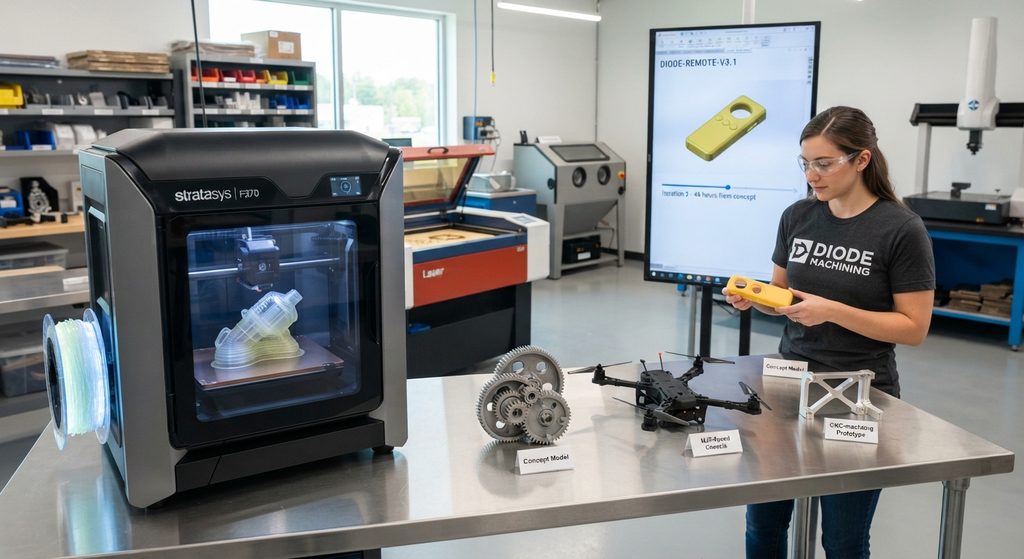
A 3D model on a screen rarely tells the whole story of how a part behaves in human hands or inside an assembly. Tạo mẫu nhanh—whether through SLA, SLS, MJF, or CNC-machined engineering plastics—lets engineering and procurement teams test form, phù hợp, and basic mechanical stress within days rather than months.
In practical sourcing workflows, three things usually go wrong if a buyer skips physical validation:
- Undetected tolerance stack-ups: A housing looks clean in CAD, yet real-world boss locations bind against a PCB or mating aluminum frame by 0.25 mm.
- Wall-thickness surprises: Thick ribs that look sturdy in rendering often cause sink marks or warpage once resin cools inside a cavity.
- Late stakeholder sign-off: Distributors, compliance labs, and end customers almost always request tweaks once they hold a physical sample.
At Diode Machining, prototype runs via 3D printing (SLA, SLS, MJF, DMLS) and CNC plastic machining typically turn around in 48 ĐẾN 72 giờ, with dimensional accuracy down to roughly ±0.2 mm on printed prototypes and ±0.01 mm on machined parts. That speed gives importers room to run two or three physical iterations in the time it would normally take just to finalize a tool design.
Where Injection Molding Takes Over—and What Changes
Once geometry is frozen and demand moves from dozens of validation units into hundreds or tens of thousands of pieces, injection molding becomes the clear economic winner. While upfront mold fabrication adds initial capital expense, cycle times drop to seconds per shot, pushing unit costs down by 70% ĐẾN 90% compared to additive or subtractive methods.
Điều đó nói rằng, moving from a printed prototype to a molded production part is not a simple “export STL and press go” handoff. Molded parts obey physics that 3D printers ignore:
- Draft angles: Vertical walls need 1° to 2° of draft so parts eject cleanly without drag marks.
- Uniform wall thickness: Keeping walls consistent prevents uneven shrinkage, internal voids, and cosmetic sink.
- Gate and ejector pin placement: Where molten plastic enters the cavity affects weld lines, structural strength, and visible surface aesthetics.
- Resin shrinkage rates: ABS, Nylon (PA6/PA66), PC, PP, and POM each shrink differently as they cool, meaning cavity dimensions must be compensated during tool cutting.
Practical Sourcing Tip: Before paying for steel tooling, ask your supplier to run a Design for Manufacturability (DFM) check specifically for molding—not just general machining. Catching an undercut or sharp internal corner before CNC cutting the mold base saves both tooling surcharges and three weeks of rework.
Rapid Prototyping vs. ép phun: Side-by-Side Comparison for Buyers
| Decision Factor | Rapid Prototyping (3D Printing / CNC Plastics) | ép phun (Bridge & Production Tooling) |
| Typical Lead Time | 2–5 business days | 2–4 weeks for tooling + sample T1 shots |
| Upfront Tooling Cost | $0 (no hard mold required) | Moderate to high (depends on cavities & steel grade) |
| Ideal Order Volume | 1 ĐẾN 100+ pieces | 500 ĐẾN 100,000+ pieces |
| Unit Cost at Scale | High; stays relatively flat per piece | Very low once mold cost is amortized |
| Material Options | Photopolymers, SLS/MJF Nylon, CNC ABS/POM/PEEK | Full production-grade thermoplastics & custom colorants |
| Design Flexibility | Easy to modify CAD between batches | Costly after steel is cut; minor tweaks only |
Bridging the Gap: Low-Volume Tooling and Multi-Process Sourcing
Many importers hit an awkward middle zone: they need 300 ĐẾN 1,500 units for pilot launches, trade shows, or initial distributor stock, yet they are not ready to commit to a hardened multi-cavity production mold.
Two hybrid strategies keep budgets intact during that bridge phase:
- Aluminum or P20 Prototype Molds: Soft-steel or aluminum tooling machines faster and costs noticeably less than hardened H13 steel, making it ideal for bridge runs of 500 ĐẾN 5,000 parts while proving real-world market demand.
- 3D-Printed Patterns & CNC Pre-Production Runs: Using SLS/MJF parts or CNC-machined ABS/POM housings alongside early injection molding trials lets you test actual production resins and surface textures—like matte bead blasting or SPI polish—before locking in high-volume tooling.
Working with a single manufacturing partner that handles CNC machining, 3in D, sheet metal, Và injection molding under one roof also prevents finger-pointing between vendors. If a molded plastic cover needs to mate with a CNC-machined aluminum chassis, one engineering team owns the interface tolerances across both processes.
Câu hỏi thường gặp (Câu hỏi thường gặp)
How many units justify switching from rapid prototyping to injection molding?
In most cases, the break-even point lands between 300 Và 800 units, depending on part size, geometry complexity, and resin type. Below 200 pieces, 3D printing or CNC plastic machining usually wins because you avoid tooling fees entirely. Once orders cross 1,000 units—or repeat quarterly—injection molding delivers dramatically lower landed cost per part.
Can I test the exact production resin during rapid prototyping?
If you use gia công CNC for your prototypes, yes—you can cut parts directly from production-grade blocks of ABS, Polycarbonate, Nylon, POM (Delrin), or PEEK. Standard SLA/SLS 3D printing uses simulated resins that mimic mechanical properties closely, though they do not replicate mold flow lines or exact shrinkage behavior.
What files and details should I send to get an accurate quote for both stages?
Send native 3D CAD files (STEP, IGES, or X_T) along with a 2D PDF drawing calling out critical tolerances, cosmetic surfaces, target material, surface finish, and estimated batch quantities (for example: 20 prototype units now, 3,000 molded units in Q3). Sharing both numbers upfront allows engineers to quote prototype pricing alongside DFM notes for future tooling.
How do I protect my CAD files when quoting overseas suppliers?
Always sign a binding Non-Disclosure Agreement (NDA) before uploading proprietary assemblies, and verify that your manufacturer enforces ISO-certified access controls on engineering files. Reputable suppliers will execute your NDA prior to file transfer and keep prototype and tooling data segregated.
Ready to Move Your Part from Prototype to Production?
Whether you need a 72-hour functional sample to verify an assembly or a full DFM review ahead of production tooling, getting engineering eyes on your CAD early saves time and margin. Upload your STEP/IGS files and target quantities to the Gia công điốt engineering team for a confidential NDA-protected review and fast quote across both tạo mẫu nhanh Và injection molding.