If you are stepping into the world of CNC metal fabrication, you quickly realize that not all metals are born equal. Among them, aluminum is the undisputed king of the modern machine shop. It is lightweight, highly conductive, incredibly versatile, and—on paper—highly machinable. But if you have ever actually run a lathe, you know that the turning of aluminum parts isn’t always a walk in the park.
Get your parameters slightly wrong, and you are left with bird-nesting chips, a ruined surface finish, or a melted lump of aluminum fused to your cutting tool.
Whether you are designing aerospace components, automotive prototypes, or custom consumer electronics, mastering CNC metal turning for aluminum is essential. Let’s break down the practical, shop-tested strategies to get flawless, mirror-like aluminum parts every single time.
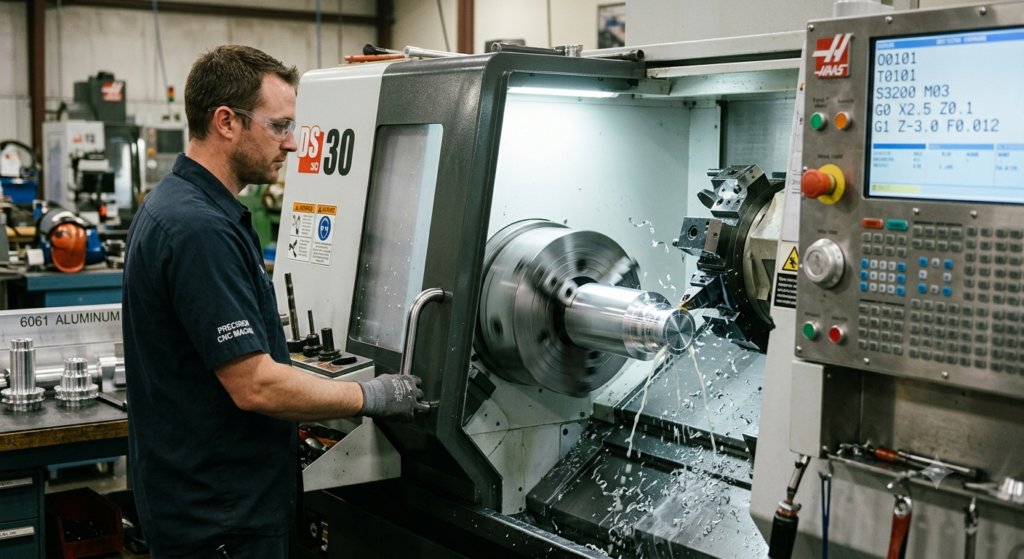
Why Aluminum is the Go-To for CNC Metal Turning
Before we talk about spindle speeds and feed rates, we need to talk about why we use aluminum in the first place.
Aluminum has an incredible strength-to-weight ratio. It naturally forms a protective oxide layer that resists corrosion, and it conducts heat beautifully. In CNC metal drehen, this high thermal conductivity is a massive advantage: it helps draw heat away from the cutting zone and into the chips, preserving your tool life.
However, aluminum has a low melting point and is highly ductile. In simple terms, it’s “gummy.” If your cutting tool isn’t sharp enough or your speeds are too slow, the metal will rub and stick to the tool instead of shearing away cleanly. This is known as Built-Up Edge (BUE), and it is the absolute enemy of a great surface finish.
Choosing the Right Aluminum Grade
Not all aluminum alloys behave the same way on a CNC lathe. Understanding your material is the first step to successful turning of aluminum parts.
| Aluminum Grade | Machinability | Best Used For | Key Characteristics |
| Alloy 6061-T6 | Excellent | General structural parts, brackets, fittings | The absolute workhorse. Highly machinable, welds well, and anodizes beautifully. |
| Alloy 7075-T6 | Outstanding | Aerospace, high-stress components | Almost as strong as steel, but lightweight. It chips beautifully during turning, making chip control a breeze. |
| Alloy 2024 | Good to Great | Aircraft structures, high-fatigue parts | High copper content makes it incredibly strong, but it is less corrosion-resistant than 6061. |
| Alloy 5052 | Poor (Gummy) | Sheet metal, marine applications | Highly ductile and corrosion-resistant, but a nightmare to turn because it tends to stick to the tool. |
Tooling Secrets for Flawless Aluminum Turning
If you want to master the turning of aluminum parts, you have to stop treating aluminum like steel. Steel likes to be pushed and deformed by a heavy, negative-rake insert. Aluminium, auf der anderen Seite, needs to be sliced.
1. Go Extremely Sharp (High Positive Rake)
You need a razor-sharp cutting edge to shear aluminum without causing BUE. Look for carbide inserts designed specifically for aluminum (often labeled as “non-ferrous”). These inserts feature a highly positive rake angle and a very narrow, sharp cutting edge.
2. Polished Flank Faces are Non-Negotiable
Have you ever noticed those shiny, mirror-like carbide inserts? They aren’t just for aesthetics. Polished insert faces prevent the gummy aluminum chips from sticking to the rake face of the tool. If the chip can slide off smoothly, heat stays low, and the surface finish remains flawless.
3. Consider PCD (Polycrystalline Diamond)
If you are running high-volume production of abrasive aluminum alloys (like cast aluminum with high silicon content), carbide will wear down quickly. PCD-tipped tools are the gold standard here. They are incredibly sharp, wear-resistant, and can run at jaw-dropping cutting speeds.
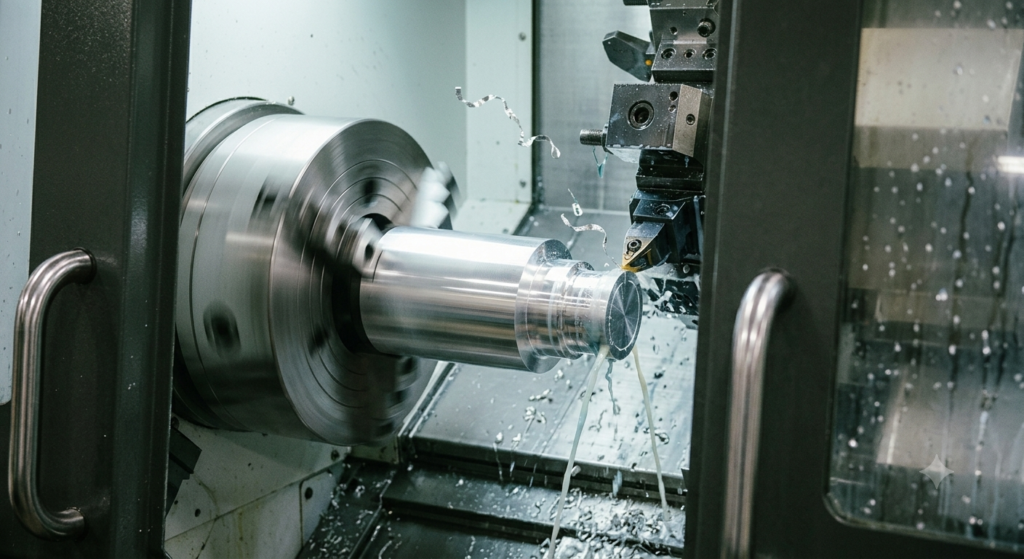
Dialing in the Parameters: Speeds and Feeds
To get the most out of your CNC metal setups, you need to push your machine. Aluminum loves speed. If you are babying the machine with slow spindle speeds, you are actually increasing the chances of tool rub and BUE.
The Golden Rule for Aluminum: High surface footage (SFM) and aggressive, consistent feed rates.
- Cutting Speed (SFM): For general turning of 6061-T6 with carbide tools, you should target anywhere from 800 Zu 2,000+ SFM (roughly 240 Zu 600+ m/min). If your CNC lathe has the RPM capability, don’t be afraid to use it.
- Feed Rate: Your feed rate determines your chip thickness. If it’s too light, the tool rubs. If it’s too heavy, you risk breaking the insert or creating a rough surface finish. For roughing cuts, aim for 0.008 Zu 0.015 IPR (inches per revolution). For finishing, drop down to 0.002 Zu 0.006 IPR.
- Depth of Cut (DOC): When roughing, take a deep enough cut to get below the surface skin of the material. A good rule of thumb is a DOC at least equal to the nose radius of your insert.
Chip Control and Coolant: The Unsung Heroes
In CNC metal drehen, chip control is the difference between a smooth-running lights-out operation and a midnight disaster. Because aluminum is so ductile, it loves to create long, continuous, stringy chips. These “bird nests” can wrap around the chuck, damage the finished surface of your part, or even trigger an emergency stop.
Chip Breakers are Key
Never use flat-top inserts for turning aluminum. Ensure your inserts have a aggressive, molded chip breaker designed specifically to curl and snap the aluminum chip into tight “C” shapes or 9s.
Flood Coolant vs. MQL
Aluminum generates a lot of friction heat. Flood coolant is highly recommended because it performs three crucial functions:
- It cools the workpiece and the tool down to prevent thermal expansion.
- It lubricates the interface, preventing BUE.
- It flushes the chips away from the cutting zone instantly.
If your machine allows it, high-pressure coolant directed right at the cutting edge is the ultimate setup for deep boring or high-speed turning.
Troubleshooting Common Aluminum Turning Issues
Even the most experienced machinists run into roadblocks when dealing with the turning of aluminum parts. Here is a quick cheat sheet to get you back on track:
- Issue: Poor Surface Finish (Torn or Cloudy Appearance)
- Fix: Increase your cutting speed (RPM) and ensure you are using a polished, positive-rake insert. Check for built-up edge on the tool nose.
- Issue: Stringy, Unbroken Chips
- Fix: Increase your feed rate to force the chip breaker to do its job, or use an insert with a tighter chip-breaking geometry.
- Issue: Part Distortion or Dimensional Drift
- Fix: Aluminum expands rapidly when warm. Ensure you are using plenty of coolant to keep the part cool, or reduce your roughing depth of cut to minimize heat buildup.
Letzte Gedanken
Mastering CNC metal drehen, specifically the turning of aluminum parts, requires a shift in mindset. You cannot treat it like mild steel. By choosing the right alloy, utilizing razor-sharp, polished carbide tools, pushing your spindle speeds, and managing your chip evacuation with high-pressure coolant, you will unlock incredibly fast cycle times and beautiful surface finishes.
Get out onto the shop floor, load up a bar of 6061, dial in those high speeds, and watch those chips fly!