When you are bringing a new product to market, choosing the right manufacturing process isn’t just a technical detail—it’s a major business decision. The method you choose dictates your production speed, your total costs, and the ultimate quality of your components. Two of the most widely discussed solutions in the modern manufacturing landscape are Sheet Metal China sourcing and precision Swiss machining.
While both methods are staples of modern supply chains, they serve vastly different purposes. One is the undisputed king of structural, large-scale enclosures, while the other is the gold standard for miniature, ultra-precise components.
So, how do you know which one fits your project? Let’s break down the mechanics, the benefits, and the ideal use cases for both sheet metal fabrication in China and high-precision Swiss machining.
Understanding Sheet Metal China Fabrication
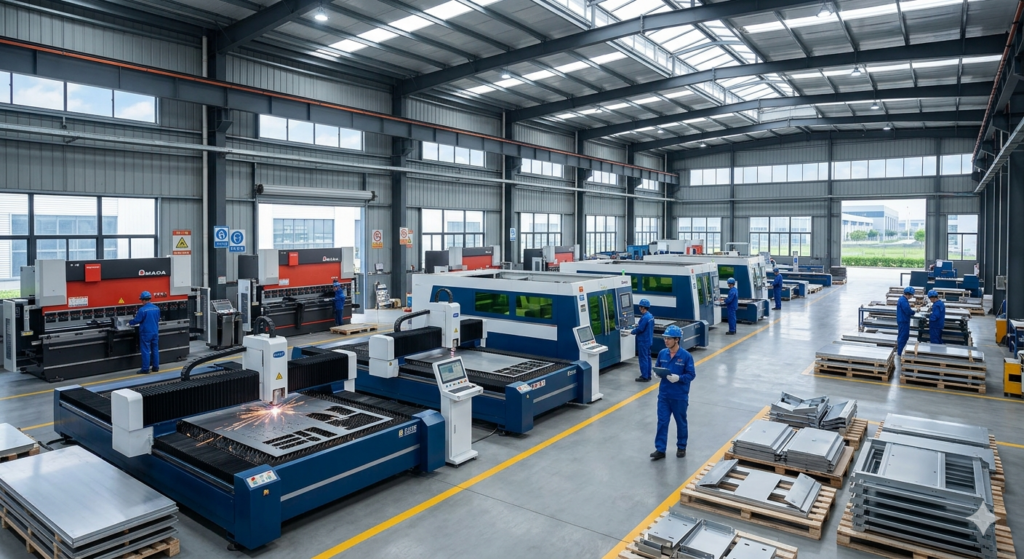
When companies talk about sourcing sheet metal China Dienstleistungen, they are usually looking for scalability, cost-efficiency, and a massive ecosystem of raw materials. Sheet metal fabrication involves cutting, punching, bending, and assembling flat sheets of metal (typically steel, aluminum, or brass) into three-dimensional structures.
The Core Advantages of Sourcing Sheet Metal from China
- Unmatched Cost Efficiency: China’s manufacturing infrastructure allows for incredibly competitive pricing, especially for medium-to-high volume production runs.
- Scalability and Speed: Chinese fabrication facilities are built for speed. They can transition from a rapid prototype to a mass production run of tens of thousands of units faster than almost anywhere else on earth.
- Comprehensive Surface Finishing: One of the biggest perks of using a Chinese sheet metal ecosystem is the easy access to secondary processes. Whether you need powder coating, Eloxieren, silk-screening, or laser engraving, it is usually done under one roof.
Typical applications for sheet metal fabrication include server racks, computer chassis, automotive panels, medical device enclosures, and heavy machinery brackets.
What is Swiss Machining?
On the other side of the manufacturing spectrum lies Swiss machining. Originally developed by the Swiss watchmaking industry in the late 19th century to produce tiny, intricate internal gears, modern Swiss machining has evolved into a powerhouse for high-tech industries.
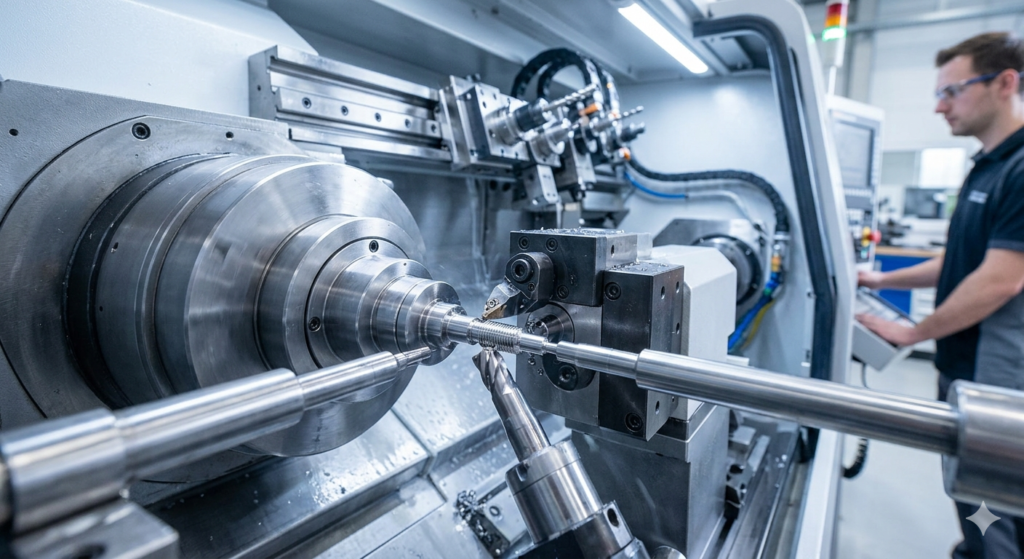
A Swiss lathe (or Swiss screw machine) is a specific type of CNC turning center. The defining characteristic of Swiss machining is that the bar stock moves along the Z-axis through a guide bushing, while the cutting tools operate right next to the bushing support.
Because the metal is cut immediately adjacent to the point of support, deflection is virtually eliminated. This allows the machine to achieve mind-boggling tolerances—often within a few micrometers—even on incredibly thin or long parts.
The Core Advantages of Swiss Machining
- Extreme Precision: If your part requires tolerances tighter than $\pm0.005\text{ mm}$, standard machining won’t cut it. Swiss machining excels here.
- Complex Geometries in One Pass: Modern Swiss CNC machines utilize live tooling and multiple axes, meaning they can turn, drill, mill, and slot a part simultaneously. It drops off the machine completely finished, eliminating the need for secondary operations.
- Perfect for Miniature Parts: If your component is smaller than a pen cap or involves complex internal threading on a micro-scale, Swiss machining is likely your only viable option.
Sheet Metal China vs. Swiss Machining: The Ultimate Head-to-Head
To help your engineering and procurement teams make the right call, let’s look at how these two methods stack up across critical project metrics.
| Feature / Metric | Sheet Metal China | Swiss Machining |
| Primary Geometry | Large, flat, hollow, or structural shapes | Small, cylindrical, and highly intricate parts |
| Tolerances | Standard ($\pm0.2\text{ mm}$ to $\pm0.5\text{ mm}$) | Ultra-precise ($\pm0.005\text{ mm}$ or better) |
| Material Waste | Moderate (stamping skeletons) | High (subtractive turning/chipping) |
| Initial Tooling Cost | Low for laser cutting; High for stamping dies | Low to Moderate (mainly programming and custom fixtures) |
| Best Volume Fit | Scalable from prototyping to millions | High-volume is ideal due to setup times |
How to Choose: The Deciding Factors for Your Project
Choosing between these two powerhouses comes down to asking three fundamental questions about your product design:
1. What is the Scale and Size of the Component?
If you are building a housing for a drone, a bracket for a solar panel, or a metal cabinet for consumer electronics, you are firmly in the territory of sheet metal China fabrication. If you are manufacturing a dental implant, a fiber-optic connector, or a fuel injector nozzle, you need the micro-capabilities of Swiss machining.
2. What are Your Tolerance Requirements?
Sheet metal is inherently flexible. While advanced CNC hydraulic presses can bend metal with incredible accuracy, the material itself retains internal stresses that can cause slight warping. Swiss machining, however, carves components out of solid bar stock. If your design cannot tolerate a hair’s width of variation, choose Swiss turning.
3. What is Your Budget and Volume Strategy?
For massive structural components, China’s sheet metal factories offer a cost-per-part ratio that is impossible to beat domestically. Conversely, for tiny turned parts, the efficiency of a Swiss machine running “lights-out” (unattended 24/7 manufacturing) makes it incredibly cost-effective for high volumes, despite the high initial machine setup costs.
Conclusion: The Modern Hybrid Supply Chain
In many advanced products—like aerospace systems, medical devices, and high-end consumer tech—you don’t actually choose just one. You use both.
An automated medical diagnostic machine, for instance, relies on a beautifully powder-coated chassis sourced from a sheet metal China vendor to keep overall costs down, while its internal fluid-delivery valves rely on ultra-precise pins made via Swiss machining to ensure life-saving accuracy.
By understanding the distinct strengths of each manufacturing discipline, you can optimize your design for the right process, cut down on lead times, and maximize your return on investment.