In the rapidly evolving landscape of modern manufacturing, sourcing the right components is the definitive line between a market-leading product and an engineering failure. When it comes to achieving structural integrity, lightweight design, and microscopic tolerances, two fabrication methodologies dominate the industrial sector: aluminum CNC machining and the production of precision metal stamping parts.
For hardware engineers, procurement managers, and B2B OEMs worldwide, understanding how to leverage these two distinct manufacturing pillars is essential. Ce guide complet décompose les nuances techniques, strategic applications, and cost-efficiency matrices of aluminum CNC and precision metal stamping.
Understanding Aluminum CNC: Subtractive Perfection
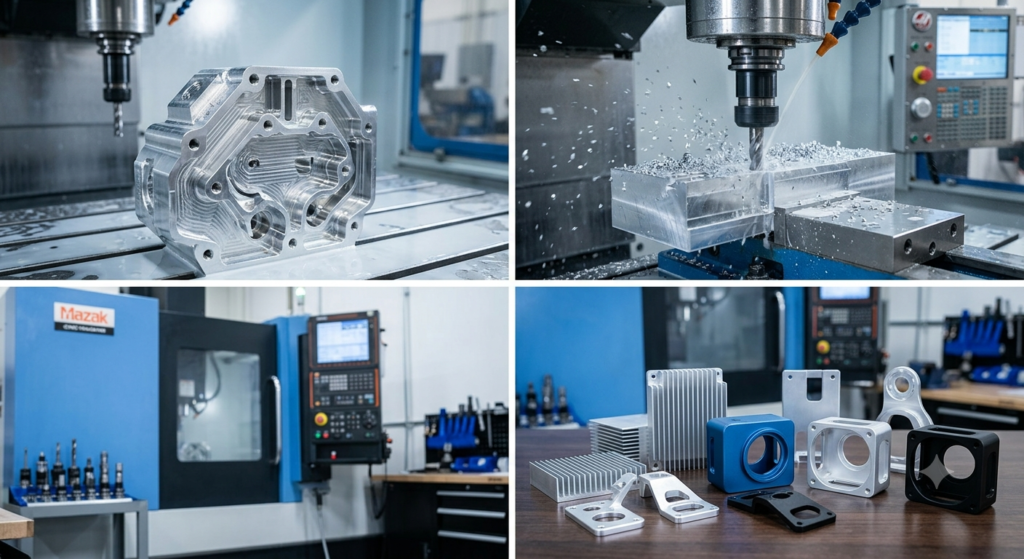
Aluminum CNC (Computer Numerical Control) machining represents the pinnacle of subtractive manufacturing. Starting with a solid block of aerospace- or commercial-grade aluminum—such as 6061-T6, 7075, or 5052—high-precision CNC mills and lathes systematically carve away material to reveal the final component.
Why Choose Aluminum for CNC Machining?
Aluminum is uniquely suited for CNC operations. It possesses an exceptional strength-to-weight ratio, excellent thermal and electrical conductivity, and natural corrosion resistance. Furthermore, its machinability index is incredibly high, allowing CNC cutting tools to slice through the material with minimal tool wear, reducing cycle times and operational costs.
The Technical Edge of CNC Milling and Turning
- Microscopic Tolerances: Standard aluminum CNC setups easily achieve tolerances as tight as $\pm0.025\text{ mm}$ ($\pm0.001\text{ inches}$), with specialized aerospace-grade machinery tightening that margin even further.
- Complex Geometries: Multi-axis CNC machines (3-axe, 4-axe, et 5 axes) can execute intricate internal pockets, deep undercuts, and complex organic curves that are impossible to replicate via traditional molding or stamping.
- Zero Tooling Costs: Unlike stamping, which requires expensive die fabrication, CNC runs directly off digital CAD/CAM files. This makes it the absolute ideal choice for rapid prototyping and low-to-medium volume production runs.
Demystifying Precision Metal Stamping Parts: High-Volume Efficiency
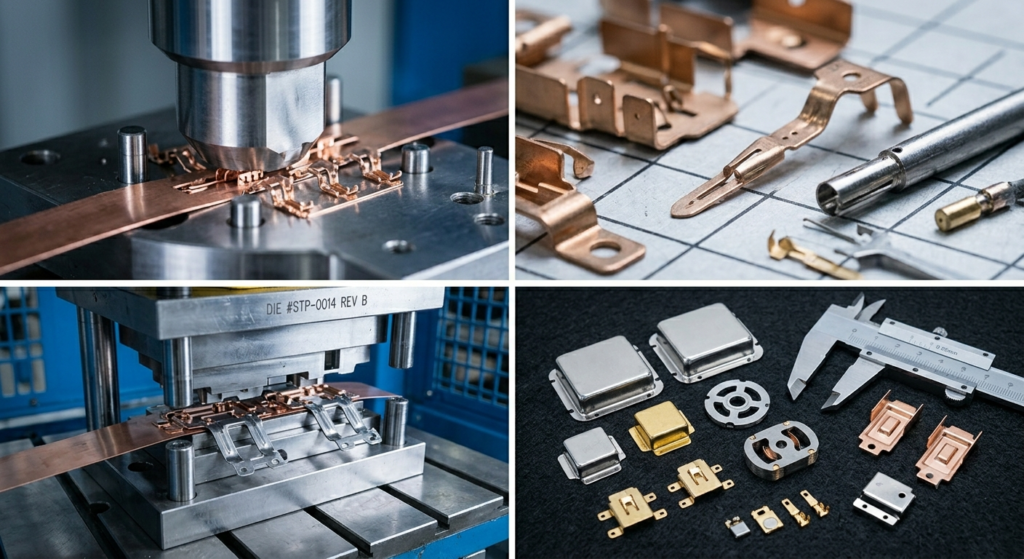
On the other side of the production spectrum lie precision metal stamping parts. While CNC is a subtractive art, precision stamping is a high-speed, transformative process. Utilizing mechanical or hydraulic presses equipped with custom-engineered dies, flat metal sheets are sheared, punched, bent, and formed into complex shapes in a fraction of a second.
The Mechanics of Mass Customization
Precision metal stamping turns raw sheet metal (including aluminum, stainless steel, copper, and brass) into highly repeatable components. The process relies heavily on progressive die stamping, where a strip of metal feeds through a series of stations, each performing a specific modification until the final part is blanked out.
Key Benefits of Stamping Parts
- Unmatched Economies of Scale: While the initial cost to design and engineer a stamping die is significant, the per-part cost for high-volume runs (tens of thousands to millions of units) drops to pennies.
- High Repeatability: Once a progressive die is calibrated, the consistency from the 1st part to the 1,000,000th part is virtually identical, ensuring strict compliance with quality control standards.
- Material Efficiency: Advanced nesting software ensures that sheet metal layout minimizes scrap waste, driving down raw material overhead.
Aluminum CNC vs. Precision Metal Stamping: The Strategic Comparison
Choosing between these two processes isn’t about finding which method is “better”; it’s about identifying which method aligns with your specific production volume, budget, and design constraints.
| Engineering Factor | Aluminum CNC Machining | Precision Metal Stamping Parts |
| Initial Tooling Cost | Extremely Low (Setup only) | High (Custom Die Design & Fabrication) |
| Per-Unit Cost | Moderate to High | Extremely Low (At Scale) |
| Vitesse de production | Minutes per part | Seconds per part |
| Design Flexibility | High (Easily modify CAD files) | Low (Modifying dies is costly) |
| Wall Thickness Capability | Thick blocks, variable depths | Uniform thin-gauge sheets |
| Surface Finish | Smooth, distinct tool marks | Clean edges, might require deburring |
Synergizing Both Methods for Modern B2B Supply Chains
In advanced product manufacturing—such as automotive EV components, telecommunications enclosures, consumer electronics, and medical devices—companies rarely rely on just one process.
For instance, an intricate electronic housing may start its life as a precision metal stamping part to quickly and cheaply form the overall chassis out of an aluminum sheet. Afterward, that stamped part is moved to an aluminum CNC milling center to drill high-tolerance threaded holes, create localized heat sinks, or mill precise mating surfaces that stamping presses simply cannot execute.
By integrating both capabilities into your supply chain, you achieve the best of both worlds: the structural speed of stamping combined with the surgical accuracy of CNC machining.
Optimizing Sourcing and Quality Assurance
When auditing a manufacturing partner for your aluminum components and stamped assemblies, looking at price alone is a trap. True cost efficiency comes from supply chain reliability and technical certification. Ensure your chosen vendor utilizes advanced Quality Management Systems (QMS) and carries certifications such as ISO 9001:2015, IATF 16949 (for automotive), or AS9100 (for aerospace).
Furthermore, look for a factory that offers comprehensive in-house post-processing. For aluminum parts, surface treatments are critical. Whether your project requires Type II/III anodizing for wear resistance, bead blasting for a sleek matte aesthetic, powder coating for outdoor durability, or chemical conversion films for electrical conductivity, consolidating fabrication and finishing under one roof dramatically slashes lead times and eliminates inter-vendor finger-pointing.
Conclusion: Engineering Your Competitive Advantage
Ultimately, mastering the deployment of aluminum CNC et precision metal stamping parts gives your business a distinct competitive edge. CNC machining unlocks unparalleled design freedom, rapid prototyping capabilities, and unmatched geometric precision for low-to-medium volumes. Meanwhile, precision metal stamping provides the high-velocity, cost-effective engine required to scale your product to global markets.
By evaluating your production volumes, target tolerances, and structural requirements against the strengths of each method, you can optimize your manufacturing pipeline for peak performance, absolute quality, and maximum profitability.