Precision CNC machining services form the backbone of modern hardware production. Whether you are scaling an aerospace bracket or milling medical-grade titanium implants, selecting the right CNC milling services determines whether your part meets print on the first run or ends up in the scrap bin.
In custom manufacturing, “good enough” rarely cuts it. When CAD files transition from digital space to physical metal or plastic, real-world factors like tool deflection, material stress, thermal expansion, and workholding stability take over. Understanding how precision subtractive processes work from the shop floor up helps you design better parts, control unit costs, and partner effectively with your machining vendor.
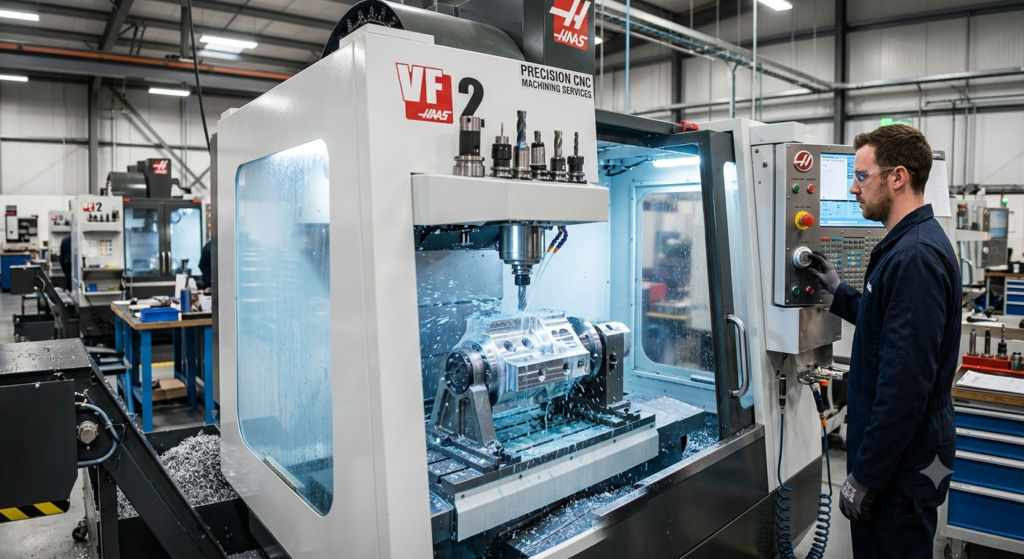
What Defines High-Precision CNC Machining Services?
Computer Numerical Control (CNC) machining uses pre-programmed software instructions to drive subtractive tools—end mills, drills, lathes, and grinders—across raw blocks of material (billets).
While standard machining handles wide tolerances, high-precision subtractive manufacturing operates in a tighter realm:
Achieving micron-level accuracy isn’t just a matter of buying a high-end machine. It requires controlling every variable in the machining cell:
- Spindle Runout: Even a few microns of eccentricity at 12,000 RPM will ruin hole concentricity and shorten tool life.
- Thermal Drift: Machine beds expand as motors warm up. Climate-controlled shop floors and real-time thermal probing compensate for those micro-inch movements.
- Workpiece Rigidity: If a thin-walled part flexes under cutting pressure, the dimensions slip as soon as the vise releases.
- Tool Path Strategy: Dynamic high-speed machining (HSM) keeps constant tool engagement, cutting heat down and preventing tool chatter.
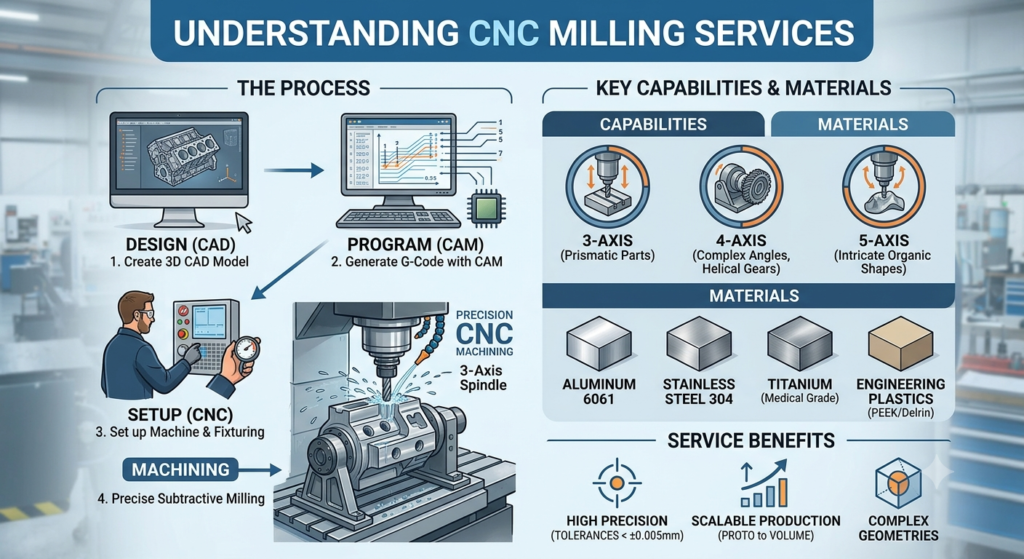
Exploring CNC Milling Services: 3-Asse, 4-Asse, and 5-Axis Capabilities(CNC milling services)
Among subtractive manufacturing techniques, CNC milling services offer the broadest versatility for complex geometry. Unlike CNC turning, where the workpiece rotates against a stationary cutting tool, milling holds the raw material stationary (or indexed) while rotary cutting tools remove material across multiple vectors.
3-Axis Milling
3-axis machines move the cutting tool along three linear axes: X (side-to-side), Y (in-and-out), and Z (up-and-down). This setup handles flat plates, simple brackets, enclosures, and shallow pockets efficiently. It remains the most cost-effective option when parts don’t require compound angles or deep undercuts.
4-Axis Milling
By adding a rotary axis (usually rotating around the X-axis, known as the A-axis), 4-axis mills allow the spindle to cut around the perimeter of a workpiece without manual repositioning. This works well for cylindrical features, off-center holes, and continuous helical cuts on shafts.
5-Axis Simultaneous Milling
5-axis machining adds two rotary axes, allowing the tool to approach the part from any direction. Simultaneous 5-axis movement lets the tool continuously adjust its angle relative to the surface.
Key advantages of 5-axis setups include:
- Single-Setup Machining: Cutting multi-sided parts in one fixture (often called “done in one”) eliminates stacking tolerance errors caused by manual flip-fixtures.
- Shorter Cutting Tools: Tool orientation tilts closer to the cut, allowing shorter, stiffer end mills that reduce vibration and improve surface finish ($Ra$).
- Complex Geometry: Curved impellers, turbine blades, and organic medical implants are practically impossible to produce accurately without continuous 5-axis paths.
Selezione dei materiali & Machinability(Precision CNC Machining Services)
The material you select directly dictates cutting speed, tool wear, and machine cycle time—all of which drive part cost.
Machinability Tip: Don’t over-specify high-strength alloys if standard materials satisfy your structural load requirements. A part cut from Stainless 304 can take twice as long to machine as the same design in Aluminum 6061-T6.
Metals
- Alluminio (6061-T6, 7075-T6): High strength-to-weight ratio, excellent machinability, and low cost. Ideal for prototypes, electronics enclosures, and structural aerospace components.
- Acciaio inossidabile (303, 304, 316L, 17-4 PH): Highly corrosion-resistant but prone to work-hardening. Requires rigid setups, lower cutting speeds, and consistent coolant application.
- Titanium (Ti-6Al-4V): Extremely strong and biocompatible, but low thermal conductivity traps heat at the cutting edge. Requires specialized tool coatings and high-pressure coolant feeds.
- Ottone & Rame (C360, C110): Exceptional electrical conductivity and low friction; cuts cleanly with minimal tool wear.
Engineering Plastics
- PEEK & POM (Delrin): Excellent dimensional stability, low moisture absorption, and high mechanical strength. Great for bushings, medical instruments, and insulating components.
- PTFE (Teflon) & Policarbonato: Require razor-sharp tooling and gentle clamping pressure to prevent material distortion during heavy roughing passes.
Progettazione per la producibilità (DFM) Rules
Optimizing your CAD model for precision subtractive workflows cuts cycle times and lowers production risks:
- Avoid Sharp Internal Corners: Rotary milling cutters always leave a radius equal to the tool’s radius. Design internal vertical corners with a radius slightly larger than standard tool sizes (per esempio., use a 0.135″ radius for a 0.250″ tool) so the cutter can sweep through smoothly without dwelling.
- Limit Deep, Narrow Cavities: Deep pockets require long-reach tools that suffer from chatter and bending. Keep depth-to-width ratios under 4:1 whenever possible.
- Be Mindful of Thin Walls: Metal walls thinner than 0.030″ (0.8 mm) or plastic walls below 0.060″ (1.5 mm) flex under cutting force, leading to chatter marks and dimensional variance.
- Standardize Thread Specs: Tap depth should rarely exceed 2x to 3x the nominal thread diameter. Going deeper adds minimal holding strength while drastically increasing the risk of broken taps.
Evaluating Quality Control in Precision Machine Shops
A reliable machining vendor does not rely solely on the machinist’s calipers at the end of a run. Quality assurance should be built into every step of the workflow:
- In-Process Probing: Spindle-mounted touch probes verify part orientation, zero-points, and key dimensions right on the machine bed before taking finishing passes.
- Coordinate Measuring Machines (CMM): Automated CMM inspections in climate-controlled quality labs measure complex geometric dimensioning and tolerancing (GD&T) features down to sub-micron accuracy.
- Traceability & Certificazioni: Look for vendors holding ISO 9001:2015 or AS9100D certifications, offering full material test reports (MTRs), heat treatment certifications, and inspection documentation.
By pairing clear DFM practices with experienced CNC milling services, engineering teams can turn complex concepts into repeatable, production-ready components—on schedule and within budget.