When you’re making things with high precision, choosing the right way to produce them affects how strong your product will be and how much money you make. For companies that build original equipment in aerospace, medical devices, and electronics, getting tiny parts with very exact measurements is absolutely essential. If you’re looking for these complex parts, you usually have two main choices: standard multi-axis turning or Lavorazione CNC svizzera.
Even though both ways involve cutting material from spinning bars, how they actually work is quite different. Knowing how Swiss precision machining makes production better can help people in charge of supply chains and buying parts. It can mean faster production, no need for extra steps, and getting parts that are extremely accurate.
How It Works: Bending and the Guide Bushing
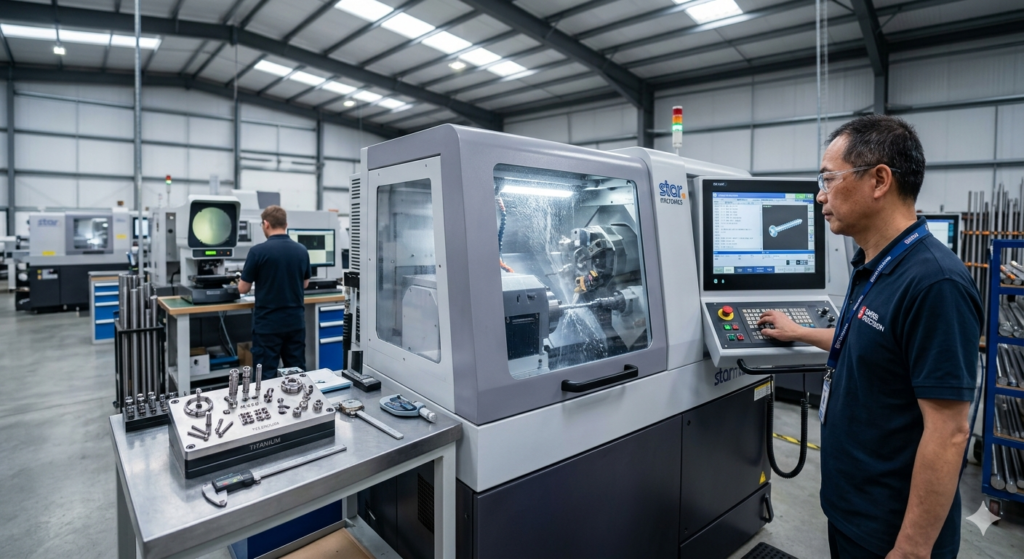
What really sets a Swiss CNC lathe apart is how its headstock slides and how it uses a guide bushing. On a regular CNC lathe, the bar of material is held tightly in a chuck or collet and just spins in one spot. The cutting tool then moves along the part that’s sticking out. If the part is long and skinny, the pressure from the cutting tool can make the material bend or flex – something called deflection.
Swiss precision machining gets rid of this problem entirely. Here’s how it does that:
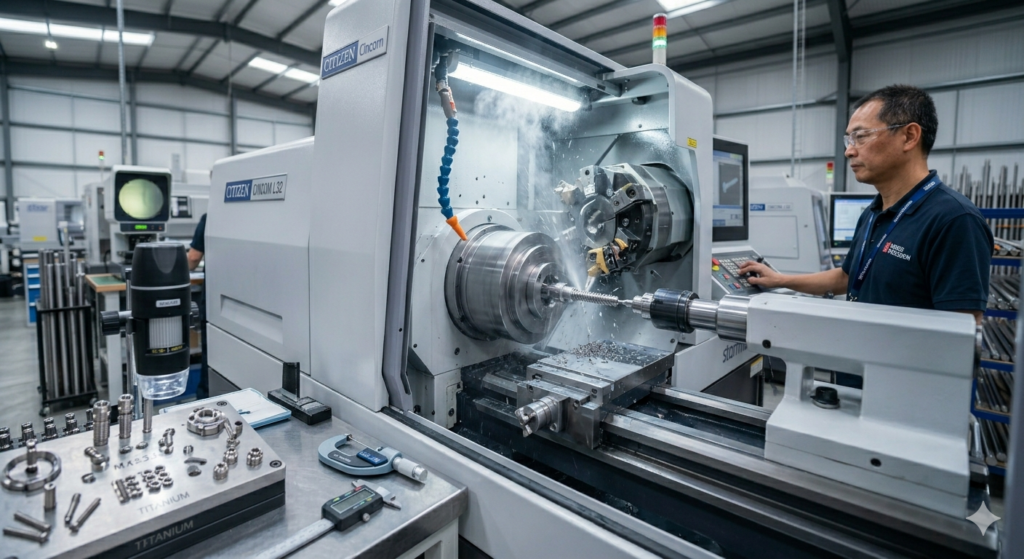
First, a collet in the headstock holds the raw bar, and this headstock slides along the Z-axis.
Then, the material goes through a very precise guide bushing, straight into where the tools work.
The cutting tools start working on the material just millimeters from where the guide bushing supports it.
Since the material is cut right as it leaves the bushing, the part being made experiences almost no bending at all. This design advantage means a Swiss CNC machine can easily make very long, thin parts – parts with a big difference between their length and diameter – that would be impossible to make on a regular machine.
Key Technical Specifications and Tolerances
When engineers evaluate manufacturing partners, specific tolerances dictate the feasibility of a project. Lavorazione CNC svizzera shines when dimensional accuracy must be maintained across thousands of cycles.
| Parameter | Traditional CNC Turning | Swiss CNC Machining Capabilities |
| Standard Dimensional Tolerance | $\pm 0.005\text{ mm}$ | $\pm 0.002\text{ mm}$ (or tighter) |
| Finitura superficiale ($Ra$) | $0.8 \text{ A } 1.6\ \mu\text{m}$ | Down to $0.2 \text{ A } 0.4\ \mu\text{m}$ |
| Max Length-to-Diameter Ratio | Typically $3:1$ A $5:1$ | Exceeds $20:1$ without support tailstocks |
| Micro-Machining Diameter | Down to $3.0\text{ mm}$ | Down to $0.1\text{ mm}$ |
Why B2B Buyers Choose Swiss Precision Machining
For purchasing departments looking to streamline their components supply chain, the operational benefits of Swiss turning extend far beyond basic dimensional accuracy.
1. Done-In-One Production
Modern Swiss CNC machining centers are equipped with live tooling, sub-spindles, and multi-axis configurations (often up to 7 A 10 axes). This means a single machine can perform turning, milling, cross-drilling, knurling, and thread-whirling simultaneously. Complex parts drop out of the machine fully finished, eliminating the need for secondary deburring, manual setups, or secondary milling operations. Fewer setups mean fewer opportunities for human error and a drastically reduced lead time.
2. Micro-Feature Capability
Medical implants (like bone screws and pacemaker components) and aerospace connectors require micro-machining. Features like deep blind holes, internal hexes, and microscopic threads can be executed reliably because the rigidity of the Swiss setup prevents tool chatter and premature tool wear.
3. Cost Efficiency for Volume Production
While the initial programming and setup time for a Swiss CNC machine can be more intensive than a standard lathe, the cycle time savings are massive. Once the bar feeder is loaded and the machine is optimized, it can run “lights-out” (unattended overnight production). The extreme repeatability reduces scrap rates to fractions of a percent, saving expensive raw materials like titanium, Inconel, surgical stainless steel, and medical-grade plastics.
Material Compatibility and Strategic Applications
Choosing the right substrate is critical to maximizing the benefits of Swiss manufacturing. The process is highly compatible with a broad spectrum of challenging materials:
- Exotic Alloys & Titanium: Grades 2 E 5 Titanium, Nitinol, and Inconel, widely utilized in surgical instruments, dental implants, and aerospace fasteners.
- Acciaio inossidabile: 303, 304, 316, and 440C, providing corrosion resistance and high strength for industrial valves and fluid control components.
- Engineering Plastics: PEEK, PTFE (Teflon), and Delrin, often machined for electrical insulators and biocompatible medical components.
Engineering Note: To get the most consistent tolerances from a Swiss lathe, it is highly recommended to source centerless-ground bar stock. Minor variations in raw material outer diameter can affect the fit within the guide bushing, impacting final part concentricity.
Conclusione: Partnering for Precision
Integrating Lavorazione CNC svizzera into your manufacturing strategy is more than just purchasing a service; it is a commitment to component longevity and assembly perfection. By leveraging the unique zero-deflection mechanics of the guide bushing, you ensure that your critical components meet strict regulatory standards and function flawlessly in high-stakes environments.
When auditing potential manufacturing partners, look closely at their quality management systems (such as ISO 9001 or AS9100 for aerospace) and ensure they have the exact multi-axis Swiss capabilities required to bring your complex geometries to life efficiently.