When sourcing high-end components for aerospace, медицинское оборудование, or advanced robotics, the phrase “precision machined metal parts“ is often the first thing on an engineer’s specification sheet. You calculate the tolerances, map out the CNC toolpaths, and select the high-grade alloys. But a flawless blueprint is only half the battle.
The raw truth of manufacturing is that even the most advanced multi-axis CNC machine leaves micro-burrs, tool marks, and surface tension. To transition a component from a machined blank to a high-performance industrial asset, precision metal finishing is not optional—it is the exact point where mechanical design meets real-world survival.
Understanding how these two disciplines intersect is what separates failing components from field-proven assemblies.
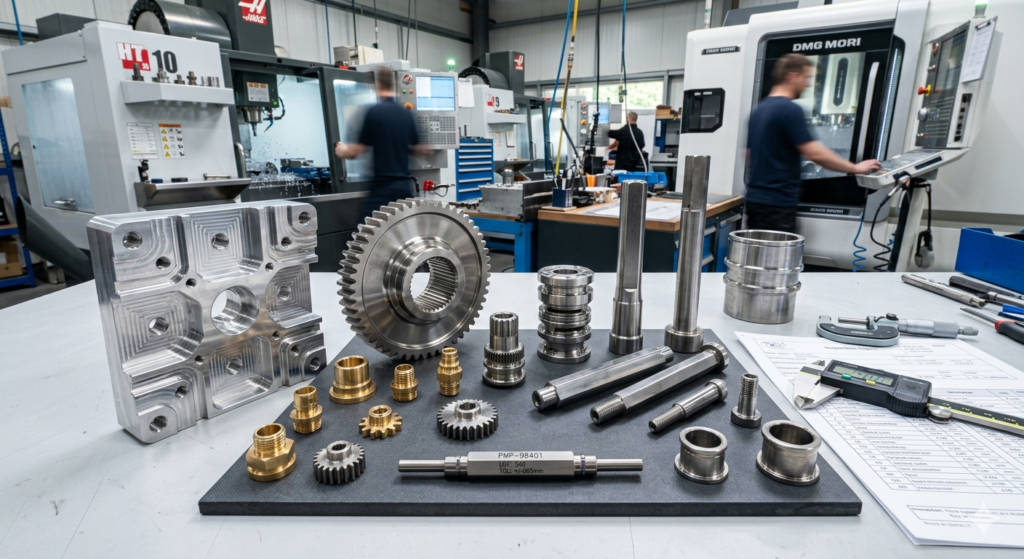
Why High-Tolerance Machining Requires Specialized Surface Finishing
A common misstep in product procurement is treating machining and finishing as isolated production steps. They are, in reality, two sides of the same coin. When you mandate tolerances measured in microns, the subsequent surface treatment drastically alters the final dimensions.
The Dimensional Impact of Finishing Processes
Every post-machining treatment either removes material or adds a layer to the substrate. Failing to calculate this variance during the initial programming of precision machined metal parts leads to assembly failures:
- Anodizing (Type II & Type III): Widely used for aluminum parts, Type III hardcoat anodizing builds up a heavy oxide layer that penetrates the metal and builds on top of the surface. If your machine shop doesn’t offset the thread pitches or bore diameters, the finished parts will not fit.
- Electroless Nickel Plating: This method deposits a completely uniform layer of nickel-phosphorus alloy across complex geometries. It is highly predictable, making it a favorite for intricate internal cavities, but still requires a precise calculus before the cutting tool ever touches the raw billet.
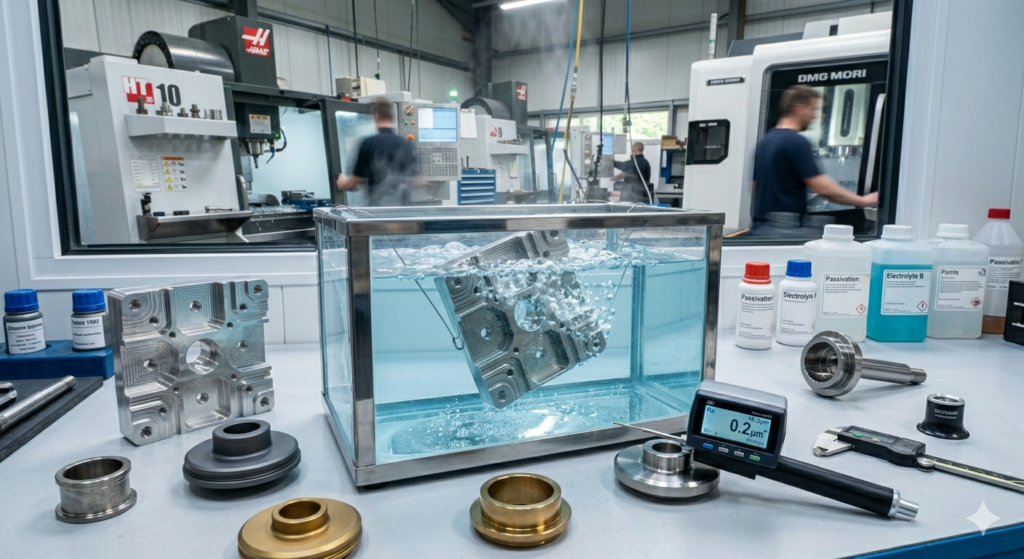
- Chemical Passivation: Unlike plating, passivation uses nitric or citric acid to strip free iron from the surface of stainless steel without altering the dimensions. It doesn’t add thickness, but it completely transforms the chemical resistance of the outer layer.
Navigating the Spectrum of Precision Metal Finishing Operations
Choosing the right precision metal finishing technique depends entirely on the operational environment of your end product. Are you fighting friction, corrosive chemicals, electrical conductivity, or cosmetic imperfections?
1. Electropolishing: The Gold Standard for Ultra-Clean Demands
Often described as electrochemical machining in reverse, electropolishing removes a microscopic layer of material from the surface of stainless steel, медь, or titanium.
- How it works: By immersing the machined parts in an electrolytic bath with an electrical current, the process preferentially dissolves high points on the surface.
- The Result: A mirror-like, ultra-smooth finish that minimizes microscopic crevices where bacteria or contaminants can hide. This is the baseline standard for medical implants and semiconductor manufacturing hardware.
2. Micro-Blasting and Controlled Shot Peening
When your components face high-cycle fatigue—such as turbine blades or automotive transmission gears—the surface needs to be reinforced against mechanical stress. Shot peening bombards the surface with spherical media, creating compressive residual stress layers. This prevents microscopic cracks from propagating under intense mechanical loads.
3. Advanced Anodizing for Ruggedized Defense and Aerospace
For defense hardware, aluminum parts must survive salt spray tests and extreme thermal cycling. Hardcoat anodizing changes the molecular structure of the aluminum exterior into an aluminum oxide ceramic shield. It provides exceptional wear resistance and dielectric properties, transforming lightweight aluminum into a component capable of enduring harsh marine and aerospace environments.
Optimizing the Supply Chain: The Single-Source Advantage
Subcontracting your manufacturing to one vendor for CNC milling and another for precision metal finishing is a logistical nightmare that frequently compromises quality control.
Industry Insight: When the machining team and the finishing team do not communicate, the blame game begins the moment a batch of parts fails inspection. The finisher blames the machinist for poor surface roughness ($Ra$), and the machinist blames the finisher for over-plating.
Partnering with an integrated manufacturer who manages both the production of your precision machined metal parts and the technical finishing execution offers major advantages:
- Unified Tolerance Management: The CNC programmers write their code with the exact plating thickness already accounted for. If a hardcoat adds 50 microns to a diameter, the lathe operators turn the raw part 50 microns undersize.
- Streamlined Quality Inspection: Parts are inspected under one Quality Management System (QMS). Any surface defects caused by dull cutting tools are caught before the chemical treatment stage, saving thousands of dollars in wasted materials and hours of unrecoverable lead time.
- Elimination of Inter-Stage Oxidation: Raw machined metals, especially copper and carbon steel, begin to oxidize the moment they leave the coolant tank. An in-house finishing line ensures that parts move from machining to passivation or plating before atmospheric moisture can degrade the pristine metal surface.
Engineering Checklist for Flawless Post-Machining Results
To ensure your next production run yields flawless components without costly rework or unexpected delays, run through these critical engineering parameters during the design phase:
| Critical Factor | Evaluation Criteria | Recommended Action |
| Edge Break & Burrs | Are microscopic burrs acceptable prior to plating? | Specify deburring methods (vibratory tumbling, thermal deburring) on the primary blueprint. |
| Surface Roughness ($Ra$) | Will the selected finishing process smooth out deep tool marks? | Most plating methods mirror the underlying surface. If you need a smooth finish, ensure the machining spec dictates a low $Ra$ value. |
| Masking Requirements | Do critical ground connections or high-tolerance bores need to stay unplated? | Provide explicit masking schematics detailing exactly where chemical coatings must be kept away. |
| Hydrogen Embrittlement | Are you plating high-strength steels that are susceptible to hydrogen cracking? | Mandate a post-plating baking cycle to release trapped hydrogen gas before the parts are subjected to load. |
Elevating Performance Through Integrated Manufacturing
В конце дня, industrial components are judged by their reliability in the field. High-quality precision machined metal parts only achieve their maximum lifecycle, corrosion resistance, and operational efficiency when paired with an identically precise, well-engineered precision metal finishing strategy.
By aligning your mechanical designs with the chemical and physical realities of surface treatments from day one, you eliminate structural vulnerabilities, secure predictable assembly fits, and deliver a superior end-market product that withstands the toughest operational stress.