When it comes to sourcing custom metal components, manufacturing buyers and product engineers face the same recurring headache: how to balance intricate geometry with tight tolerances, without blowing the budget on secondary finishing operations.
For high-precision industries, the answer increasingly points to one specific synergy: 5-axis CNC machining services paired with high-quality brass CNC parts.
While standard 3-axis milling can handle basic brackets and blocks, it hits a hard wall when confronted with complex, multi-sided components. By unlocking the power of simultaneous multi-axis movement, advanced machine shops are rewriting the rules of what is possible with brass fabrication. Here is a deep dive into why this manufacturing combination is dominating global supply chains, and how it can optimize your next production run.
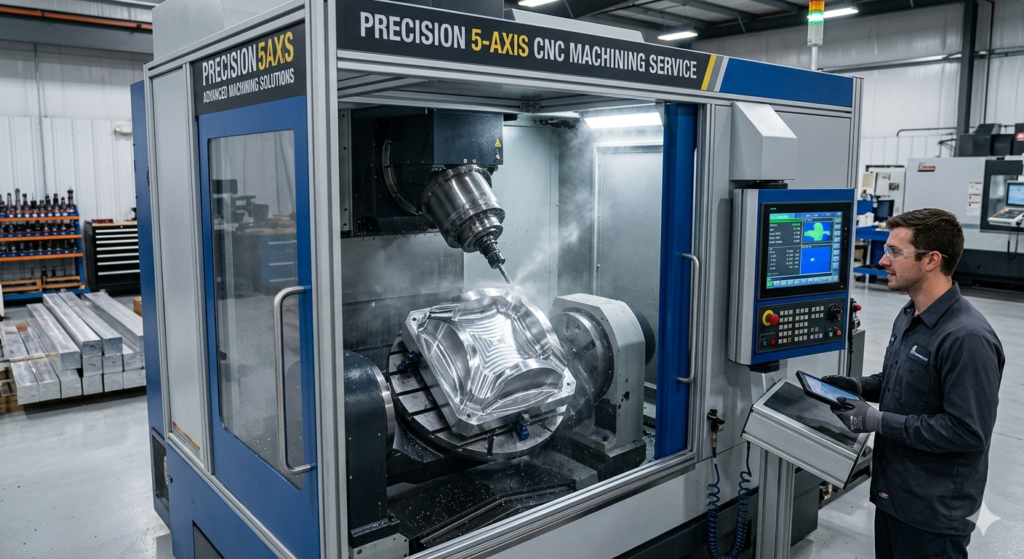
The Evolution of Precision: Understanding 5-Axis CNC Machining Services
To appreciate the value of advanced machining, it helps to look at how traditional setups handle complex parts. In a standard 3-axis system, the cutting tool moves along the linear $X$, $Y$, and $Z$ axes. If a part requires machining on multiple faces, the operator must manually stop the machine, re-fixture the workpiece, and recalibrate the coordinates.
Every single manual flip introduces a margin of error. A deviation of just a few microns during re-fixturing can ruin a high-tolerance run for aerospace or medical applications.
5-axis CNC machining services eliminate this vulnerability entirely. By adding two rotational axes (usually the $A$ and $B$ axes), the cutting tool or the workpiece can approach the part from virtually any angle.
- Single-Setup Operations: The raw stock is clamped once, and the machine cuts intricate features on five sides simultaneously.
- Extremely Tight Tolerances: Eliminating manual repositioning keeps the coordinate system perfectly intact, achieving geometric tolerances that are impossible with multi-step setups.
- Superior Surface Finishes: Because the tool can maintain an optimal cutting angle relative to the material, tool chatter is minimized, leaving a pristine finish straight out of the machine.
Why Choose Brass for Custom CNC Components?
While 5-axis machines can cut everything from titanium to engineering plastics, brass CNC parts represent a unique sweet spot for high-performance engineering. Brass—an alloy primarily composed of copper and zinc—is prized for its structural integrity, aesthetic appeal, and exceptional machinability.
1. Unmatched Machinability Rating
Brass is famously forgiving on cutting tools. It creates clean chips rather than long, stringy ribbons, which prevents tool clogging and reduces wear on expensive carbide cutters. This high machinability index means CNC machines can run at faster spindle speeds and higher feed rates, driving down cycle times and lowering per-part costs for buyers.
2. Corrosion Resistance and Electrical Conductivity
Unlike ferrous metals, brass does not rust when exposed to moisture or harsh marine environments. It also boasts excellent thermal and electrical conductivity, making it the default choice for heavy-duty electrical connectors, terminal blocks, fluid control valves, and plumbing manifolds.
3. Natural Low Friction
Brass is inherently self-lubricating. For moving mechanical assemblies—such as gears, bearings, lock cylinders, and bushings—using brass parts reduces friction and wear, significantly extending the operational lifespan of the final product.
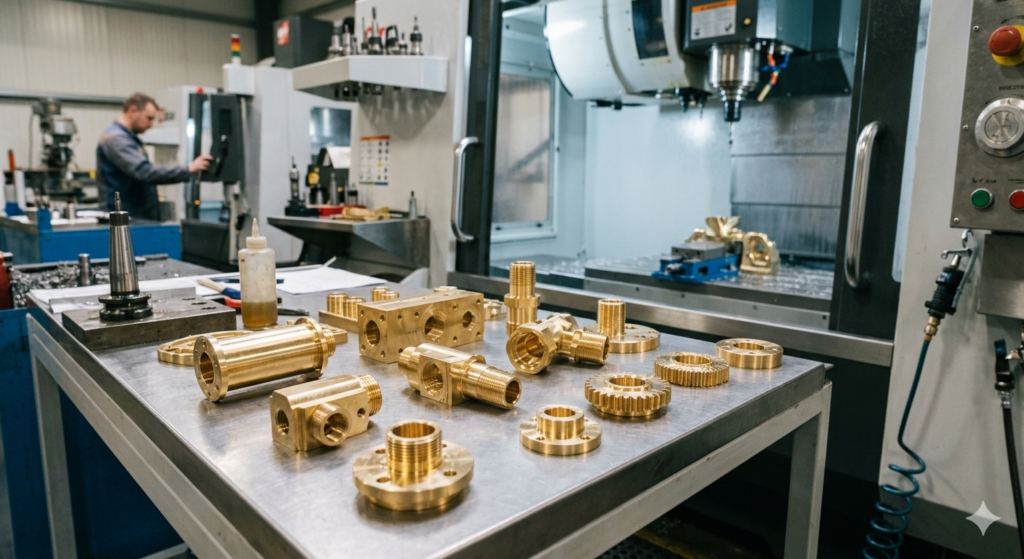
The Strategic Advantages of 5-Axis CNC Machining for Brass Parts
When you combine the multi-angle capabilities of 5-axis milling with the material benefits of brass, you get a production process optimized for complex, high-volume, or ultra-precise industrial applications.
| Feature / Benefit | 3-Axis Machining + Manual Labor | 5-Axis Simultaneous Machining |
| Setup Frequency | Multiple setups required per part | Single setup for comprehensive cutting |
| Tolerance Integrity | Moderate ($\pm 0.05 \text{ mm}$ due to stacking errors) | Ultra-tight ($\pm 0.005 \text{ mm}$ consistent) |
| Complex Geometries | Limited; requires specialized jigs | Unlimited; handles deep pockets & contours |
| Cycle Times | High (due to manual intervention) | Low (continuous automated cutting) |
Deep Cavities and Intricate Undercuts
Many industrial valves, fluid meters, and aerospace connectors feature deep internal cavities, curved paths, or complex undercuts. On a traditional mill, these require custom-made specialized tooling or multiple setups. A 5-axis machine can tilt the workpiece or the spindle head to allow shorter, more rigid cutting tools to reach deep into pockets without deflection, ensuring clean, sharp internal corners.
Perfect Surface Geometry for Seals
For brass parts used in hydraulic or pneumatic systems, surface finish is everything. A minor tool mark can cause a fluid leak under high pressure. Because 5-axis machining maintains a constant chip load and optimal tool-to-part contact, it delivers highly uniform surfaces that seal perfectly without requiring secondary hand-polishing or grinding.
Technical Considerations for Sourcing Professionals
If you are drafting RFQs or finalizing blueprints for custom brass components, keeping a few practical design-for-manufacturability (ДФМ) tips in mind can save thousands of dollars:
- Specify the Right Brass Grade: Free-cutting brass (C36000) is ideal for high-speed automated production due to its lead content, which maximizes machinability. For applications requiring lead-free compliance (like drinking water components), specify Eco-Brass or C69300.
- Minimize Sharp Internal Corners: While 5-axis machines are incredibly agile, they still use rotating round tools. Designing parts with reasonable corner radii allows tools to transition smoothly through pockets without slowing down.
- Leverage Tapping and Threading: Brass is excellent for holding clean, strong threads. Utilizing 5-axis setups allows for multi-angle tapped holes to be executed in sequence, ensuring perfect alignment across the entire component geometry.
Partnering with the Right CNC Shop
Investing in high-end 5-axis machining centers requires massive capital, deep technical expertise, and rigorous quality management systems. When vetting an overseas manufacturing partner for your brass components, look beyond the price per piece. Ensure they utilize robust coordinate measuring machines (CMM) for quality control, offer comprehensive material certifications, and understand the nuances of exporting to global markets.
By moving your complex brass designs from traditional multi-step manufacturing to an integrated 5-axis workflow, you eliminate human error, slash lead times, and secure components that fit perfectly into your assembly lines every single time.