In the fast-paced world of modern manufacturing, sourcing the right fabrication methods isn’t just about getting a job done—it’s about achieving absolute perfection. Whether you are developing aerospace components, medical devices, or intricate automotive parts, the dual powerhouse of CNC turning services и precision laser cutting represents the pinnacle of modern production capability.
When these two distinct manufacturing powerhouses converge, they unlock unprecedented efficiency, cost-effectiveness, and design flexibility. Let’s dive deep into how leveraging CNC turning and advanced laser fabrication can elevate your next project from a rough concept to a high-tolerance masterpiece.
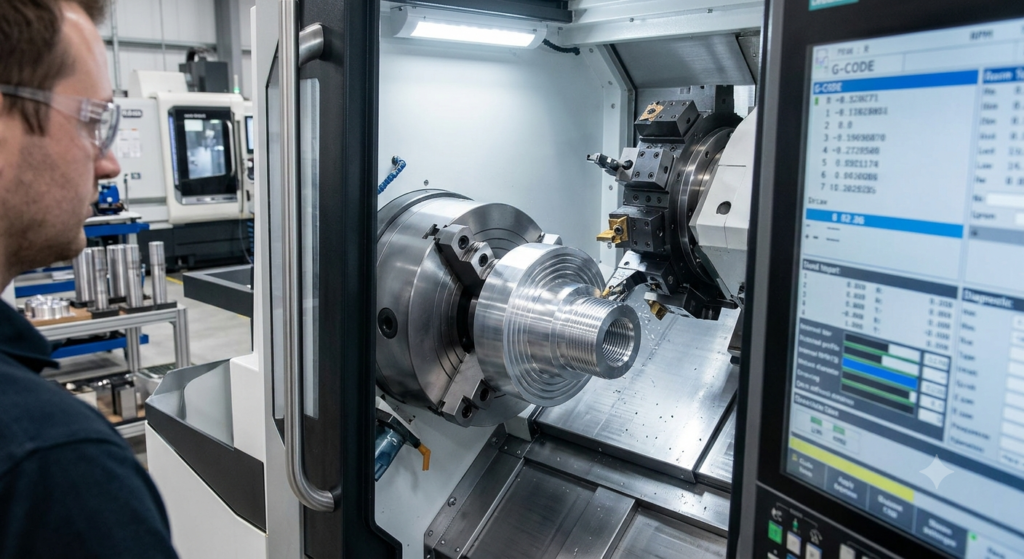
Understanding CNC Turning Services: The Art of Rotational Precision
At its core, a CNC turning service is the go-to solution for creating cylindrical components with exceptional accuracy. Unlike CNC milling, where the cutting tool rotates, CNC turning rotates the workpiece itself at high speeds while a stationary cutting tool meticulously removes material.
The Mechanics of the Lathe
Modern CNC lathes and turning centers are guided by precise computer code (G-code). This automation ensures that whether you are producing a single custom prototype or a high-volume run of 10,000 units, the 1st piece and the 10,000th piece are identical down to the micron.
Why Engineers Rely on CNC Turning:
- Rotational Symmetry: It is the absolute best method for producing shafts, nozzles, couplings, and custom fasteners.
- Superior Surface Finishes: The continuous contact of the turning tool yields incredibly smooth finishes, often eliminating the need for secondary polishing.
- Material Versatility: From tough titanium and aerospace-grade aluminum to specialized engineering plastics like PEEK and Delrin, CNC turning handles them all seamlessly.
Precision Laser Cutting: Redefining Flat-Sheet Fabrication
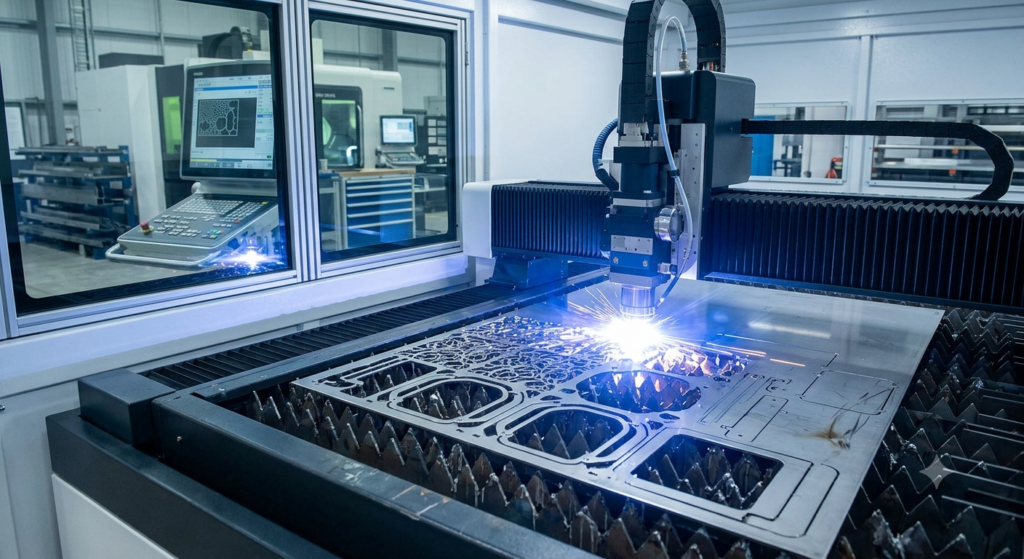
If turning owns the realm of the round, precision laser cutting dominates the world of flat profiles and complex geometries. Utilizing high-powered fiber or $CO_2$ lasers, this technology directs a focused beam of light to melt, burn, or vaporize material, leaving behind incredibly clean, burr-free edges.
The Power of the Beam
What sets precision laser cutting apart from traditional stamping or shearing is its non-contact nature. Because no physical force is applied to the workpiece, there is zero risk of material distortion or warping.
Key Benefits of Precision Laser Fabrication:
- Intricate Geometries: Lasers can cut complex patterns, sharp angles, and micro-holes that mechanical routing tools simply cannot reach.
- Minimal Heat-Affected Zone (HAZ): Advanced laser optics confine the heat to a localized area, preserving the structural integrity of the surrounding metal.
- Speed and Efficiency: With cutting speeds that outpace traditional tooling, laser cutting slashes lead times and minimizes material waste through smart nesting software.
The Perfect Pair: How Turning and Laser Cutting Complement Each Other
While many product designers view these technologies as mutually exclusive, forward-thinking manufacturers know that combining them yields superior results. Rare is the complex assembly that consists only of turned parts or only of flat sheet metal.
Imagine a high-pressure fluid manifold. The internal valves and core fittings require the sub-micron tolerances of a CNC turning service. Meanwhile, the outer mounting brackets, enclosures, and detailed faceplates are perfectly suited for precision laser cutting. By integrating both capabilities under one manufacturing strategy, you streamline your supply chain, reduce shipping overhead, and ensure that mating parts fit together perfectly every single time.
| Feature / Metric | CNC Turning Service | Precision Laser Cutting |
| Primary Geometry | Cylindrical, round, rotational | Flat sheets, structural tubes, profiles |
| Material Thickness | Best for solid bars or thick-walled tubes | Best for thin to medium gauges (up to 25mm+) |
| Tool Wear | High (physical cutting inserts require swapping) | None (non-contact light beam technology) |
| Setup Times | Moderate (requires chuck and fixture adjustments) | Ultra-fast (purely digital file uploads) |
Overcoming Design Challenges with Hybrid Fabrication
When you design with both manufacturing methods in mind, you inherently design for manufacturability (ДФМ). For instance, instead of trying to machine a complex flange out of a massive, expensive solid block of aluminum using standard milling or turning, you can turn the cylindrical hub and laser-cut the outer flange profile from sheet metal.
Welding or fastening these two components together afterward often cuts production costs by over 40% and slashes raw material waste significantly.
Pro Tip for Engineers: Always communicate your final assembly tolerances to your manufacturing partner early. A professional workshop can optimize the programming of both the CNC lathe and the laser cutter to account for material variances, ensuring seamless post-fabrication assembly.
Driving Success with Your Next Manufacturing Project
In today’s competitive market, efficiency dictates profitability. Relying on outdated manual fabrication methods or fragmented supply chains will only lead to delayed product launches and budget overruns.
By partnering with a manufacturer that bridges the gap between state-of-the-art CNC turning services and ultra-accurate precision laser cutting, you unlock a seamless path from CAD design to final product. Look for partners who invest in multi-axis CNC turning centers and high-wattage fiber lasers, as these technologies offer the best blend of speed, repeatable quality, and competitive pricing.
Ready to optimize your component design and scale your production? Reach out to our engineering team today to upload your step files and receive a comprehensive, DFM-optimized quote for your next machining project.