 Пређи на садржај
 Diode precision machining and custom OEM assembly services form the backbone of modern power electronics, optical telecommunications, and defense-grade micro-optoelectronics. As semiconductor chips get smaller and power densities increase, standard off-the-shelf enclosures and generic assembly lines fail. Achieving thermal dissipation, electrical isolation, and sub-micron positioning requires specialized ultra-precision micro-machining paired with tailored original equipment manufacturer (OEM) contract assembly.
In this deep dive, we explore how combining advanced CNC micro-machining with dedicated custom OEM assembly services transforms raw diode components into high-performance, field-ready optoelectronic and power modules.
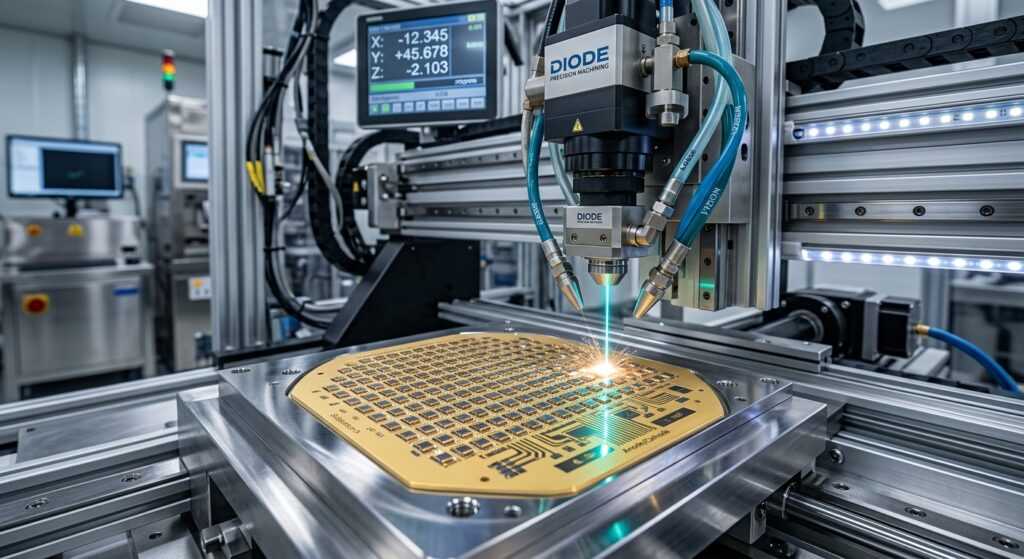
The Role of Precision Machining in Diode Manufacturing
Laser diodes, photodiode arrays, and high-power rectifiers require exacting housing and heatsink environments. Standard tolerances simply won’t cut it when dealing with heat fluxes that rival the surface of the sun. Precision CNC milling, micro-turning, and electrical discharge machining (EDM) are critical for crafting diode submounts, headers, and packages.
- Sub-Micron Tolerances: Laser diodes often require mounting surface flatnesses within 0.5 microns to ensure complete surface contact with copper or tungsten-copper heatsinks, preventing catastrophic optical damage (COD).
- Thermal Management Materials: Machining specialized thermal substrates like Copper-Tungsten ($CuW$), Molybdenum-Copper ($MoCu$), and Aluminum Nitride ($AlN$) requires specialized diamond tooling and high-speed spindles.
- Complex Geometries: Micro-channels for direct-liquid cooling, internal optical alignment registers, and precise pin-hole passages must be machined without burrs or residual stresses that could deform under thermal cycling.
Why Custom OEM Assembly Services Are Essential
Manufacturing a flawless micro-machined header or heatsink is only half the battle. Integrating tiny, fragile diode die onto those machined substrates demands specialized equipment, cleanroom environments, and highly trained technicians. That’s where a custom OEM assembly service comes in.
Instead of managing separate suppliers for machining, платинг, die-attach, wire bonding, and hermetic sealing, partnering with an integrated OEM partner streamlines the production pipeline.
Core Capabilities of a Custom OEM Assembly Service:
- Die-Attach & Soldering: Utilizing automated high-precision pick-and-place equipment to perform eutectic ($AuSn$) or epoxy die-attach with micron-level placement accuracy.
- Fine Wire Bonding: Performing ultrasonic or thermosonic wedge and ball bonding using gold or aluminum wire ($0.7$ mil to $20$ mil thick) to handle signal logic or high current.
- Hermetic Packaging: Sealing housings under inert gas coverage (Argon/Nitrogen) using resistance welding or laser welding to isolate delicate diodes from atmospheric moisture.
- Optical Alignment: For laser diodes, active alignment attaches lenses and fiber pigtails directly to the machined housing to maximize optical coupling efficiency.

Bridging Machining and Assembly for Peak Performance(Diode precision machining)
The real magic happens at the intersection of precision machining and contract assembly. When the team cutting the metal works alongside the engineers assembling the components, joint optimization becomes second nature.
Eliminating Thermal Barriers
A minor burr or slightly convex footprint on a machined heat spreader creates micro-air gaps beneath the diode die. Under high power, these voids cause localized hotspots and rapid diode burn-out. An integrated manufacturing workflow ensures that machined surfaces are measured with white-light interferometry before entering the assembly line for die bonding.
Custom Plating and Surface Preparation
Precision machined diode packages must undergo specialized surface treatments—such as electroless nickel-gold plating ($ENIG$) or direct Au-plating—to ensure optimal solder wetting during assembly. By keeping machining and OEM assembly under one roof, plating specifications are customized directly for the specific die-attach temperature profiles used down the line.
Key Applications Driving Demand
Industries demanding extreme durability and tiny footprints drive the need for custom OEM diode modules:
- Medical Laser Systems: Surgical and aesthetic lasers require custom-machined sub-mounts to manage intense pulse heat, coupled with strict cleanroom assembly to satisfy ISO 13485 standards.
- Defense & Aerospace: Diode-pumped solid-state (DPSS) lasers used in rangefinding and target designation need ruggedized, hermetically sealed assemblies that survive high shock and vibration.
- Telecommunications: High-speed optical transceivers rely on sub-micron diode placement to maintain data throughput across dense wavelength-division multiplexing (DWDM) networks.
- Industrial Material Processing: High-power diode lasers used for metal cutting and additive manufacturing depend on direct-liquid-cooled machined copper mounts to run continuous multi-kilowatt outputs.
How to Select the Right OEM Partner
When outsourcing your diode precision machining and custom OEM assembly requirements, look for a partner with the following cross-disciplinary capabilities:
- In-House Metrology: Look for CMMs, non-contact optical profiling, and laser scanning capabilities capable of verifying micron-level features on both raw metal parts and finished electronic packages.
- Class 10,000 / ИСО 7 Cleanrooms: Essential for preventing airborne particles from contaminating optical facets or wire bonds during the assembly process.
- Design for Manufacturability (ДФМ) Подршка: Engineering teams that review your diode housing designs early can suggest minor machining tweaks that dramatically lower yield loss during die-attach and testing.
- Turnkey Traceability: Full component batch tracking, thermal resistance testing, and burn-in screening to ensure every outgoing unit meets strict reliability standards.
Scaling Your Diode Assembly Workflow
Combining high-precision machining with custom OEM assembly provides a scalable path from prototype to volume production. By eliminating multi-vendor handoffs, engineering teams minimize turnaround times, cut down on scrap rates, and maintain control over critical thermal and electrical tolerances.
Whether you are scaling high-power industrial laser modules or designing micro-optoelectronic packages, leveraging integrated machining and custom contract manufacturing ensures your products perform reliably when put to the test.