 Skip to content
5-axis CNC machining has fundamentally transformed how modern engineers approach the manufacturing of complex mechanical components. In industries where tolerances are tight, geometries are intricate, and room for error is virtually zero, traditional 3-axis or 4-axis milling often falls short. Whether you are developing advanced robotics, aerospace hardware, or specialized automation equipment, understanding the capabilities of 5-axis technology can mean the difference between a successful product launch and costly redesign delays.
The Limitations of Traditional 3-Axis Milling
For decades, standard 3-axis CNC machines served as the backbone of the machining industry. These machines move cutting tools across the X, Y, and Z linear axes. While highly effective for flat plates, pockets, and basic prismatic blocks, they encounter severe bottlenecks when confronted with modern engineering demands.
When manufacturing parts with deep undercuts, compound angles, or multi-sided features, a 3-axis machine requires multiple manual setups. Every time a technician unclamps and reorients a workpiece in a vise, microscopic alignment errors accumulate. These cumulative tolerances can quickly ruin a high-precision component. Furthermore, reaching deep cavities with standard tooling requires long, slender endmills that vibrate, chatter, and degrade surface finish.
How 5-Axis Machining Solves Complex Geometry Challenges
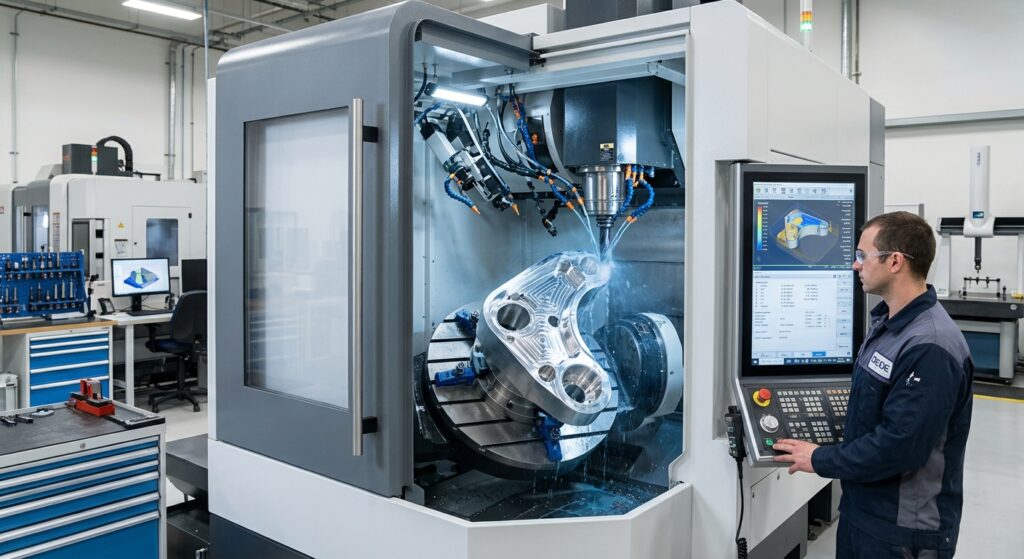
Unlike their 3-axis predecessors, 5-axis CNC systems introduce two rotational axes alongside the three linear axes—typically tilting and rotating the table (or the spindle head). This configuration allows the cutting tool to approach the workpiece from virtually any direction in a single setup.
1. Single-Setup Accuracy
By completing a complex part in one fixture placement, 5-axis machining eliminates the human error inherent in multiple repositionings. Positional accuracy remains razor-sharp, ensuring tight geometric tolerances ($\pm0.01\text{ mm}$ or finer) across complex contours.
2. Superior Surface Finishes and Shorter Tools
Because the machine can tilt the part or the tool toward the cutting surface, engineers can use shorter, more rigid cutting tools. Shorter tools reduce chatter, allow higher feed rates, and produce mirror-like surface finishes on free-form turbine blades, impellers, and medical implants.
3. Minimized Lead Times
Fewer setups translate directly into reduced cycle times. Components that once required days of intricate manual handling and fixture adjustments can now be machined continuously from raw stock to final inspection-ready status.
Core Applications in Modern Industries
The ability to machine complex contours in a single operation has unlocked unprecedented design freedom across multiple sectors:
- Aerospace & Defense: Structural brackets, engine housings, and aerodynamic control surfaces requiring lightweighting and high strength-to-weight ratios.
- Industrial Robotics: Custom robotic arms, intricate end-effectors, and gearbox housings that demand absolute coaxial precision.
- Advanced Electronics & Optics: Specialized heat sinks and camera mounts featuring complex cooling channels and light-baffling geometries.
Best Practices for DFM (Design for Manufacturing)
To extract maximum value from a 5-axis CNC machining partner, collaboration between design engineers and machinists must happen early in the prototyping phase. Here are a few practical strategies to optimize your complex mechanical components:
- Leverage Undercuts Wisely: Use the continuous rotational freedom of 5-axis systems to integrate internal features that would otherwise require multi-part assemblies fastened together.
- Optimize Fillet Radii: Avoid sharp internal 90-degree corners. Giving your machinists a slight corner radius allows for larger, more robust ball-nose endmills that cut faster and wear slower.
- Material Considerations: Whether you are cutting aerospace-grade aluminum, stainless steel, or engineering plastics like PEEK, discuss chip evacuation and thermal expansion with your supplier before locking in CAD models.
Conclusion: Partnering for Success
As product designs grow increasingly sophisticated, relying on outdated manufacturing methods can stall your time-to-market. Embracing advanced machining strategies empowers engineering teams to push boundaries without sacrificing manufacturability.
When your next project demands uncompromising precision, choosing an experienced manufacturer equipped with state-of-the-art multi-axis technology and rigorous ISO-certified quality control ensures your designs go from digital CAD models to flawless physical reality efficiently and reliably.