 Skip to content
 When sourcing custom CNC machining China, product designers and procurement managers usually focus on tight tolerances, spindle speeds, and unit costs. That makes sense—holding a ±0.005mm tolerance on a complex 5-axis aerospace manifold is serious engineering work. But talk to any veteran hardware engineer who has brought a physical product to market, and they will tell you the exact same thing: a part is only half-done when it leaves the mill.
Without specialized surface finishing services, even perfectly cut aluminum, titanium, or stainless steel components stay vulnerable to corrosion, surface wear, tool chatter marks, and environmental degradation. The real trick to getting production-ready hardware lies in seamlessly combining high-precision cutting with the right post-processing treatment.
Here is an inside look at how modern hardware teams navigate the Chinese manufacturing ecosystem to take raw CAD files, transform them into precision components, and deliver market-ready hardware on tight schedules.
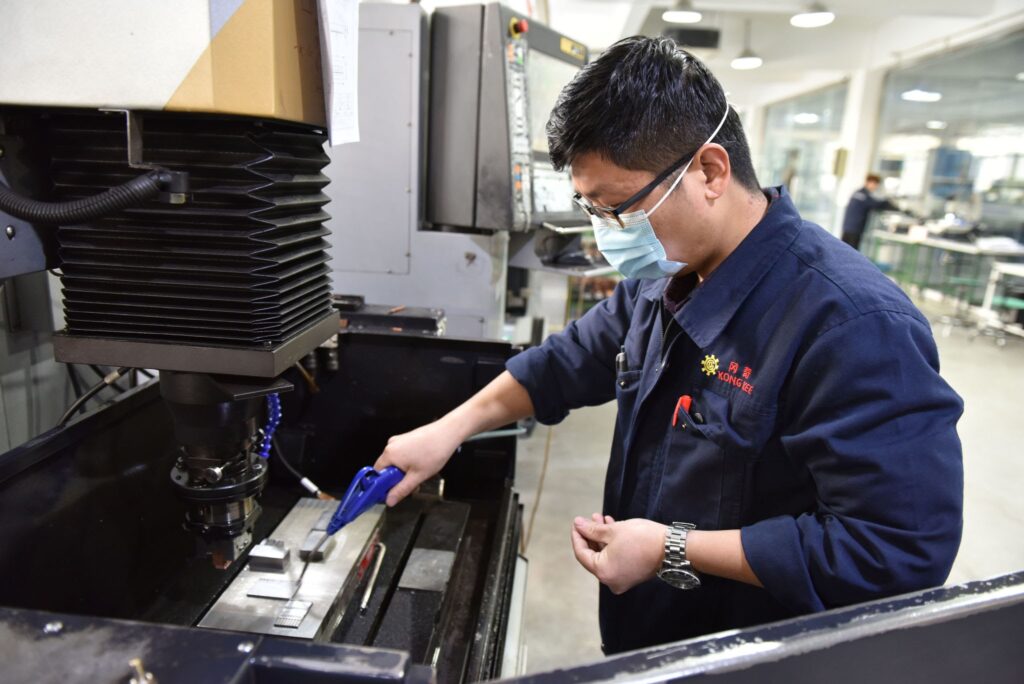
Beyond the Spindle: Why Modern Custom CNC Machining China Is Evolving
For decades, foreign buyers looked to Chinese machine shops primarily for low unit prices on simple turned parts. That model is ancient history. Today, top-tier facilities across manufacturing hubs like Shenzhen, Dongguan, and Suzhou house state-of-the-art 5-axis mill-turn centers, automated robotic loaders, and coordinate measuring machines (CMM) calibrated to ISO standards.
What really sets top-tier custom CNC machining China apart now is speed and integrated supply chain agility. A prototype that might take four to six weeks to clear a domestic backlog in North America or Europe can often be programmed, cut, inspected, and shipped from a specialized Chinese shop in five to seven business days.
However, raw machining capability is only step one. Machine tools leave tool paths. End mills leave tiny ridges. Raw metals react with oxygen, absorb oils, and scratch easily. If your component serves in a high-wear environment, an outdoor application, or a consumer-facing product where cosmetics matter, the raw surface won’t cut it. That’s where surface engineering takes over.
The Critical Role of Surface Finishing Services in Metal Fabrication
Surface finishing isn’t just cosmetic icing on the cake—it’s a core engineering requirement that directly impacts part longevity, mechanical fit, and electrical conductivity. Choosing the right post-processing method depends heavily on substrate material, functional environment, and visual targets.
Below are the primary surface finishing services specifying engineers use when completing CNC machined parts:
1. Anodizing (Type II Architectural & Type III Hardcoat)
Anodizing is the go-to finish for aluminum parts (such as 6061-T6 or 7075). Through an electrochemical bath, the metal surface transforms into a durable, corrosion-resistant aluminum oxide layer.
- Type II Anodizing: Offers clear or vibrant color options (black, red, blue, gold) with a protective layer thickness usually between 5 to 25 microns. Ideal for consumer electronics, brackets, and visual enclosures.
- Type III (Hardcoat) Anodizing: Creates a much thicker layer (25 to 50+ microns) that penetrates deep into the metal. It delivers exceptional abrasion resistance and electrical insulation, widely specified for military, automotive, and industrial wear plates.
2. Media Blasting & Mechanical Polishing
Before anodizing or painting, raw parts often exhibit micro-burrs and machining lines.
- Bead Blasting: Uses microscopic glass beads or ceramic media driven by compressed air to create a uniform, matte texture. It effectively erases tool paths and gives aluminum a clean, satin feel.
- Mirror Polishing: Uses progressively finer abrasive compounds and buffing wheels to bring stainless steel, brass, or aluminum to a high-luster, reflective shine—essential for medical instruments and luxury hardware.
3. Powder Coating and E-Coating
When raw metal needs heavy-duty defense against harsh weather, chemicals, or impact, fluid media coatings win out.
- Powder Coating: Electrostatically applies dry polymer powder, which is then cured under heat to form a thick, durable skin. It resists chipping far better than traditional liquid paint.
- Electrophoretic Deposition (E-Coating): Submerges parts in an electrically charged paint bath. Because the current reaches every nook and cranny, e-coating guarantees uniform coverage, making it a favorite for automotive chassis components.
4. Chemical Passivation & Metal Plating
For steel and specialized alloys, plating adds functional surface characteristics.
- Passivation: A citric or nitric acid bath removes free iron from the surface of stainless steel, forming a passive chromium oxide layer that prevents rust without changing part dimensions.
- Electroless Nickel Plating: Deposits a uniform nickel-phosphorus alloy over complex geometries without needing electrical current. It offers outstanding wear resistance and precise thickness control across internal threads and blind holes.

The Hidden Engineering Challenge: Tolerance Stack-Up and Surface Build
One major trap engineers fall into when ordering custom CNC machining China alongside post-processing is forgetting to factor surface thickness into the initial CAD model.
Post-processing changes dimensions. If your engineering drawing demands a tight tolerance bore of 10.000mm (+0.005 / -0.000mm) for a press-fit bearing, adding 20 microns of anodize or nickel plating will ruin the fit.
Here is how experienced manufacturing engineers handle this:
- Understand Growth vs. Penetration: Type III hardcoat anodizing grows outward by ~50% of its total thickness and penetrates into the substrate by 50%. A 40-micron hardcoat layer will expand your part’s outer dimensions by 20 microns per side.
- Communicate Masking Requirements: Critical contact surfaces, grounding points, and fine threads often require custom silicone plugs or heat-resistant tape masking prior to plating or painting.
- Specify Pre-Finish Dimensions: Always note on your 2D drawings whether dimensions apply before or after surface treatment. A reliable supplier will offset their cutting paths to accommodate the final coating thickness.
Why Sourcing Machining and Finishing Under One Roof Matters
Splitting your project between a machinist in one facility and a plater in another is a recipe for headaches. If a batch of anodized housings comes back with peeling finish or dimensional drift, the machinist will blame the anodizer, and the anodizer will blame the metal heat treatment.
Working with an integrated provider in China that handles both custom CNC machining and surface finishing services in-house (or through fully audited turnkey partners) eliminates finger-pointing.
| Single-Source Advantage | What It Means for Your Project |
| Unified Accountability | One engineering team owns quality control from raw billet to final export packaging. |
| Lower Scrap Rates | Machinists prepare surfaces specifically for the planned bath or coating, preventing plating failures. |
| Faster Turnaround | Saves days or weeks lost to shipping parts between separate processing vendors. |
| Consolidated QC | Final CMM checks and surface roughness (Ra) testing happen at one final inspection desk. |
Final Takeaway for Hardware Procurement
High-precision hardware requires more than just sharp end mills and fast cutting speeds. By pairing custom CNC machining with carefully targeted surface finishing services, you get components that perform mechanically while enduring harsh real-world environments.
Before uploading your next CAD package, double-check your finish callouts, calculate your coating growth, and make sure your manufacturing partner understands both the cutting tool path and the chemical bath. Done right, turnkey overseas manufacturing delivers world-class precision at a pace that keeps your project moving forward.