 Skip to content
When transitioning a custom metal component from initial prototyping into early-stage production, technical managers and procurement engineers face a crucial decision: Die Casting vs. CNC machining for low-volume metal parts. Both manufacturing methods deliver excellent mechanical properties, structural integrity, and professional surface finishes, but their underlying economic models could not be more different. Choosing incorrectly at this junction can tie up tens of thousands of dollars in unneeded tooling or severely inflate piece-part costs as your order batch scales.
Historically, the rule of thumb was simple: precision CNC machining was reserved for prototypes and small batches, whereas die casting belonged exclusively to mass production runs in the tens or hundreds of thousands. Today, however, advances in flexible rapid tooling, 5-axis high-speed CNC milling, and hybrid production workflows have blurred the line between low-volume die casting and rapid prototyping CNC machining.
Below is a comprehensive breakdown of the financial, technical, and operational parameters to help you evaluate die casting vs. CNC machining for low-volume metal parts and pick the right process for your budget and timeline.
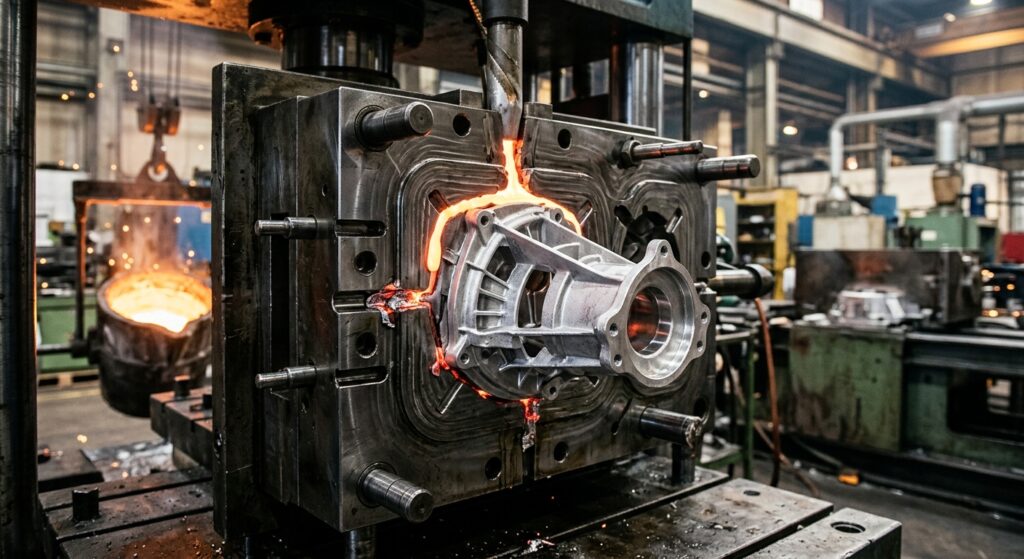
1. Upfront Tooling Costs and Initial Setup Capital
The upfront financial barrier is usually the first factor hardware teams evaluate when choosing a production method.
- Die Casting (Upfront Tooling Heavy): Conventional high-pressure die casting relies on heavy-duty steel molds (hard steel dies) designed to endure extreme hydraulic pressure and thermal cycling. Traditional production molds can easily cost between $10,000 and $50,000+, with lead times ranging from 6 to 12 weeks. Even with low-volume die casting techniques—which utilize modular MUD (Master Unit Die) bases or softer aluminum/tool steel inserts—upfront tooling costs typically start between $3,000 and $12,000.
- CNC Machining (Zero Custom Tooling): CNC milling and turning subtract material directly from solid billet stock (aluminum, titanium, stainless steel, etc.). The setup involves creating G-code program paths, picking standard cutting inserts, and setting up modular fixtures or soft jaws. Upfront custom tooling costs are effectively $0, keeping initial financial risk low and preserving working capital.
2. Unit Cost Analysis and the Volume Crossover Point
While CNC machining wins on initial tooling investment, die casting dominates raw cycle efficiency once production volume ramps up.
Die casting cycle times are measured in seconds or minutes. Once molten metal is injected into the die, cooled, and ejected, a complex near-net-shape part is produced. Conversely, CNC machining subtracts metal incrementally; complex geometries with high material removal rates translate into longer spindle hours, driving up individual piece-part costs.
The General Crossover Rule of Thumb:
- 1 to 200 Units: Custom precision CNC machining is almost always the most cost-effective solution due to zero mold investment and rapid setup times.
- 200 to 1,000 Units (The Grey Zone): The optimal choice depends heavily on part geometry, material removal volume, and surface finish requirements. Rapid low-volume die casting using insert tooling starts to compete directly with complex CNC milling.
- 1,000+ Units: Low-volume die casting generally delivers a lower total cost of ownership (TCO), assuming the component design is completely frozen and will not require modifications.
3. Comparative Feature Matrix
| Manufacturing Parameter | Custom CNC Machining | Low-Volume Die Casting |
| Upfront Tooling Cost | Minimal to None ($0 – $1,500) | Moderate to High ($3,000 – $15,000+) |
| Unit Cost (Low Volume) | Higher per unit (machine time dependent) | Significantly lower per unit |
| First Article Lead Time | 2 to 5 Days | 3 to 6 Weeks (Tooling Lead Time) |
| Dimensional Tolerance | Ultra-Tight (Down to ±0.01 mm) | Standard (±0.1 mm to ±0.2 mm) |
| Design Revision Cost | Low (Software/CAM update only) | High (Requires mold re-machining or new dies) |
| Wall Thickness Freedom | Highly Flexible (Thick walls easy) | Requires Uniform Thin Walls (1.5mm – 4mm) |
| Material Density | 100% Homogenous Wrought Billet | Risk of Internal Gas Porosity |
4. Design Flexibility and Modification Constraints
Design adaptability is an overlooked factor that often catches hardware teams off-guard during early production runs.
In CNC machining, modifying a design simply requires updating the 3D CAD file, tweaking CAM toolpaths, and running a new block of metal. You can seamlessly iterate from Revision A to Revision B in a single afternoon without discarding prior equipment.
In die casting, the component geometry is permanently carved into hardened tool steel. Modifications that require removing metal from the final part mean adding steel to the mold (which is doable via EDM or milling), but modifications that add metal to the part mean removing steel from the die—a costly, time-consuming, and sometimes impossible modification. Furthermore, die-cast designs demand strict adherence to draft angles (1° to 3°), uniform wall thicknesses, and generous fillets to prevent shrink defects, air entrapment, and ejection friction.

5. Mechanical Integrity and Material Performance
The structural performance of wrought billet material differs inherently from cast metal structures:
- Internal Density & Porosity: CNC machined parts are carved from extruded or forged wrought metal blocks. They exhibit maximum structural density, superior fatigue strength, and complete freedom from internal voids. This makes CNC parts ideal for high-stress aerospace, defense, or high-vacuum applications. Die cast parts, while robust, can harbor micro-porosity caused by trapped gas during high-pressure injection, which can impact fatigue life or vacuum sealing unless post-treated.
- Surface Finishes: Die casting delivers smooth, consistent surface finishes directly out of the mold (RMS 32–63), making it an attractive option for cosmetic enclosures, heatsinks, and brackets. CNC machining leaves visible tool marks that often necessitate secondary operations—such as bead blasting, anodizing, or powder coating—to achieve cosmetic perfection.
6. The Hybrid Strategy: Combining Die Casting with CNC Post-Machining
In modern low-volume manufacturing, the choice is rarely purely “either/or.” For complex high-precision components, the optimal strategy is often a hybrid approach: utilizing low-volume die casting for the primary body, followed by CNC post-machining.
A rapid die casting tool creates the primary near-net shape—saving expensive raw material and eliminating bulk metal removal—while a 3-axis or 5-axis CNC mill trims critical mounting faces, reams tight-tolerance bearing bores (down to ±0.01 mm), and taps fine threads that cannot be cast directly. This hybrid workflow merges the low unit-cost benefits of casting with the extreme precision of CNC machining.
Conclusion: Making the Right Call for Your Project
When weighing die casting vs. CNC machining for low-volume metal parts, let your project’s current lifecycle stage guide your decision:
- Choose CNC Machining if your design is still evolving, your required volume is under 200–500 units, you require ultra-tight tolerances (under ±0.02 mm), or your project requires immediate delivery without waiting weeks for tooling.
- Choose Low-Volume Die Casting if your engineering design is completely locked, production demand is between 500 and 5,000 units, cosmetic housing appearance is paramount, and lowering unit cost is your primary KPI.
Partner with Diode Machining for Expert Manufacturing Support
At Diode Machining, we specialize in helping hardware engineers and procurement leaders navigate these exact trade-offs. Whether you need rapid CNC prototyping in as fast as 2 days or flexible, low-volume die casting with zero-defect quality control, our engineering team provides comprehensive Design for Manufacturability (DFM) reviews to ensure your custom metal components are produced with maximum efficiency and precision.