 Skip to content
 In high-precision manufacturing, a single day of unexpected downtime can derail an entire quarter’s production schedule. For European factory managers and procurement officers, balancing machine longevity with cost-effective component sourcing is a continuous tightrope walk. Maximizing operational efficiency requires a two-pronged strategy: implementing a rigorous CNC Service Wartung (preventive maintenance) protocol and establishing a reliable partnership with an advanced China sheet metal fabricator.
When your production floor relies on flawless execution, understanding how machine maintenance aligns with global supply chain logistics isn’t just a technical necessity—it’s a major competitive advantage.
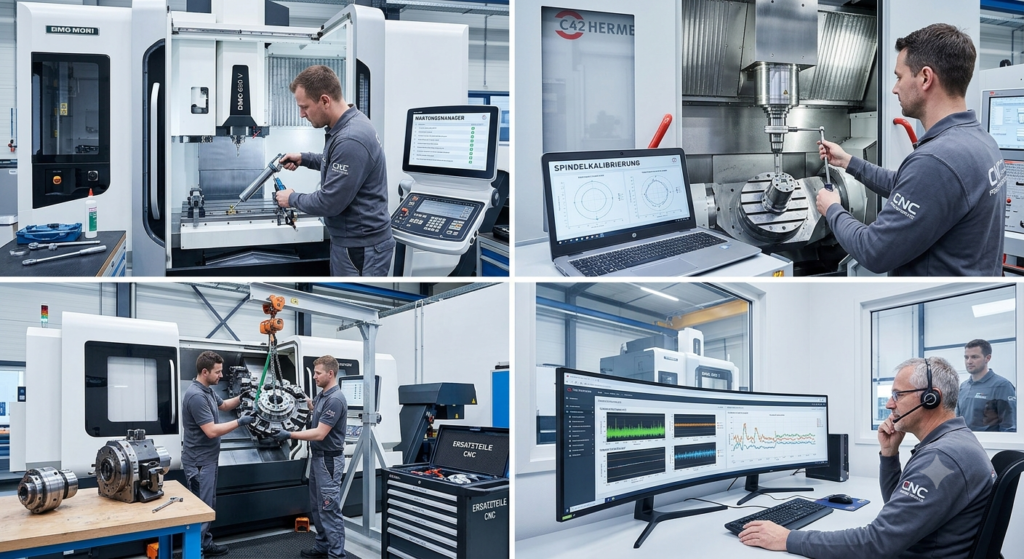
Why CNC Service Wartung Cannot Be an Afterthought
Many production facilities treat machine servicing as reactive—they call a technician only when a spindle seizes or an axis drifts out of tolerance. This approach is a financial drain. Regular CNC Service Wartung is the baseline requirement for maintaining the repetitive accuracy of your milling, turning, and laser-cutting machinery.
Preventive maintenance preserves structural rigidity and geometric alignment. Over months of high-speed operation, thermal expansion and micro-vibrations naturally degrade machine tolerances. A structured Wartung program catches these shifts early, preventing catastrophic component failures that halt production for weeks while waiting for specialized European replacement parts.
Beyond saving your hardware, consistent maintenance directly impacts your product quality. A well-calibrated machine reduces scrap rates, ensures tight tolerances ($ \pm0.01\text{ mm} $ or better), and guarantees that the raw materials you feed into the machine are never wasted.
Leveraging China Sheet Metal Fabrication for High-Mix, Low-Volume Production
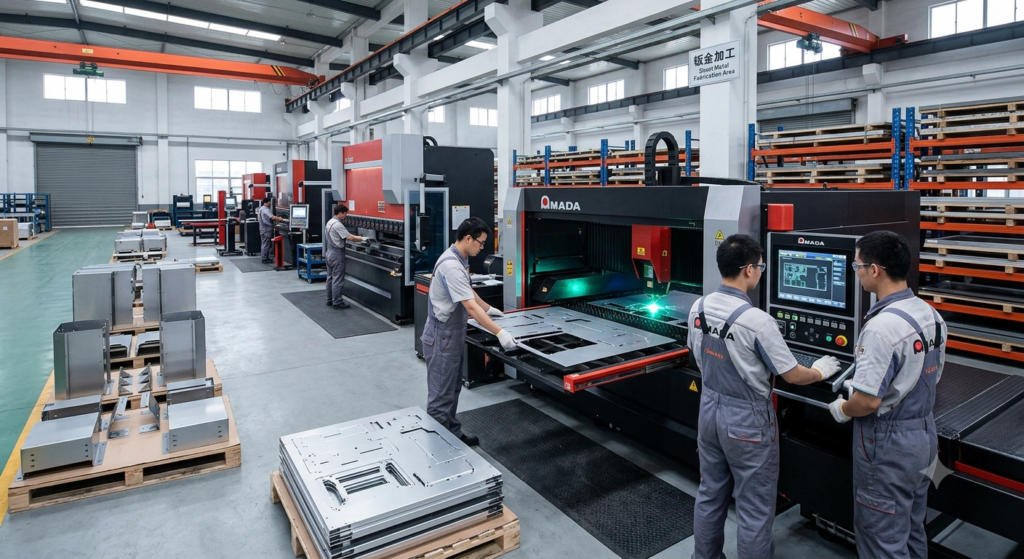
While keeping machines running smoothly internally is critical, your external supply chain for raw enclosures, brackets, and structural components is equally vital. Sourcing custom components from an advanced China sheet metal factory has evolved far beyond simple cost reduction. Today, it is about accessing world-class engineering infrastructure and massive material capacity.
The real advantage lies in their agility. Leading Chinese sheet metal manufacturers operate with massive economies of scale, allowing them to source raw alloys—like aluminum, stainless steel, and galvanized iron—at a fraction of the cost available to localized regional shops.
Furthermore, their ability to rapidly pivot between high-volume production runs and rapid prototyping means your engineering team can test structural designs, iterate on enclosures, and scale up to full container-load shipments without changing vendors.
The Intersection: Seamless Sourcing Meets Shop-Floor Precision
The true magic happens when your internal CNC Service Wartung aligns perfectly with the output of your China sheet metal vendor. If your internal machinery is maintained to micron-level accuracy, the incoming components must match that standard perfectly.
When evaluating an overseas sheet metal partner, look for physical evidence of their internal quality control and production standards:
- Manufacturing Certifications: Ensure the facility holds verifiable ISO 9001:2015 certifications for quality management and IATF 16949 if you are sourcing automotive-grade components.
- Traceability Reports: A reliable supplier should provide material test certificates (MTC) and coordinate-measuring machine (CMM) inspection reports with every batch.
- Logistics Expertise: The best factory partners don’t just fabricate; they manage the entire export process, ensuring heavy metal components are crated securely to prevent sea-freight corrosion or bending during transit.
When you know your incoming sheet metal components are perfectly flat, deburred, and within spec, your shop floor can run at maximum speed without constant manual adjustments or machine recalibrations.
A Practical Preventive Maintenance Checklist for Sheet Metal Workshops
To keep your shop floor running seamlessly alongside your international supply chain, your team should execute a strict, scheduled maintenance routine. Here is a practical roadmap for your technical crew:
1.Daily Fluid & Guide Rail Inspection:Performed at shift start。
Check all centralized lubrication levels. Wipe down linear guide rails to remove metal dust, slag, and abrasive debris. Ensure pneumatic pressures meet the machine’s OEM specifications.
2.Weekly Axis Calibration & Backlash Checks:Performed every Friday。
Inspect the ball screws for visible wear or play. Run basic circle-diamond-square test cuts to verify geometric accuracy across the X, Y, and Z axes, compensating for any minor mechanical backlash.
3.Monthly Electrical & Cooling System Audit:Requires machine lockout。
Clean electrical cabinet filters to prevent overheating. Verify that the chilling units for the spindles or fiber laser sources are free of contamination and maintaining constant, stable temperatures.
4.Quarterly Precision Geometry Diagnostics:Comprehensive deep dive。
Utilize ballbar testing or laser interferometry to measure the machine’s true volumetric accuracy. Check spindle runout and adjust leveling pads to correct any minor foundation settling.
Balancing Long-Term Machine Reliability with Cost-Effective Procurement
Ultimately, manufacturing success is driven by predictability. Unexpected breakdowns destroy margins, while overpaying for local custom fabrication limits your ability to scale.
By committing to a disciplined CNC Service Wartung schedule, you protect your primary equipment investments and ensure your workshop can handle demanding jobs. Concurrently, partnering with a vetted, high-capacity China sheet metal manufacturer gives you the pricing leverage and production flexibility needed to win larger contracts and expand into international markets.
Don’t wait for an unexpected failure or a supply shortage to force your hand. Establish your maintenance schedules, audit your overseas sourcing channels, and build a resilient production ecosystem that handles market volatility with ease.
| Strategy Component | Primary Metric | Primary Benefit |
| CNC Service Wartung | Overall Equipment Effectiveness (OEE) | Reduces unplanned downtime by up to 35% |
| China Sheet Metal Sourcing | Cost Per Part (CPP) & Lead Time | Lowers structural component costs by 20-40% |
| Combined Integration | First Pass Yield (FPY) | Ensures seamless assembly with zero rework |