 Skip to content
 Custom metal stamping services and 3D printing services in China sit at opposite ends of the modern manufacturing spectrum, yet hardware engineers increasingly rely on both to bring products from initial sketch to retail shelf.
If you are developing a custom enclosure, bracket, or complex mechanical assembly, picking between additive manufacturing and progressive die stamping isn’t just a technical decision—it determines your unit economics, time-to-market, and ultimate profitability.
The manufacturing landscape has shifted rapidly over the past few years. While additive technology has matured beyond quick plastic trinkets into industrial end-use metal parts, traditional metal stamping remains the undisputed king of high-volume metal fabrication. Understanding where these two technologies intersect—and where one clearly beats the other—saves hardware teams tens of thousands of dollars in wasted tooling and months of delayed launches.
3D Printing Services in China: Rapid Iteration and Low-Volume Flexibility
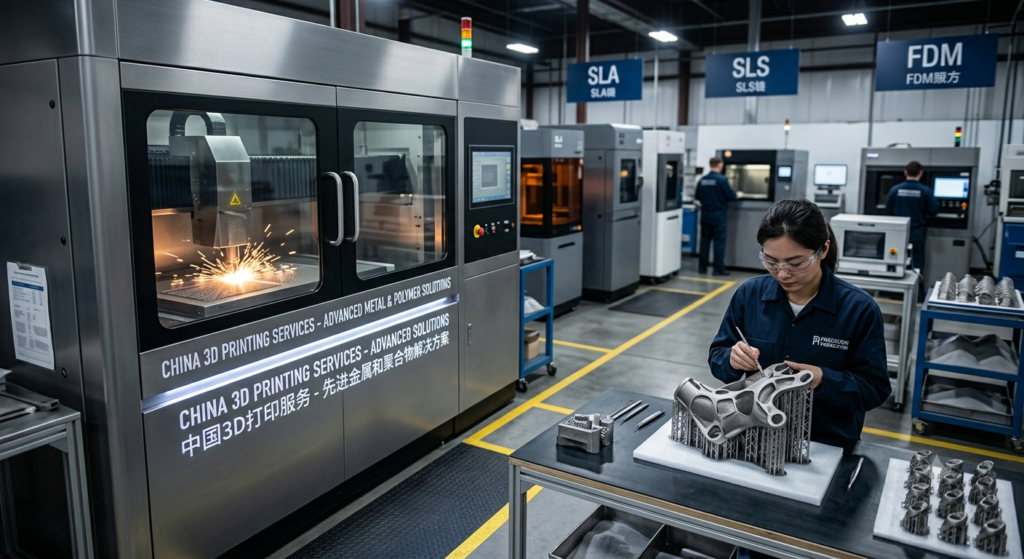
When speed and geometric complexity matter more than hard unit-cost ceilings, turning to 3D printing services in China provides an unmatched speed advantage. China’s additive manufacturing ecosystem has evolved far beyond desktop FDM printers. Today, specialized hubs in Shenzhen, Dongguan, and Suzhou house massive industrial parks packed with Selective Laser Sintering (SLS), Direct Metal Laser Sintering (DMLS), and Stereolithography (SLA) equipment operating 24/7.
Key Advantages of Sourcing 3D Printing in China
- Zero Tooling Investments: Traditional metal fabrication requires custom steel dies, which cost anywhere from $3,000 to over $50,000 upfront. Additive manufacturing builds parts directly from 3D CAD files, eliminating upfront capital risks.
- Complex Geometric Freedom: Internal channels, lattice structures, and organic topologies that are impossible to stamp or machine can be printed easily.
- Lightning-Fast Turnaround: With China’s dense supply chain, a uploaded STL or STEP file can yield physical metal or plastic prototypes on your workbench in North America or Europe within 4 to 6 business days.
- Low-Volume Viability: If your annual demand is under 500 units, additive manufacturing is almost always cheaper than amortizing custom tooling costs.
Where Additive Reaches Its Limit
Additive manufacturing is fundamentally a point-by-point or layer-by-layer process. As production quantities scale into thousands of units, the per-part cost stays almost flat. Printing a metal bracket might cost $25 whether you print one or five hundred. Furthermore, printed metal parts often require secondary machining, heat treatment, or surface polishing to match the density, tensile strength, and crisp cosmetic finish of rolled sheet metal.
Custom Metal Stamping Services: High-Speed Precision at Massive Scale
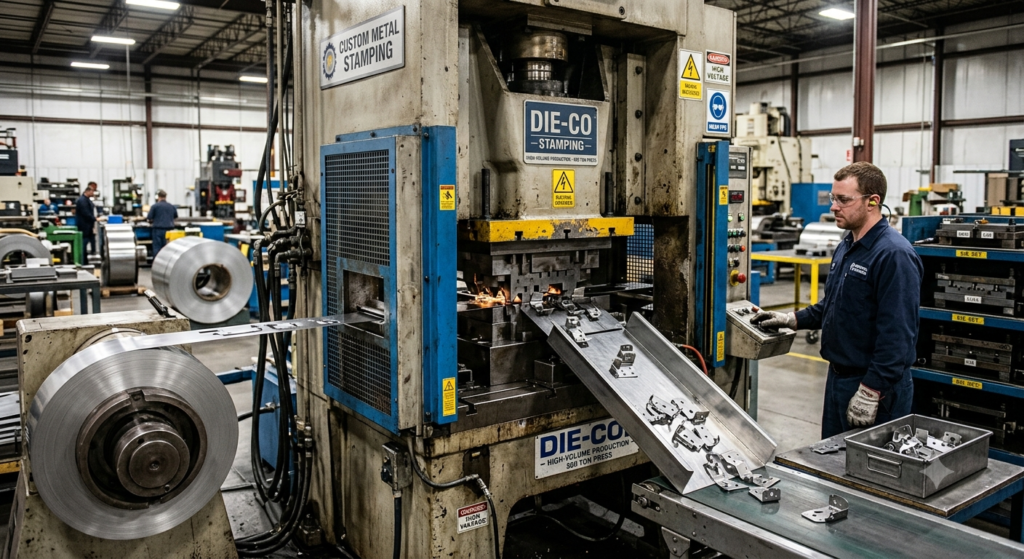
When your production forecast transitions from hundred-unit pilot runs to tens of thousands of parts per month, custom metal stamping services become essential. Metal stamping utilizes high-tonnage mechanical or hydraulic presses equipped with custom-engineered die sets to cut, pierce, bend, and coin sheet metal into precise geometries in fractions of a second.
Why Metal Stamping Dominates Mass Production
- Unbeatable Unit Economics: While a progressive stamping die set requires a notable upfront investment, the per-unit material and processing cost drops dramatically. A stamped bracket that costs $20 to 3D print can often be stamped for $0.35 in volume.
- Rapid Cycle Times: High-speed presses run at speeds from 60 to over 500 strokes per minute. A single multi-station progressive die can execute dozens of cutting and forming operations simultaneously on every stroke.
- Material Integrity: Stamped components start from cold-rolled sheet metal, brass, aluminum, or stainless steel strip. They retain uniform grain structure, excellent mechanical strength, and tight dimensional tolerances ($\pm 0.02\text{ mm}$) across millions of cycles.
- Consistency: Die wear is predictable and manageable. Part number 1,000 and part number 100,000 will be virtually identical.
Direct Side-by-Side Comparison
Choosing the wrong process at the wrong phase of your product lifecycle can strain your runway. Here is how the two manufacturing methods stack up across core production metrics:
| Operational Metric | 3D Printing Services in China | Custom Metal Stamping Services |
| Upfront Tooling Cost | $0 (No dies or fixtures required) | High ($3,000 to $50,000+ depending on die complexity) |
| Lead Time to First Part | 2 to 5 days | 3 to 8 weeks (die design, wire EDM, testing, approval) |
| Per-Unit Cost (Low Volume) | Low to Moderate | High (due to unamortized tooling cost) |
| Per-Unit Cost (High Volume) | High (flat cost curve) | Extremely Low (pennies to a few dollars per part) |
| Production Speed | Hours per part | Seconds (or fractions of a second) per part |
| Design Changes | Instant (modify CAD and re-upload) | Expensive (requires machining or replacing die steel) |
| Material Variety | Engineering plastics, titanium, Inconel, stainless steel | Sheet metals (aluminum, stainless, copper, brass, spring steel) |
The Modern Hardware Strategy: A Two-Phase Hybrid Workflow
The most successful hardware brands do not choose one service over the other in isolation. Instead, they leverage both technologies sequentially across their product development lifecycle.
Phase 1: Prototyping & DFM Optimization with China 3D Printing
During early design stages, send your CAD files to 3D printing services in China for quick, low-cost physical samples. Test the housing fit, verify mounting holes, and validate ergonomics.
Using metal printing (like DMLS) during this phase lets you perform real stress tests on structural brackets without committing to tooling. You can catch critical Design for Manufacturability (DFM) errors early, before a machinist cuts a single block of die steel.
Phase 2: Scale-Up with Custom Metal Stamping
Once your product design locks, user testing is complete, and purchase orders are confirmed, transition your part geometry for custom metal stamping services.
Work closely with your stamping vendor to add bend radii, adjust hole-to-edge clearances, and select sheet metal gauges that match standard stock sizes. The initial capital spent on stamping dies pays for itself quickly as your unit costs drop.
Decision Checklist: Which Process Do You Need Right Now?
Ask your engineering and procurement teams these four questions to decide which route to take today:
- What is your total order volume for the next 12 months?
- Under 1,000 units: Go with 3D printing services in China.
- Over 5,000–10,000 units: Invest in custom metal stamping tooling.
- Is your geometry locked, or will it evolve after customer feedback?
- Evolving design: Stick with 3D printing to avoid costly die modification fees.
- Locked design: Proceed with progressive stamping dies.
- How fast do you need parts delivered to your assembly line?
- Within 10 days: 3D printing is your only viable path.
- Within 2 to 3 months: You have enough runway for metal stamping die build and First Article Inspection (FAI).
- What are your structural and cosmetic surface finish requirements?
- Isotropic sheet metal strength and mirror-smooth surfaces required: Stamping delivers right off the press.
- Complex internal channels or non-uniform wall thickness: 3D printing excels where stamping punch tools cannot reach.
By pairing the initial flexibility of Chinese 3D printing hubs with the raw production power of dedicated metal stamping facilities, hardware developers can move fast, keep initial capital requirements low, and scale smoothly into high-margin mass production.