 コンテンツにスキップ
 Choosing between precision CNC milling services そして CNC旋削サービス often dictates whether a custom metal or plastic component finishes on budget or turns into an expensive manufacturing headache. While both processes rely on Computer Numerical Control to carve raw stock with micron-level accuracy, the fundamental way they hold and cut material makes each suited for completely different part geometries.
Core Difference: Motion Dynamics
Understanding how the machine moves relative to your part reveals which process fits your design best:
- Precision CNC Milling Services: The workpiece remains stationary clamped in a vise, fixture, or vacuum table, while a high-speed rotating cutting tool moves along multiple axes (typically 3, 4, or 5 axes) to carve away material.
- CNC旋削サービス: The workpiece rotates rapidly in a chuck or collet while a stationary, single-point cutting tool feeds into the material along linear paths to shave off stock.
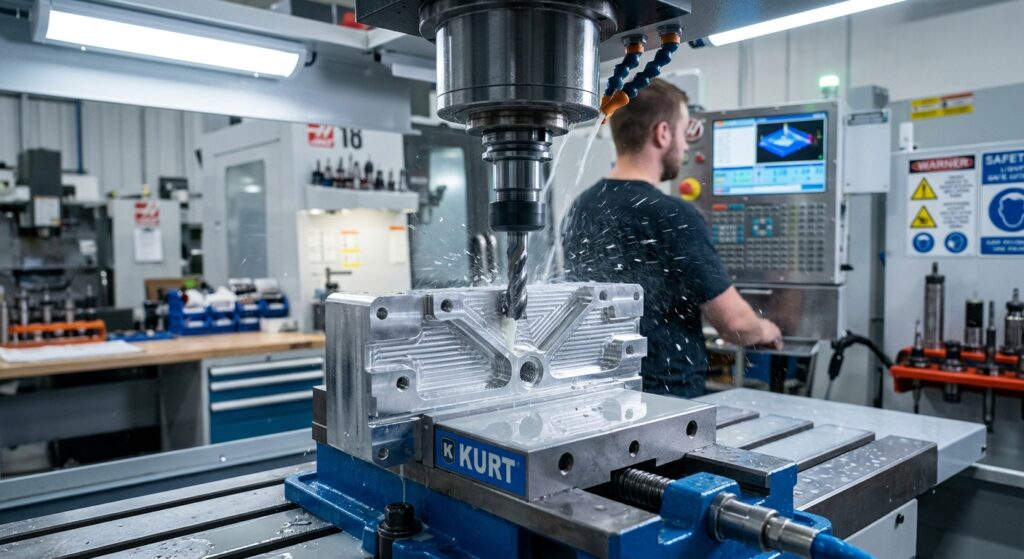
How Precision CNC Milling Works
In milling operations, multi-flute cutting tools like end mills, face mills, and drills spin anywhere from a few thousand to over 20,000 RPM. As the tool rotates, it travels across X, Y, and Z axes (plus rotary A/B axes in 5-axis systems) to create pockets, slots, organic contours, and complex 3D surfaces.
Ideal Part Geometries for Milling
- Flat plates, brackets, and engine blocks
- Enclosures with internal cavities and deep pockets
- Parts requiring precise hole patterns, countersinks, and tapped threads on off-axis surfaces
- Sculpted, organic 3D shapes common in aerospace components or medical implants
How CNC Turning Works
Turning takes place on a machine known as a CNC lathe or turning center. The raw bar stock or pre-cut blank spins at high speeds while the tool turret holds rigid cutting inserts that travel alongside or directly into the workpiece. Because the part rotates continuously, turning naturally produces symmetrical round shapes with exceptional concentricity and surface finish.
Ideal Part Geometries for Turning
- Shafts, pins, sleeves, and bushings
- Cylindrical fittings, flanges, and threaded fasteners
- Tapered nozzles and round housings
- Rings, spacers, and rotational pulleys

Direct Comparison: Milling vs. Turning
| Feature / Metric | Precision CNC Milling Services | CNC旋削サービス |
| Primary Part Shape | Flat, square, boxy, or irregular 3D shapes | Round, cylindrical, tubular, or conical shapes |
| Primary Motion | Rotating tool, stationary workpiece | Rotating workpiece, stationary tool |
| Cutting Tool Type | Multi-flute tools (end mills, drills, ball nose) | Single-point tools (turning inserts, boring bars) |
| Machining Speed | Highly variable based on path complexity | Rapid stock removal on round outer dimensions |
| Symmetry | Asymmetrical, prismatic geometries | Axisymmetric (concentric about a center axis) |
| Material Waste | Often higher when hogging blocks out of square stock | Lower when starting from round bar stock |
5 Critical Factors for Choosing the Right Service
1. Part Geometry and Symmetry
Look down the central axis of your 3D CAD model. If the part is predominantly circular, round, or tubular, CNC旋削サービス will be the faster, cheaper option. If your part features flat mounting faces, irregular mounting tabs, pockets, or complex sculpts, precision CNC milling services are required.
2. Required Production Volume & Cycle Times
For cylindrical features, turning clears large volumes of material rapidly in a continuous pass. Turning setups often cycle significantly faster than milling setups for round geometries, lowering piece-part costs in high-volume production runs.
3. Surface Finish & Concentricity
Achieving tight concentricity tolerances (例えば, maintaining 0.0005 inches / 0.012 mm between an inner bore and an outer diameter) is significantly easier on a lathe, because both features are machined relative to the exact same rotational center.
4. Setup Complexity and Tooling Costs
Milling intricate parts often demands custom soft jaws, multi-station vises, or dedicated fixture plates to hold the component through various operations. Turning setups typically use standard three-jaw chucks or collet systems, reducing upfront tooling costs for simple shaft-like profiles.
5. Multi-Axis Hybrid Requirements (Live Tooling)
Modern CNC turning centers frequently feature live tooling—driven rotating cutters mounted right in the lathe’s turret. This hybrid approach lets a shop perform turned outer-diameter operations and then lock the spindle to drill cross-holes or mill flat keyways without transferring the part to a separate milling machine.
Real-World Applications
Making Your Decision
To keep your project moving efficiently, apply this quick decision matrix:
- Choose Precision CNC Milling Services if:
- The part is mostly square, flat, or has multi-sided pockets.
- You require complex surface sweeps or 3D contours.
- Holes and slots are located on multiple distinct faces.
- Choose CNC Turning Services if:
- The part’s core profile is round or cylindrical.
- You need external or internal precision threads along a rotational axis.
- High concentricity across rotational features is critical.
When parts combine round bodies with offset mounting holes or flat keyways, look for machine shops offering CNC turning centers with live tooling or 5-axis mill-turn machines to combine both operations into a single set-up.