If you look closely at the modern devices we rely on every single day—whether it is the vascular stent keeping a heart beating, the tiny connector inside your smartphone, or the ultra-precise sensor on an aerospace control board—you will find a silent hero. That hero is the miniature component. Producing these tiny wonders requires more than just basic machining; it demands a highly specialized CNC turning service capable of carving out complex, high-precision micro metal parts from solid stock.
But why is CNC turning the go-to manufacturing method for these micro-scale marvels? And what does it take to run a production line where a single speck of dust can ruin an entire batch?
Let’s dive deep into the micro-world of precision machining, explore the unique challenges of Swiss-type turning, and look at what you should search for in a manufacturing partner.
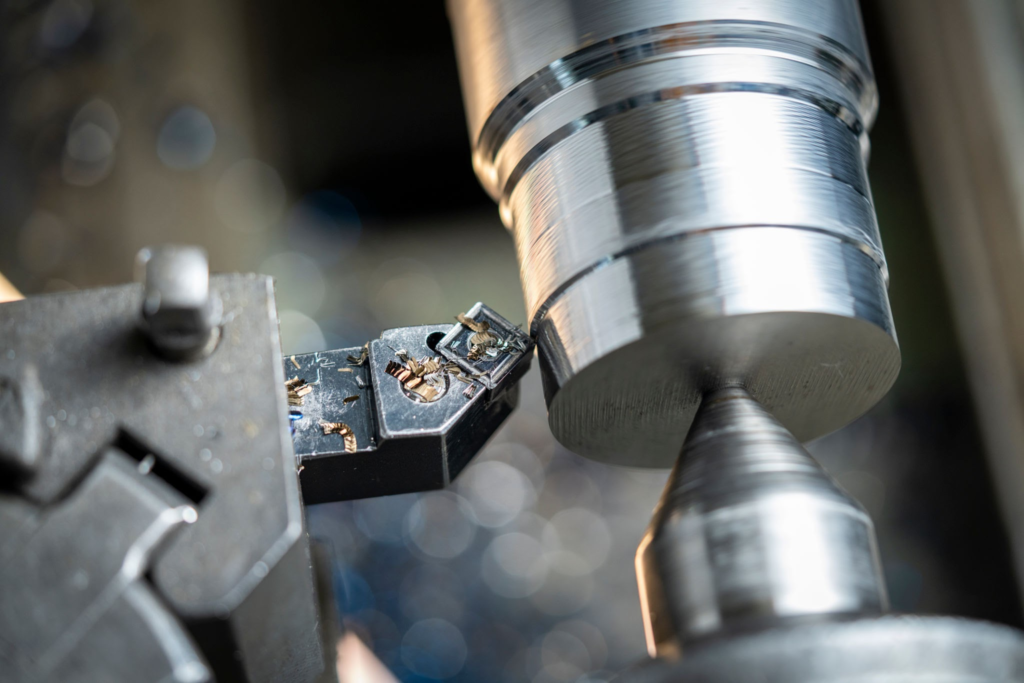
What Exactly Defines a Micro Metal Part?
Before we talk about the machines, let’s establish the scale. We aren’t talking about screws you can easily hold between your thumb and forefinger.
In the manufacturing industry, micro metal parts typically refer to components with dimensions measuring under a few millimeters—sometimes even fractions of a millimeter. We are talking about wall thicknesses as thin as $0.05 \text{ mm}$ (which is thinner than a human hair) and tolerances tight enough to make even seasoned machinists sweat: often down to $\pm 0.002 \text{ mm}$ ($\pm 2 \text{ microns}$).
To achieve this level of accuracy, standard vertical mills or generic lathes simply won’t cut it. You need a dedicated, high-performance CNC turning service that utilizes Swiss-type automatic lathes and advanced live tooling.
Why CNC Turning is Ideal for Miniature Components
When it comes to cylindrical, symmetrical, or complex axial geometries, turning is king. Here is why the process shines on a miniature scale:
- Exceptional Surface Finishes: Micro components used in medical and aerospace applications cannot tolerate burrs or rough surfaces. A precise CNC lathe delivers pristine, polished finishes directly off the machine, reducing the need for risky secondary polishing.
- Rotational Symmetry and Concentricity: When making parts like miniature shafts, pins, or fuel injection nozzles, the part must spin perfectly on its axis. Turning ensures that the outer diameter (OD) and inner diameter (ID) remain perfectly concentric.
- High-Volume Efficiency: Once a Swiss CNC lathe is programmed and calibrated, it can run 24/7. Bar feeders continuously slide raw metal wire into the machine, spitting out finished micro-components every few seconds with flawless repeatability.
The Hidden Challenges of Machining on a Micro Scale
To the untrained eye, micro-machining looks just like regular machining, only smaller. But ask any shop floor manager, and they will tell you a completely different story. The physics of metal cutting changes dramatically when you scale down.
1. The Fight Against Tool Deflection
Imagine trying to cut a metal rod that is only $0.5 \text{ mm}$ thick. The moment the cutting tool touches the metal, the raw stock wants to bend away from the pressure. This is called tool deflection.
To combat this, a premium CNC turning service uses Swiss-style lathes. In a Swiss lathe, the metal stock is held tightly by a guide bushing right next to the cutting tool. Because the material is supported mere millimeters from where it is being cut, deflection is virtually eliminated.
2. Micro Heat Generation
In macro-machining, the metal chips carry away most of the heat generated during cutting. Met micro metal parts, the chips are so microscopic that they cannot dissipate heat quickly enough. If the temperature spikes, the metal can expand, throwing off your tight tolerances, or worse, welding the micro-drill right inside the part. Specialized, high-pressure coolant systems are mandatory to flush away heat and debris instantly.
3. Microscopic Burrs
A tiny burr (a leftover metal ridge) on a standard engine block might not matter. But a microscopic burr on a surgical valve or a fiber optic connector can cause catastrophic system failure. Removing these burrs without damaging the delicate geometry of the part requires incredible skill, specialized chemical etching, or micro-blasting.
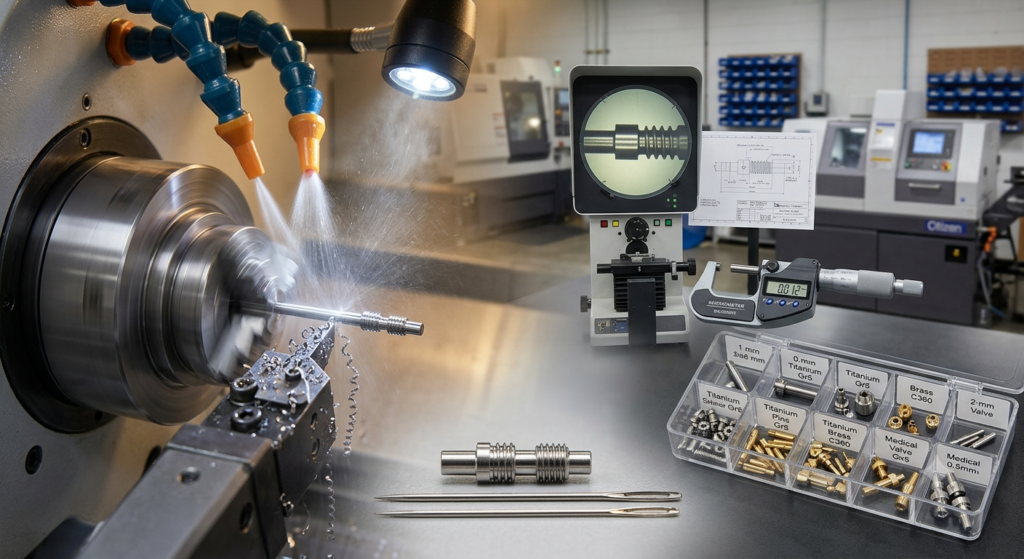
Key Industries Driving the Demand for Micro Turning
Who is buying these incredibly tiny components? The push toward miniaturization is accelerating across almost every high-tech sector:
| Industrie | Typical Micro Metal Parts Produced | Key Material Requirements |
| Medical Devices | Bone screws, surgical staples, cardiac implants, cannula tips | Titanium, 316L Stainless Steel, Nitinol |
| Electronics & Telecom | Fiber optic ferrules, micro-pins, pogo pins, coaxial connectors | Messing, Koper, Gold-plated alloys |
| Aerospace & Defense | Miniature gyroscopes, valve needles, sensor housings | Inconel, Titanium, Kovar |
| Automotive | Fuel injector nozzles, sensor components, miniature actuator shafts | High-strength steel alloys |
Choosing the Right CNC Turning Partner
If your product design relies on micro-components, choosing a manufacturing partner is a high-stakes decision. A minor mistake on their end can stall your entire product launch. Here are three non-negotiable questions to ask potential partners:
- Do you use Swiss-type CNC machines? If they plan to make your micro parts on a standard lathe, run away. Swiss machines are the industry gold standard for long, slender, or ultra-small components.
- What are your quality control and inspection protocols? You cannot measure a 2-micron tolerance with a standard caliper. Ask if they use optical comparators, laser measurement systems, or digital microscopes in a climate-controlled inspection room.
- Have you worked with exotic materials? Machining brass is easy. Machining medical-grade titanium, Nitinol, or Inconel at a micro-scale requires deep metallurgical knowledge and custom-ground tooling.
The Bottom Line
Miniaturization is not just a passing trend—it is the future of technology. Whether you are building the next generation of wearable medical tech or highly sensitive aerospace instruments, securing a reliable CNC turning service is the key to bringing your designs to life.
By understanding the unique physics of producing micro metal parts and partnering with a manufacturer who has the specialized Swiss-style equipment to handle them, you can turn your microscopic concepts into highly precise, high-performing realities.