 Skip to content
 Rapid Injection Molding Services are redefining the landscape of modern Custom Parts Manufacturing by bridging the critical gap between early-stage prototyping and full-scale production. In today’s high-velocity hardware market, waiting months for production-grade aluminum or steel tooling is no longer a viable strategy. Modern engineering teams demand low-volume custom parts delivered in days, not weeks, without compromising on real-world material properties or dimensional tolerances.
Whether you are developing complex medical devices, automotive sub-assemblies, or high-performance consumer electronics, integrating rapid molding workflows into your product development pipeline gives you a distinct competitive edge. This article explores how rapid tooling operates, key design consideration rules, and how custom injection molding accelerates time-to-market while reducing financial risk.
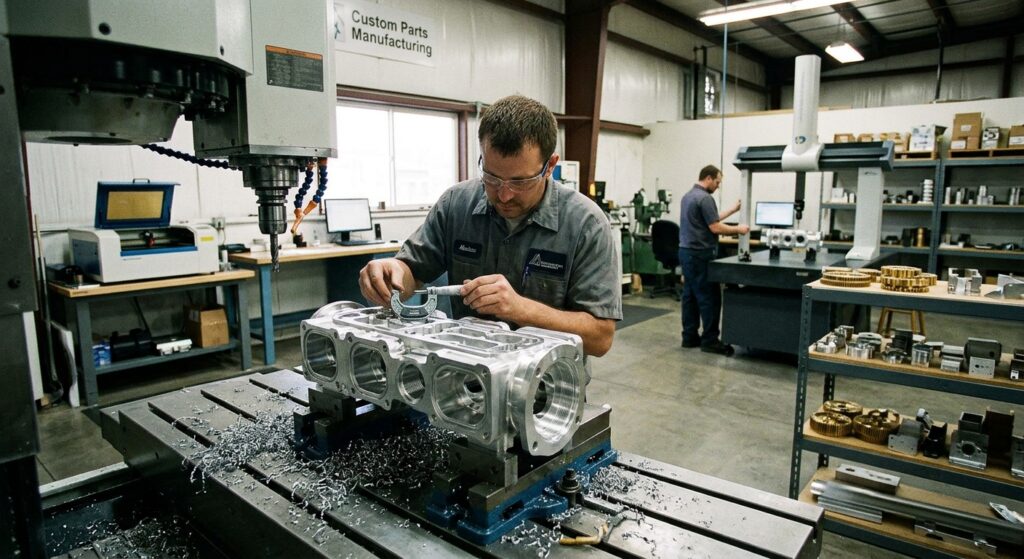
Why Custom Parts Manufacturing Relies on Rapid Injection Molding
Traditional injection molding processes require heavy upfront investments in hardened steel tooling, which often take 8 to 16 weeks to fabricate and debug. While ideal for high-volume runs exceeding 100,000 units, traditional tooling severely bottlenecks agile prototyping and small-batch production. This is precisely where Rapid Injection Molding Services transform the workflow.
By leveraging advanced multi-axis CNC machining, high-speed EDM, and standardized aluminum mold bases, manufacturers can produce functional custom parts using end-use thermoplastic resins in as few as 3 to 10 business days. This capability empowers engineering teams to execute critical steps faster:
- Execute Functional Validation: Test real injection-molded parts under actual mechanical, thermal, and chemical stress conditions—something 3D printing often fails to simulate accurately.
- Mitigate Tooling Risk: Detect geometric errors, wall thickness discrepancies, and assembly tolerances on a lower-cost aluminum mold before committing six figures to hardened steel tooling.
- Bridge-to-Production Gaps: Fulfill early customer orders, regulatory submission samples, or Kickstarter fulfillment goals while full-scale production tooling is being built.
Key Engineering Advantages of Rapid Tooling Technologies
When evaluating options for Custom Parts Manufacturing, hardware leaders often balance trade-offs between speed, piece price, and component quality. Rapid injection molding provides a unique sweet spot that outperforms additive manufacturing and traditional machining under specific conditions.
1. Production-Grade Thermoplastics
Unlike 3D printing resins, which can degrade over time or display anisotropic weaknesses, rapid molding uses genuine thermoplastic polymers such as ABS, Polycarbonate (PC), Nylon (PA6/PA66), PEEK, Polypropylene (PP), and liquid silicone rubber (LSR). This ensures your custom prototypes display authentic tensile strength, impact durability, and thermal resistance.
2. Scalable Tooling Economics
Because rapid tooling relies on soft aluminum alloys (such as QC-10 or 7075 aluminum), tool creation is significantly faster and less energy-intensive than machining hardened tool steel. Molds typically last between 1,000 and 10,000 shots—making them perfectly suited for custom low-volume production runs.
Essential Design for Manufacturability (DFM) Guidelines
To maximize the speed and efficiency of Rapid Injection Molding Services, components must be designed specifically for the molding process. Implementing solid Design for Manufacturability (DFM) principles early in the CAD modeling stage prevents costly tool modifications and production delays.
- Wall Thickness (1.5mm – 3.0mm Uniform): Prevents sink marks, warping, and excessive internal stress during cooling.
- Draft Angles (1° to 2° Minimum): Allows smooth part ejection from the mold cavity without surface scuffing or dragging.
- Radii & Corners (0.5 × Wall Thickness): Reduces stress concentrations and improves molten polymer flow through gates.
- Rib Structure (50%–60% of Nominal Wall): Provides structural stiffness without causing exterior sink marks.
Additionally, keeping gate placements in mind ensures optimal resin filling without causing cosmetic blemishes on critical external surfaces. Working with a manufacturing partner that offers automated DFM feedback during quoting can shave days off your design iterations.

Rapid Injection Molding vs. Additive Manufacturing vs. Traditional Molding
| Factor | Additive Manufacturing (3D Printing) | Rapid Injection Molding | Traditional Steel Tooling |
| Lead Time | 1 to 3 Days | 5 to 15 Days | 8 to 16 Weeks |
| Best Volume Range | 1 to 100 units | 100 to 10,000 units | 10,000+ units |
| Material Selection | Limited / Simulated Resins | Production Resins (1,000+) | Production Resins (1,000+) |
| Unit Cost (at 1k units) | High | Moderate / Low | Very Low |
| Surface Finish | Requires Post-Processing | SPI Finishes (A2 to D3) | Custom / High Polish |
How to Streamline Your Custom Parts Manufacturing Workflow
To get the best results when requesting Rapid Injection Molding Services, following a structured procurement process is key:
- Finalize STEP/IGES Models: Ensure your solid models feature consistent draft angles and no overlapping geometries.
- Specify Resin and Surface Finish Requirements: Define whether you need medical-grade certification, flame retardancy (UL94-V0), UV resistance, or specific SPI surface textures.
- Upload CAD for Interactive DFM Analysis: Modern rapid suppliers utilize automated AI/software engines to evaluate draft angles, thin walls, and undercut risks within hours.
- Approve Tooling and Sample Inspection: Review First Article Inspection (FAI) samples or T1 prototypes to confirm dimensional accuracy prior to full production runs.
[Conclusion]
Leveraging high-quality Rapid Injection Molding Services is no longer just a luxury for elite tech companies—it is a foundational strategy for modern Custom Parts Manufacturing. By combining the speed of digital prototyping with the physical integrity of real injection-molded thermoplastics, hardware engineers can validate designs faster, drastically lower financial risk, and bring superior products to market ahead of the competition.