 Skip to content
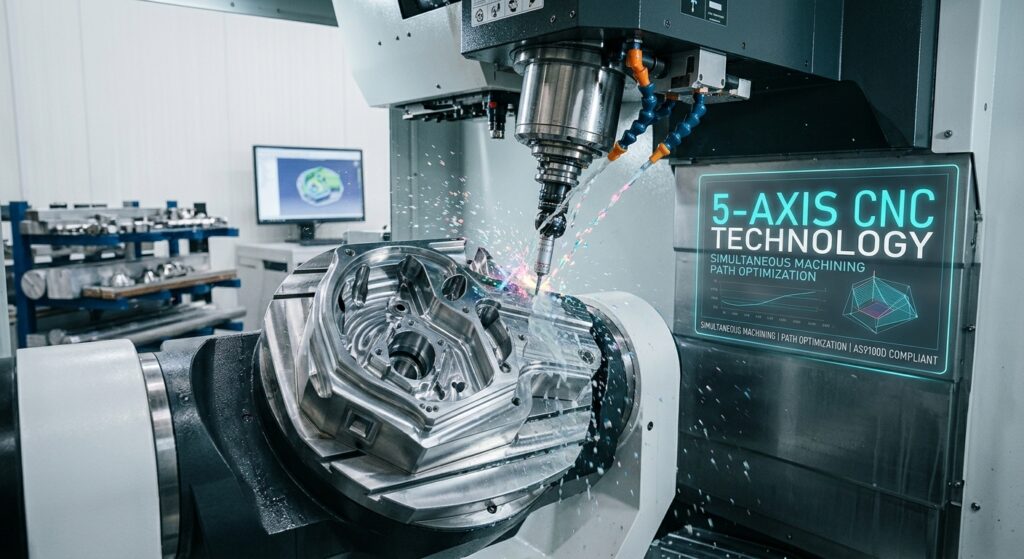
Attending a major CNC Machining Exhibition offers engineering teams and production managers a firsthand look at how 5-Axis CNC Technology is redefining precision component manufacturing. While 3-axis and 4-axis milling machines remain shop floor workhorses for simple planar cuts, the rapid growth of complex geometries in aerospace, medical implants, and automotive EV powertrains has made multi-axis capability a modern necessity.
Walking through the show floor at an international trade fair, you will see live machining demos, real-time chip formation, and advanced CAM software integration. Understanding what to look for when evaluating 5-axis CNC technology at a CNC machining exhibition ensures you return to your facility with actionable manufacturing strategies rather than just a stack of sales brochures.
1. Why 5-Axis CNC Technology Dominates the Modern Exhibition Floor
Why does multi-axis milling draw the biggest crowds at every manufacturing expo? Because it solves the single biggest bottleneck in high-precision job shops: multiple fixture setups.
When a part requires machining on five different faces, a traditional 3-axis mill forces the operator to manually unclamp, flip, and re-clamp the workpiece for each orientation. Every manual setup introduces human repositioning error and stacks dimensional tolerances.
5-axis CNC technology rotates the cutting tool or the workpiece along two additional rotary axes (A, B, or C), allowing complete multi-sided machining in a single setup. This single-setup approach delivers three immediate shop floor benefits:
- Drastic Setup Time Reduction: Cut fixture design costs and prep time by up to 70%.
- Superior Geometric Accuracy: Eliminate setup-to-setup alignment errors, holding tight tolerances down to $\pm 0.005\text{ mm}$.
- Shorter Cutting Tools: Tool tilting allows shorter, stiffer end mills to reach deep cavities, minimizing tool chatter and extending cutter life.

2. Key 5-Axis Machine Configurations to Inspect at a CNC Machining Exhibition
When exploring vendor booths at a CNC machining exhibition, you will encounter two main structural designs for multi-axis machines. Knowing how they differ mechanically helps you select the right machine footprint for your typical workpieces.
| Machine Architecture | Rotary Motion Mechanism | Best Suited Applications | Operational Advantage |
| Trunnion / Swivel Table | Table tilts and rotates (A/C axes) | Heavy structural parts, compact molds | High torque rigidity; stationary tool head |
| Swivel Head / Rotary Table | Spindle head tilts; table rotates | Long aerospace spars, large turbine blisks | Accommodates heavier raw billets without table overload |
3+2 Positional vs. Full 5-Axis Simultaneous Machining
Don’t let booth marketing confuse these two distinct operational modes:
- 3+2 Positional Machining: The rotary axes lock the part into a fixed compound angle, and the tool cuts using standard 3-axis linear moves ($X, Y, Z$). This is ideal for prism-shaped valve blocks and complex hole patterns.
- Continuous 5-Axis Simultaneous Machining: All five axes move continuously in sync. This is required for organic, freeform surfaces such as impeller blades, turbomachinery blisks, and anatomical joint replacements.
3. What to Audit During Live 5-Axis Machining Demonstrations
Exhibition live cuts are engineered to look impressive, but a trained manufacturing eye looks beyond the flying coolant. Use this checklist during your next expo visit:
- Thermal Drift & Spindle Stability: Ask booth engineers how the machine manages thermal growth during extended high-speed milling runs. Look for thermal compensation sensors and liquid-cooled spindles.
- Collision Avoidance Integration: 5-axis moves involve complex spatial motion. Verify whether the controller runs dynamic real-time collision monitoring (DCM) directly on the CNC panel to prevent costly spindle crashes.
- Surface Roughness ($Ra$ Value) on Contours: Inspect sample parts right off the machine table. Check for smooth tool-path transitions along curved surfaces without visible facets or dwell marks.
4. Bridging CAM Software and 5-Axis Machinery
Hardware is only half the battle. High-efficiency 5-axis machining relies heavily on intelligent CAM tool-path programming.
While touring a CNC machining exhibition, spend time at CAM software demonstration stations to evaluate:
- Adaptive Roughing Strategies: Advanced algorithms keep constant tool engagement, allowing aggressive material removal rates (MRR) without snapping delicate end mills.
- 5-Axis Vector Tilting: Automatic tool-axis tilting prevents the tool holder from colliding with deep wall cavities or fixture clamps.
- G-Code Simulation Accuracy: Ensure the software provides true digital twin simulation—mapping exact machine kinematics, axis travel limits, and fixture clearances before sending code to the shop floor.
Final Thoughts: Maximize Your ROI at the Machining Expo
Visiting a CNC machining exhibition is the fastest way to evaluate how 5-axis CNC technology can reduce lead times, improve part consistency, and elevate your factory’s competitive edge. By focusing your booth visits on machine rigidity, controller collision features, and CAM software integration, you can make informed capital equipment investments that transform your manufacturing capabilities.
🚀 Planning Your Next Equipment Upgrade?
Are you preparing for an upcoming trade show or evaluating multi-axis machinery for your facility? Contact our application engineering team today for a free DFM consultation or to request custom 5-axis sample components!