Choosing the right 3D printing service can make or break your product development timeline. In an era where market trends shift overnight, the transition from a back-of-the-napkin sketch to a tangible, market-ready physical object needs to be flawless. That is precisely where a modern rapid prototyping factory steps in, bridging the gap between digital imagination and physical reality.
For engineers, industrial designers, and entrepreneurs alike, prototyping is no longer just a middle step in production—it is a competitive battleground. If you are still relying on traditional, slow-turnaround manufacturing for your early-stage models, you are already falling behind.
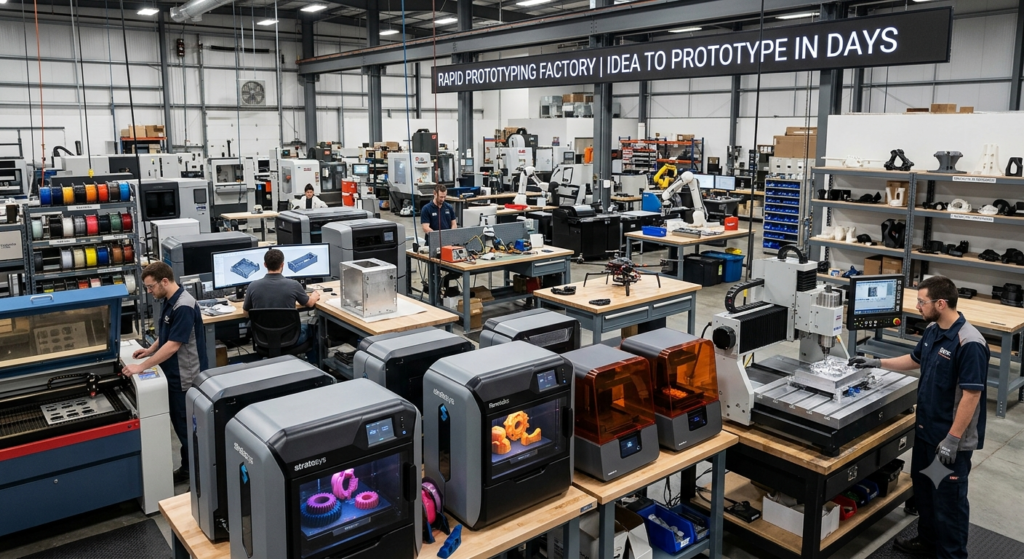
The Strategic Edge of a Specialized 3D Printing Service
When we talk about a professional 3D printing service, we aren’t talking about hobbyist desktop printers melting plastic in a garage. Industrial-grade additive manufacturing at a dedicated rapid prototyping factory involves multi-million dollar machinery, advanced material sciences, and hyper-precise calibration.
1. Unmatched Speed to Market
The most obvious benefit is, of course, speed. Traditional injection molding requires custom tool and die creation, a process that can easily swallow weeks of time and thousands of dollars before a single part is even stamped out. A 3D printing service bypasses tooling entirely. By printing directly from your CAD files, a rapid prototyping factory can deliver functional parts in 24 ถึง 48 ชั่วโมง.
2. Drastic Cost Reduction for Iteration
Fail fast, fail cheap, and fail forward. That is the mantra of successful modern hardware design. If your initial prototype has a clearance issue or a structural flaw, fixing it on a 3D-printed model costs next to nothing. You simply tweak the digital file and hit print again. If you made that same mistake with a hard tool or mold, you’d be looking at a devastating financial setback.
3. Infinite Geometric Freedom
Traditional subtractive manufacturing (like CNC milling) is bound by the physics of where a drill bit can reach. Additive manufacturing builds layer by layer from the ground up. This allows a rapid prototyping factory to produce complex internal lattices, organic geometries, and hollowed-out structures that would be utterly impossible to manufacture using any other method.
From SLA to SLS: Navigating Technologies in a Rapid Prototyping Factory
Not all prototypes are created equal, which means a one-size-fits-all approach to 3D printing just won’t cut it. A top-tier rapid prototyping factory houses a diverse fleet of technologies to meet different project requirements.
| Technology | Full Name | Best Used For | Primary Benefits |
| SLA | Stereolithography | High-detail visual models, form-fit testing | Ultra-smooth surface finish, crisp details |
| SLS | Selective Laser Sintering | Functional prototypes, durable end-use parts | No support structures needed, high strength |
| FDM | Fused Deposition Modeling | Cost-effective early stage concepts | Affordable, wide variety of engineering plastics |
| DMLS | Direct Metal Laser Sintering | Aerospace, medical, high-stress components | True metal parts (Titanium, Aluminum, Steel) |
Understanding these nuances is where the expertise of a commercial 3D printing service becomes invaluable. They don’t just print your file; they analyze your mechanical constraints, thermal requirements, and aesthetic goals to recommend the exact right recipe of technology and material.
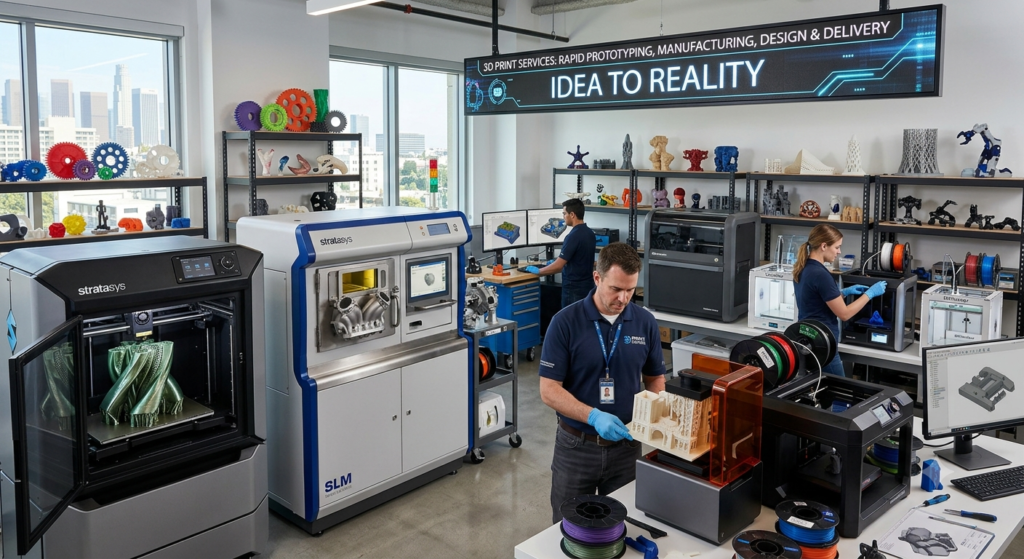
Human Ingenuity Behind the Machines
There is a common misconception that a rapid prototyping factory is entirely automated—that you just upload a file and an automated arm handles the rest. In reality, the human element is what ensures premium quality.
Post-processing is an art form. When parts come off an industrial 3D printer, they often require meticulous support removal, bead blasting, chemical vapor smoothing, or custom painting to mimic the exact finish of a mass-produced consumer product. Whether you need a matte, soft-touch finish for a consumer electronic prototype or a optically clear lens for an automotive lighting test, it takes skilled technicians to bring those details to life.
Furthermore, experienced engineers at your 3D printing service partner will often catch design-for-manufacturing (ดีเอฟเอ็ม) errors before the machines even start warming up. They act as your safety net, ensuring wall thicknesses are viable and tolerances are realistic.
Choosing the Right Production Partner
The market is flooded with online platforms offering automated quotes, but true innovation requires collaboration. When searching for a long-term rapid prototyping factory, look beyond the lowest price per gram. Look for:
- Material Variety: Can they print in high-performance polymers like PEEK or flexible elastomers like TPU?
- Quality Assurance: Do they offer inspection reports and dimensional validation?
- Scalability: Can they transition smoothly from a single 3D-printed prototype to low-volume bridge production?
Ultimately, a reliable 3D printing service is more than just a vendor; they are an extension of your R&D team. By choosing a factory that pairs cutting-edge hardware with deep engineering expertise, you effectively compress your development cycles, delight your stakeholders, and bring superior products to market before your competitors even know what hit them.
Ready to Bring Your Concepts to Life?
Don’t let your designs sit idle in a CAD dashboard. Partner with a premier rapid prototyping factory that understands the urgency of your innovation. Contact our expert 3D printing service team today to upload your files, receive a comprehensive design review, and take the first definitive step toward physical reality.